
Partying, Politics, and Equalizing Art
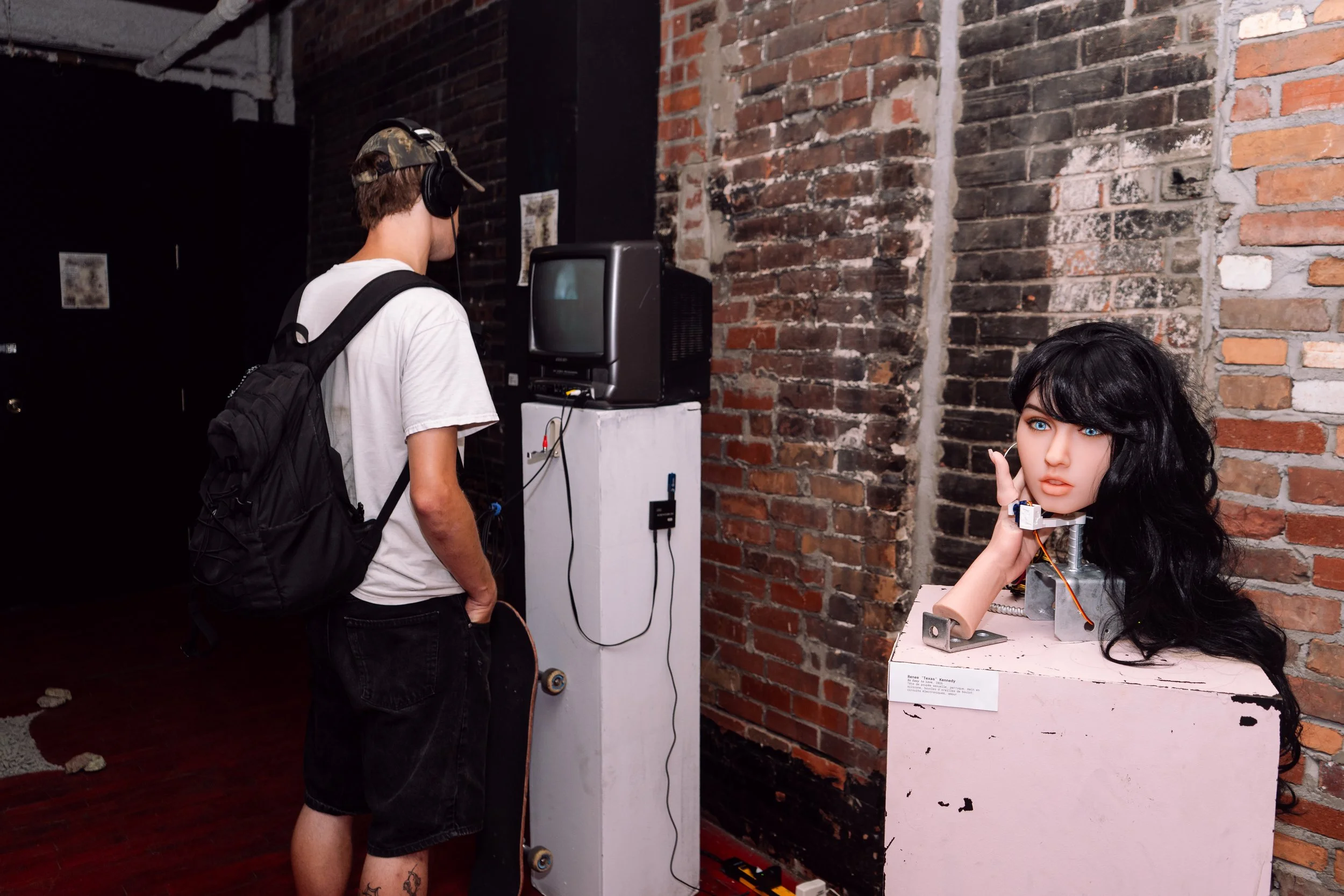
Photo by Shane Rojo
On August 13th, I climbed into the Bootlegger Magazine x Earth Tones finissage through a darkened, irregular flight of stairs. I nearly missed the entrance when walking past, positioned between an Indian restaurant and a deserted storefront. There hid the side door to ESC, a warehouse-like maze of a venue that housed the artwork on their top floor and hosted the after-party in their main area later in the night. The small and crowded stairwell was decorated with bright pink posters reading Want a good time? Call Samantha, beckoning curious onlookers to venture in. I was immediately greeted by a crowd much bigger than I expected within the confines of a non-air-conditioned room on a summer evening. The space was alive with conversations among the artists, friends, friends of friends, ex-co-workers, flings, and acquaintances, creating an atmosphere similar to that of a house party, where conversations went from intricate descriptions of the process behind a piece to people’s current roommate situation.
The exhibit had been open since August 10th, organized by the team of Bootlegger Magazine, a Montreal-based publication active since 2021 that seeks to provide a space for both local and international artists to display their work. Their featured pieces often lean toward the experimental, the playful, and the underrepresented, featuring artists across mediums and highlighting practices usually overlooked in mainstream gallery spaces. Bootlegger pushes the boundaries of the Montreal art scene by traversing the limits between the digital and physical world, while creating bridges between these that are innovative (and fun!). This exhibit caught my eye through their posters scattered across the city, and the advertisement for their Virtual Art Expo: a digital museum designed for the exhibit where the player can style and create a pixel self, and wander around a maze to see 21 of the artworks featured in the exhibit. Once in the digital museum, the viewer can click on each artwork and be redirected to individual artist interviews where they can find more information about the creative process, the significance of the pieces featured, and a more in-depth description of why these artworks matter. Viewers can also chat with each other in the digital museum, fostering an environment of community and discussion even after the exhibition has finished.
Inside the real-life-exhibit, brick walls and red wooden floors housed the work of over 20 artists across disciplines: ranging from sculpture, video and audio, to photography and ceramics, and found objects to self-portraits. The air vibrated with the buzzing of machines; a metal panel with illuminated quail eggs arranged in a grid invited my gaze in with its blinking. Attached to it was a cord to a power bar that read Thank You for Having Me (a piece by Kayt Meraw). Through the first room, one could appreciate ceramic sculptures sprawled across corners, portraits of hybrid bodies, and sometimes, poetry. Language was a common visual element in the works: not necessarily in the artist statements, but in the very body of the pieces. Next to a portrait by Jonah Fish, a wooden-looking slab read the words My death is a bed I have tucked into but is this a choice or an act of survival. Past this epitaph, the second room of the gallery opened its jaws: presenting the viewer with a severed sex doll head being constantly caressed by a mechanical silicone hand created by artist Renee (Texas) Kennedy. The subtle sound of machines continues to be the underlying presence of the exhibit: whether literally or figuratively, I could hear the grinding of gears, metallic clanking, the rusting of iron, the ripping of flesh.
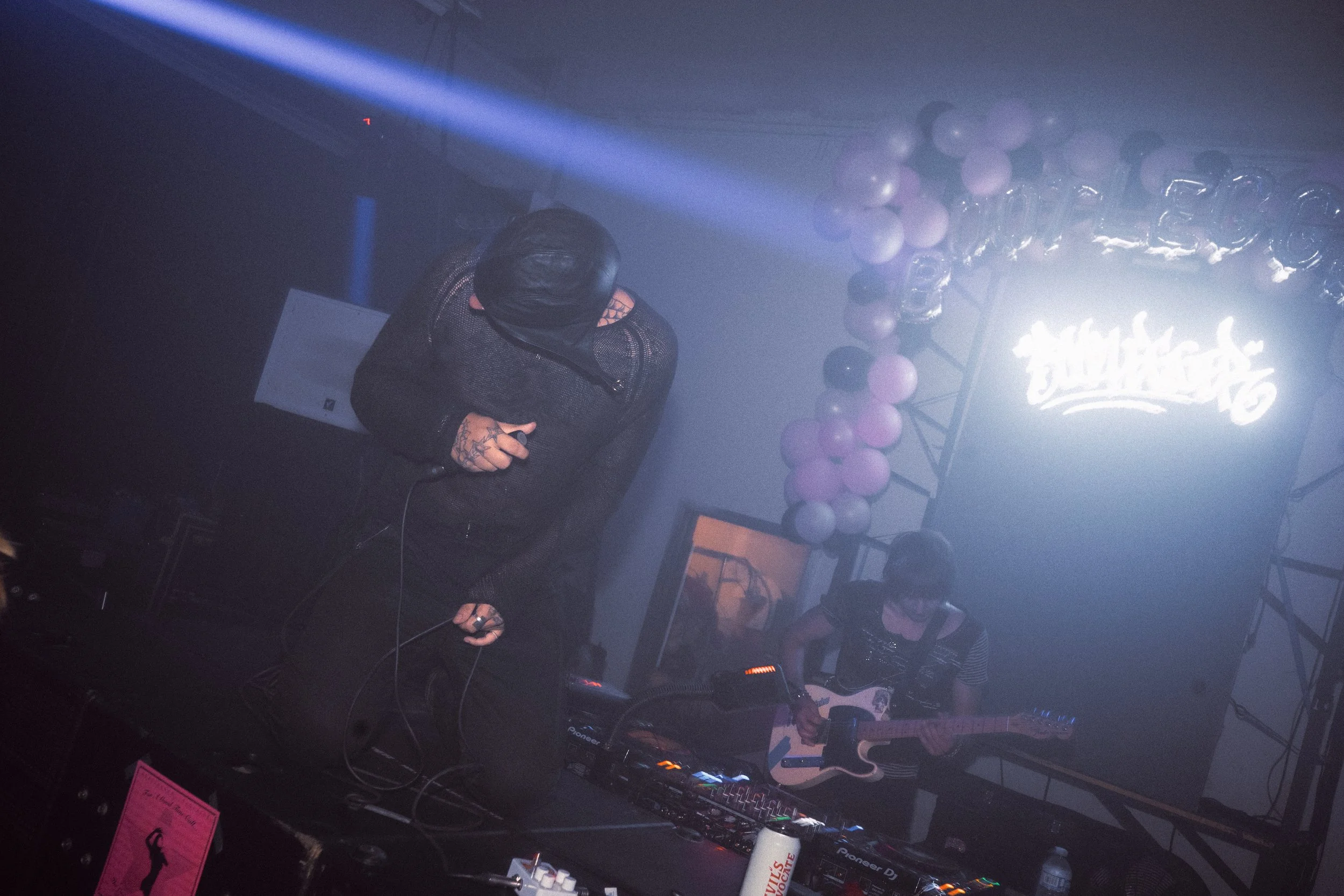
Photo by Shane Rojo
Most of the pieces in the exhibit hinged on a broken-down understanding of the self: a separation from the subjectivity of what makes human, with all of its connoted meaning, and the mechanical, functionalist understanding of being a human solely meant to produce and to consume. There was often work that lived at the juncture of the natural and the mechanical: the metallic, the artificial, and the prosthetic become conduits for the self to guard itself into, and even sometimes get lost in. The artificial becomes a conduit for our passions, and a vessel for our fears. This was exemplified by disembodied organic figures existing solely for their function: the function of a hand is to caress, and that of the sex doll’s head is to be caressed. Yet this disembodiment of the natural went beyond human-esque figures; Esther Clarke’s fallen-apart ceramic giraffe takes the space of something like a trophy: a ceramic head with metallic wires sticking out as if denoting that the inner structure of the piece was made of wire and only shielded by ceramic. The giraffe lay in the midst of a crowded room like an imitation of a naturally decayed carcass, with a peaceful expression despite its forceful or unnatural closeness to the ground.
This connection between the natural and the artificial spoke to themes of hybridity, of forced permanence and displacement, of folkloristic understandings of the inanimate and the natural: which was the case of Alexia Paz Escobar’s bronze sculpture depicting a humanoid figure, with elongated legs and eyes fixed in the distance, perpetually moving forward. The sculpture seemed to be containing its own body, hoarding it within itself in the constant movement of its metallic rigidity. Desperate to move, cast in bronze. Similarly to other pieces in the exhibit, the sculpture pointed toward themes of displacement and belonging: what will be left of us when our bodies cannot continue to carry everything we are, and everything we’ve been? An answer to this could be found within our reliance on machines and technology for holding all that is important to us.
Which brings me to the importance of our shared knowledge in relation to the internet, technology, and social media. Pieces throughout the exhibit reflected the building of significance and familiarity through remnants of a place, an identity or a self that no longer exists. Cellphones, videogames, internet lingo, and consumer products like vapes (Aphex Redditor) become a new language of symbols for the viewer to recognize something of their own “nature” and history within. Earth Tones played with the ideas of the self being built off bits and pieces, remnants of an ancient understanding of humanity mixed in with the cultural frenzy that is the amount of influence technology has on our self-perception. Hybridity ends up becoming an essential part of how we view ourselves in the context of end-stage capitalism.
In an era of constant surveillance, economic decline, fake Indeed job postings, and individualistic tendencies eroding the social net of communities, projects like Bootlegger’s Earth Tones are an extremely necessary breath of fresh air. The finissage was an undoubtedly social space: a shift that I have been noticing particularly in independent exhibitions. We are slowly moving away from the impersonal and elitist context of the art gallery as a place of silence and wealth, and transforming the appreciation of art into one big party. There was another important aspect to this encouragement of socialization: the after-party. Past 10 pm, the crowd swiftly moved out of the exhibition space into the main entrance of ESC, where some of Montreal’s most electrifying musicians and DJs created a continuation of the communal energy and artistic conversation carried on at the finisssage. When we look at events that encourage us to enjoy the company of others instead of looking at art and music through an individualistic and detached lens, we build spaces where art can become democratized, and partying can become a continuation of discussion. When speaking to the organizers, they emphasized the importance of community within this context, particularly by giving back: making the event a fundraiser for a Palestinian mutual aid fund and animation workshop. The artists featured at Earth Tones reciprocated this by donating to the fundraiser themselves, even after the party was over.
The themes the exhibit touched on (territory, decay, technology, ruins, and rebuilding) are particularly relevant in the sociopolitical context we are currently living in, where the only option after all the structures we believed in have been broken down, is to rebuild with the pieces and transform ruins into something new, as a collective. What does all of this need for rebuilding tell us? What does the fact that the turnout for this event was so great that we kept getting moved away from the door so as not to obstruct the sidewalk say about the hunger people have for community, art and partying all in one night? To me, it shows that there is a possibility for non-elitist engagement with art, that artists with experimental or non-traditional practices can still have spaces to display their work, and that these events are a deep necessity in the Montreal art scene. Earth Tones had it all.
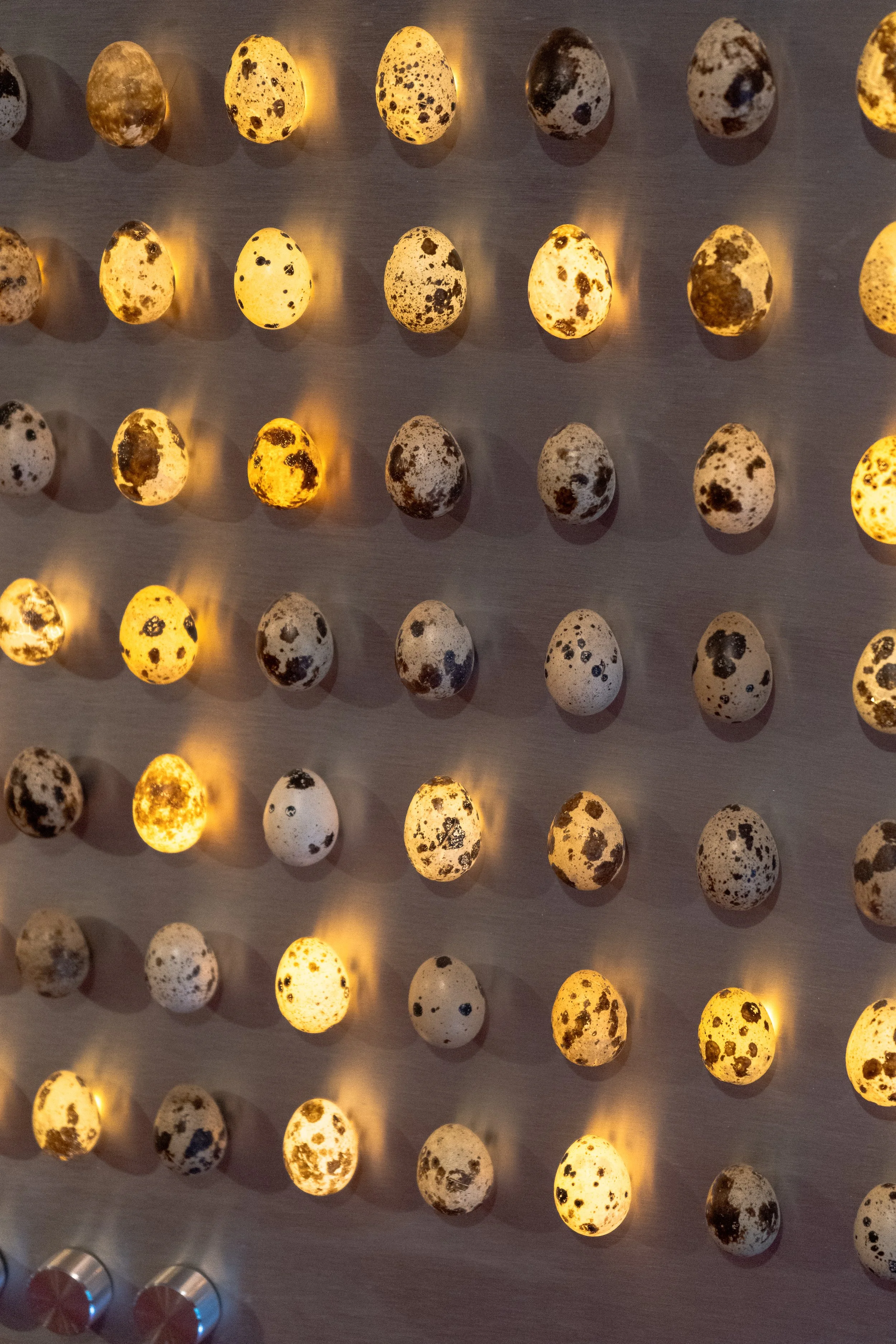
Photo by Shane Rojo
