
Navigating The Space In Between
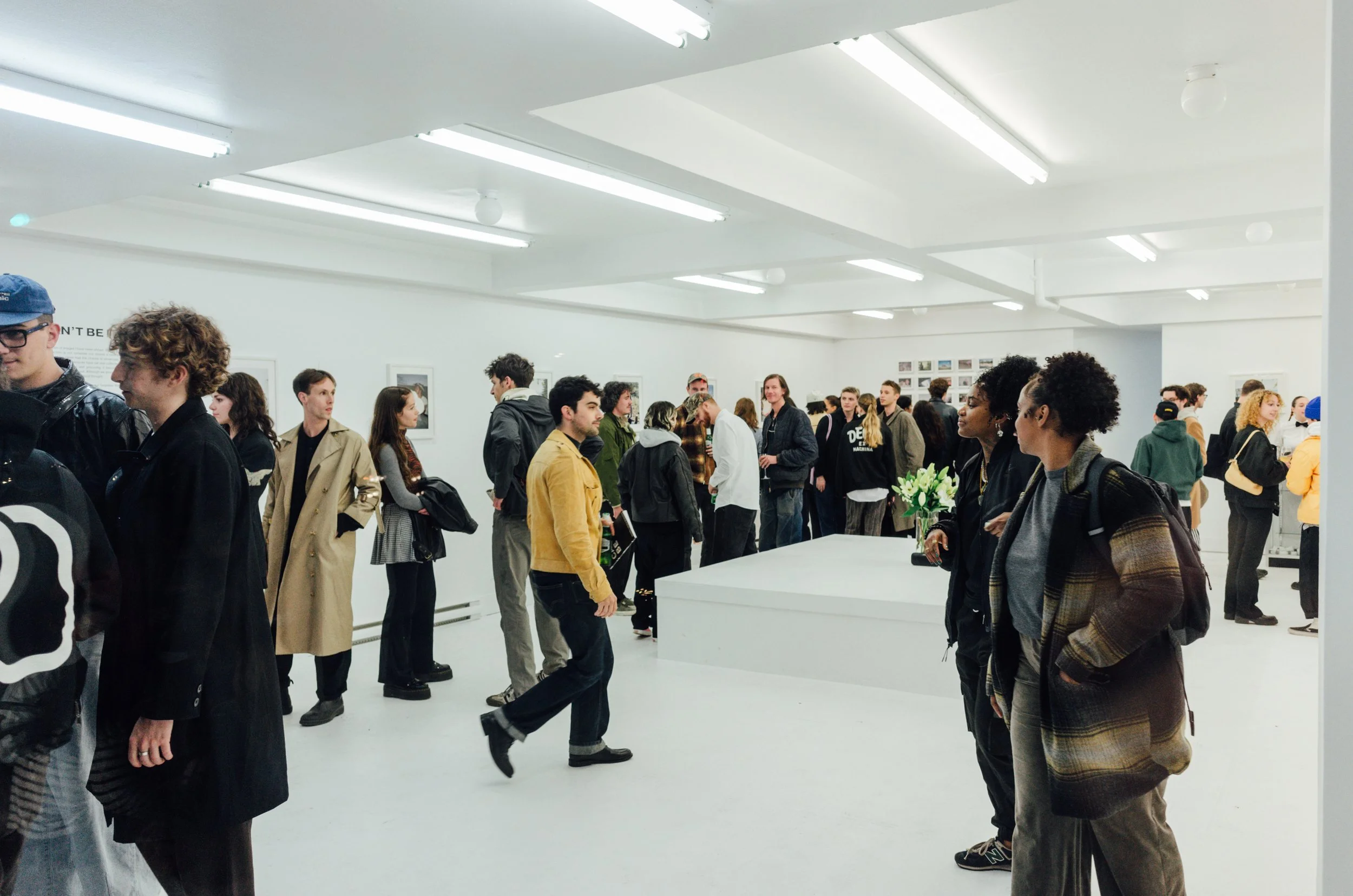
Photo by Ryan Lebel
How is identity created in an era of deep isolation and overwhelming individuality? How much of us is left behind in the snippets of memory of the places we used to inhabit, and the people we’ve shared our lives with? The upcoming 50/50 Exposition, curated by Maggie Rossy-Aulman in collaboration with artists Simon Suparatana Blitzer and Maxwell Lincoln Neubaucher, speaks to the act of remembering, identity formation, and recounting the past with a hopeful vision for the future, while analyzing how the transitional moments in life make ideas and artistic practices blossom out of uncertainty.
Supported by the Canada Council for the Arts and the Refugee Centre of Montreal, the exhibition will run from October 1st to 8th at Galerie le 1040. With an extensive programming of events, 50/50 looks to connect with the local Montreal community and the international artistic scene through friendship, memory and looking into the past with a lens informed by the current self. An exhibit that works as a homecoming, as an exploration of the “coming of age” narrative, and the spaces in between the pivotal moments in life, while basking in the marvels found in the quotidian.
Neubacher’s collection This Definitely Can’t Be It presents reflections on transitional stages captured through his artistic practice throughout his early to late twenties, and the twists and turns in how what we believe ourselves worth remembering shifts with age. Referencing his solo exhibition This Can’t Be It, which consisted mainly of photographs taken in his early twenties, This Definitely Can’t Be It showcases movement and earnestness, slices of life captured in film photography with a precise yet playful perspective. Neubacher’s photography walks the line between the quotidian and the deeply symbolic, showcasing images loaded with a sense of familiarity, fun, and intimacy: like getting a peek into someone’s memories through the crack of an open door.
On the other hand, Blitzer presents the series The Places You’ll Go, referencing the famous Dr. Seuss book with a focus on the title rather than the narrative: looking at geographical places through a childhood lens and exploring how imagination aids us in making sense of an unfamiliar world. Hinging on the fantastical and the naturalist, Blitzer presents images that feel carved out of a dream, with colouring that seems like it would stick to the top of your mouth like cotton candy.

Maxwell Lincoln Neubacher
Photo by Ryan Lebel
The themes of Blitzer and Neubacher’s work speak to two sides of the same coin: finding oneself in a distant, almost imaginative past of childhood memories, and the uncertainty and nostalgia of looking back into one's life. The name of the exhibit, 50/50, speaks to the condition of in-betweenness: of a transitional phase between the before and the now, and hopefully, the now and the after. I had the opportunity to interview both of them earlier this week to talk about their artistic practices, their hopes for 50/50 in the future, and the inherent instability and movement of the human condition explored through the stillness of photography. Throughout the interview, I immediately noticed the importance of friendship, connection and belonging within their craft, and their lives: they spoke of the possible future of the project through a perspective of community building, justifying the way that the events are shaped by emphasizing the importance of accessible art spaces, engagement with one’s local community, and the possibility of creating initiatives that open doors for other artists in the future. This connects directly with both of their practices, particularly as it was explained by Neubaucher, who stated that his photography is almost entirely shaped by the people around him; whether this is through family, friendships or travelling, these slices of life demonstrate a deep desire to look at the future through the past. He describes it as a kind of “check-in” to see if one is prepared for the next stage, by holding oneself accountable for all that has been lived, and how that can shape a future where we constantly strive to be better for ourselves and to the people around us. Similarly, Blitzer stated his collection was informed by the stories told by others in conjunction with his imagination. Taking inspiration from his own memories and wonder, he presents pictures of national and provincial parks in Alberta through impossible colour schemes in an attempt to emulate the image of what Canada seemed to be when he had no reference within memory, but only in imagination.
On the technical side of things, Blitzer stated he wanted to expand past the bounds of photography into creating a surrealist look: by shooting in a black-and-white infrared film and then digitally colouring the pictures, layer by layer. This was informed by the technique of Japanese woodblock prints but through a digital approach: merging the analogue with the contemporary throughout this practice. This choice in the colouring of the photographs speaks to a desire to talk about the liminal, transitional places we inhabit: making sense of the unknown through imagination. This emphasis on the analogue as a basis of the process is exemplified through Neubaucher’s work, where he establishes the difference between digital photography and film through a matter of intention and care: speaking of the camera as almost an extension of himself that “is lucky to be there” to capture the earnest and fleeting moments of everyday life. By thinking about the camera as almost coincidental, these analogue techniques become even more genuine: showcasing moments that would be lost in the immediacy of digital photography.
As previously mentioned, this exhibit extends beyond the vernissage. The team behind 50/50 has curated a series of events stretching all the way to Thursday, October 8th. Beginning the exhibition calendar with the vernissage, 50/50 will also be hosting a reading by the New York-based reading series Punisher, focused on themes of coming of age and spanning across the genres of fiction and non-fiction. Punisher founders Sarah Velk and Kennedy Wright cross the geographical border of memory and place by platforming seven Montreal-based readers throughout the evening. I had the opportunity to speak with both Velk and Wright this past week to learn more about Punisher: a new cool DIY space created as an antithesis to elitist and overly intellectual reading series in New York, searching to build a sense of community from the personal, the self-referential, and the intimate. Velk and Wright emphasized the “raw humanity” of Punisher and how it relates to the photographic work of the exhibit; looking into one's past as a referential point to fight the fragmenting of communities, and ultimately the self. The founders of Punisher have been creating social and literary spaces through their heavily curated readings and democratized spaces, where “delving into nostalgia as a sanctuary” brings solace and fun as a response to individualist artistic spaces.
Something I noticed across interviews with both the artists and writers was that there was a mention of the Covid 19 pandemic as a time of deep and poignant isolation that left their generation with a deep desire for regrouping: making room and space for one’s art, emotions and desires, while consistently looking back at what made us who we are today. Understanding every period in life as one of self-discovery, there are others surrounding us: in person, in memory, in dreams, and in art.
Do not miss the 50/50 exposition this upcoming week! And take a look at their impressive programming filled with local and international talent.
SCHEDULE:
OCT 1ST – VERNISSAGE 6-10 PM
OCT 2ND – PUNISHER READING 8-10 PM
OCT 4TH – MOVIE NIGHT 5-11 PM
OCT 8TH – FINISSAGE BBQ 5-11 PM
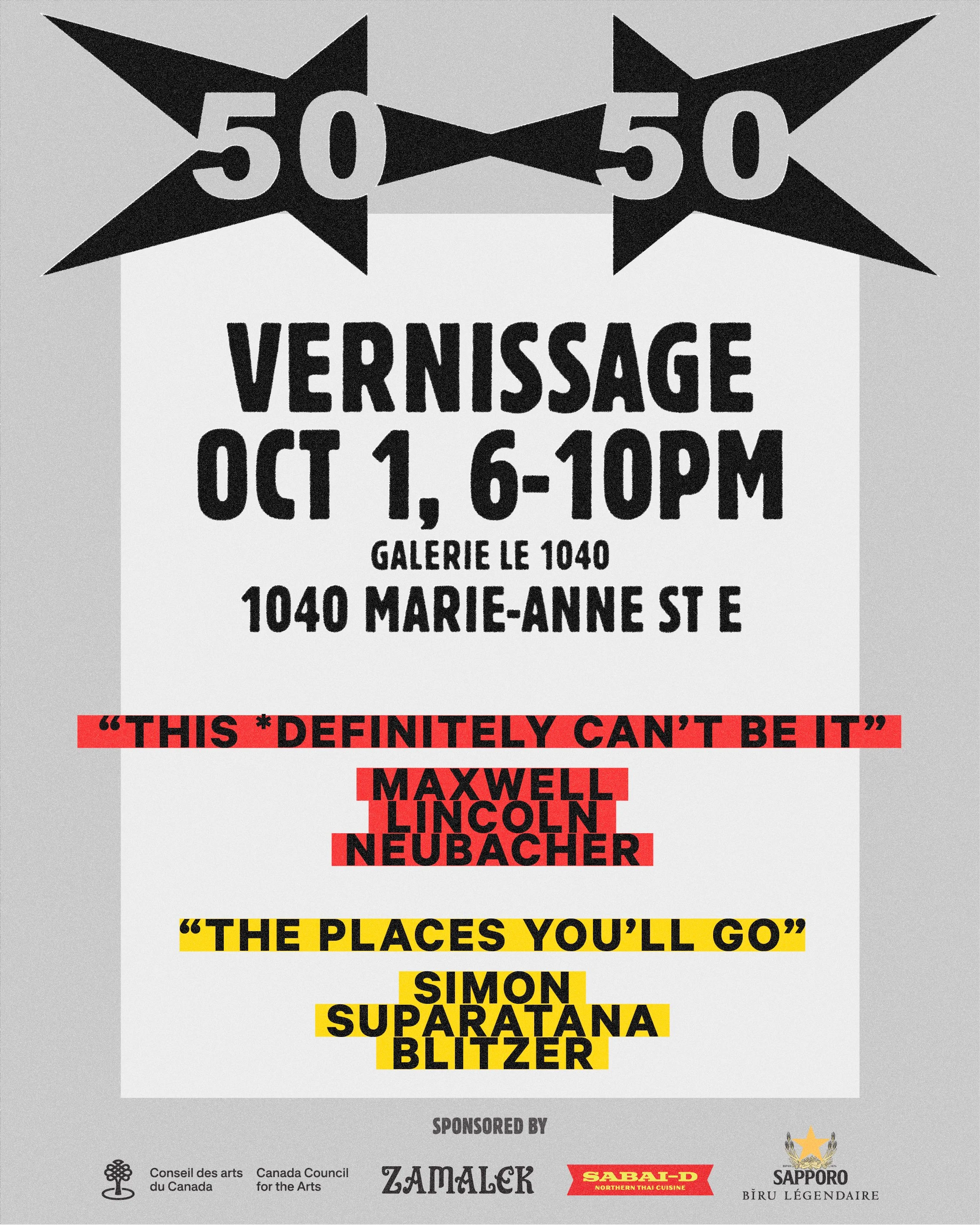
WHAT: 50/50 Exposition
WHERE: Galerie le 1040 at 1040 Marie-Anne St. Est.
WHEN: From October 1st to the 8th.
METRO: Mont Royal (Orange)
DETAILS: 50/50 Expo, Punisher
