
Photo by Maia R. Becerra
This past weekend, Expozine’s 25th edition took place at Église Saint-Arsène, a couple of steps away from metro Jean Talon. It was a windy fall morning as I made my way over, with my friends blowing up my phone, urging me to get there early because of the now quintessential overcrowding of the venue.
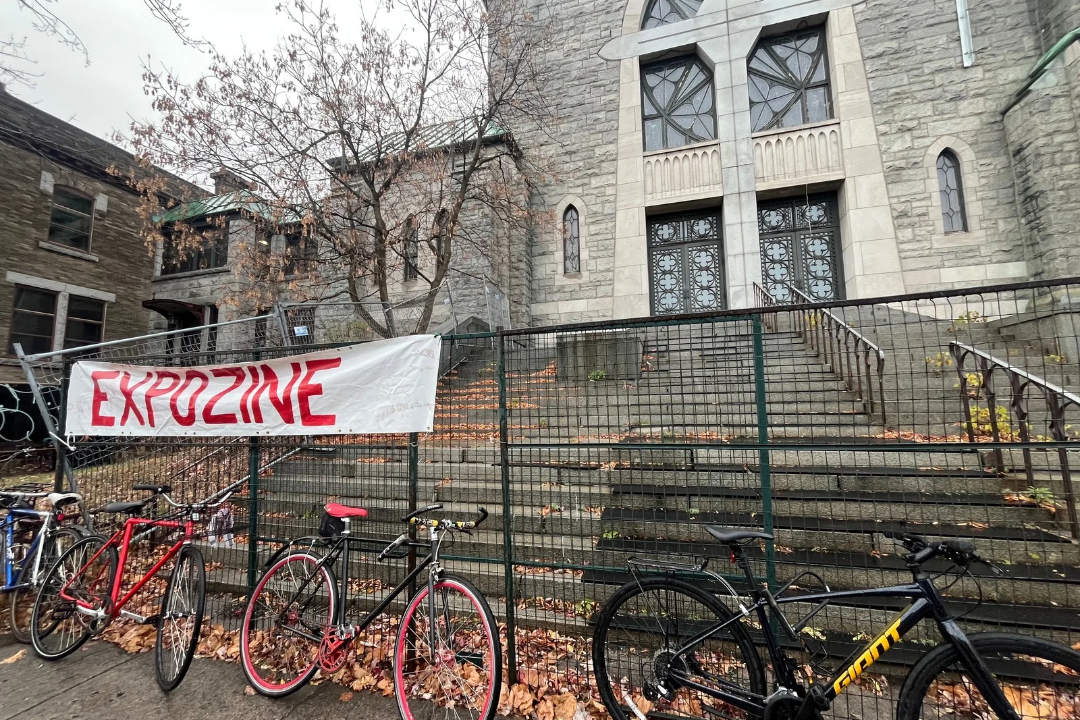
On Rue Belanger, the church seemed like it was undergoing renovations due to the construction fencing around it, yet a banner read EXPOZINE in big, red letters seemingly painted by hand. The entrance was quite hard to miss, despite it being a small opening in a scaffolding-turned-tunnel leading the attendees into the underbelly of the church. Attached to the construction fencing sat dozens of bikes of all shapes and sizes locked into place. It seems cliché, but it really was the most Montréal-independent-art-scene sight I could have ever imagined.
Inside, what felt like a community center spilled out with people — parents with small children strapped to their chests and couples on awkward dates maneuvered around tables and occasionally bumped into flyers scattered across the floor. A pile of coats lay on the floor to the left of the front door, for as soon as one entered the space, the temperature increased from the sheer amount of bodies next to one another.
Tables filled every inch of the space, ranging from publication houses like the Concordia University Press to independent zine makers, collectives, magazines and journals. The room was divided into two, with most of the expositors displaying their work on the main level of the church’s basement, and a second set of expositors up on the stage. The entire space was a colourful maze of printed goods ranging from literary publications, art magazines, anarchist collectives, postcards and calendars with cute animals screenprinted onto them, and a few prints and zines that cost less than 10 dollars. This, to me, speaks about the diversity of crowds Expozine attracts each year: the young parents, the students, the artists, the punks, the academics, the plus ones, the curious onlookers, the critics, and those passing by who peeked in because what could attract a crowd this size to a church on a weekend? With every hour that passed during the first day of the expo, I witnessed the crowds shift like waves: seeing familiar faces for a split second and complete strangers the next.
On Saturday the 14th, I managed to catch a roundtable led by Miranda Campbell, co-author of the book Making Worlds: For an Ecology of Cultural Production, co-written with Benjamin Who and published by Concordia University Press. The panel was dedicated to the book’s launch, as well as a discussion with Isabelle Métivier (POP Montréal), Crystal Harrison (Rock Camp MTL), and Expozine’s Louis Rastelli. Sitting in a little chapel that seemed like it had just recently been repurposed into a chapel after serving as a kitchenette before, I listened to Campbell open the discussion around the responsibilities and rewards of being a cultural worker. It hinged on an idea of solidarity as the only way for the arts and cultures to survive within the contemporary context of high rents, little governmental support, and outdated infrastructure. There was a constant theme of the panellists speaking about acquiring spaces, sponsorships, and aid in general because of personal relationships— having a friend of a friend who can lend you a space on a weekend afternoon is, in some ways, more sustainable for cultural workers than solely depending on funding that may or may not come.
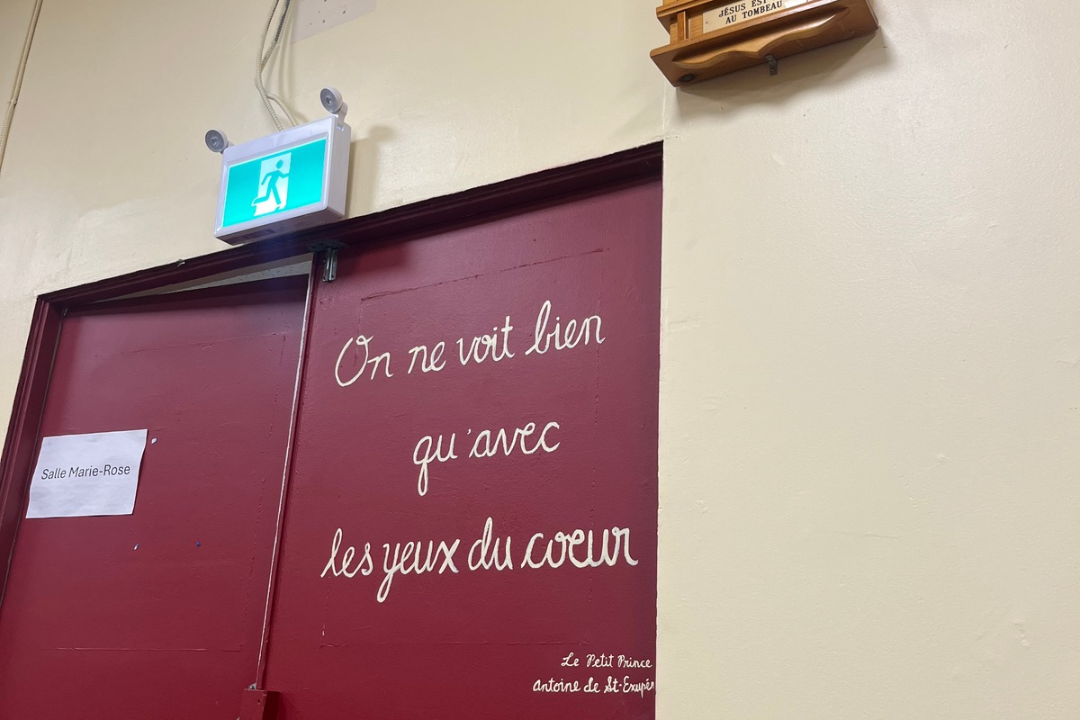
Photo by Maia R. Becerra
On the matter of space, Campbell highlighted that having access to affordable rents is “a basis for cultural production”, which made me think about the space Expozine was taking place at: an accessible, possibly affordable space that makes the expo an event where attendees do not have to pay a ticket to be a part of, nor do vendors. Yet, these kinds of venues do have their pitfalls; one of them being there is simply not enough space anymore for all the applicants submitting their work to Expozine. At this panel, Rastelli mentioned there was a 40% rejection rate due to space constraints during the selection process for exhibitors. And I witnessed the real-time consequences of an event growing beyond the space it is held in. On the second day of Expozine, November 15th, I arrived early and was eager to have a more manageable crowd within the venue. Yet, by 3 pm I noticed the space was considerably busier than the day before. I stepped out to have a smoke at around 3:30 pm to realize the venue had reached capacity! A line that extended almost around the corner of the church was filled with attendees who were not able to make it in as swiftly as I had three hours earlier due to the space being filled to the brim.
Coming back to the aforementioned panel, I have been thinking about the repurposing of spaces for cultural work: how even the chapel the panel was being held at most likely served a different crowd before. How there were Petit Prince quotes hand-painted on the walls next to wooden carvings depicting the stations of the cross. How there was a sink next to the altar, and how the panellists had to sit below it in plastic chairs. Prompting me to think about how Expozine continues to grow, maybe past the spaces or structure it was created under. There is clearly a demand and a need for it within the younger generations, and the independent publishing scene continues growing by the year. How can an expo contain so many generations of artists, writers, and creatives? How do we meet the desire for people to participate and engage with this work? I don’t have an answer to any of these questions, but I do know the seeds planted by Expozine have sprouted, and maybe now there is a need for a second floor.
