
Tara’s Review's - FringeMTL 2026
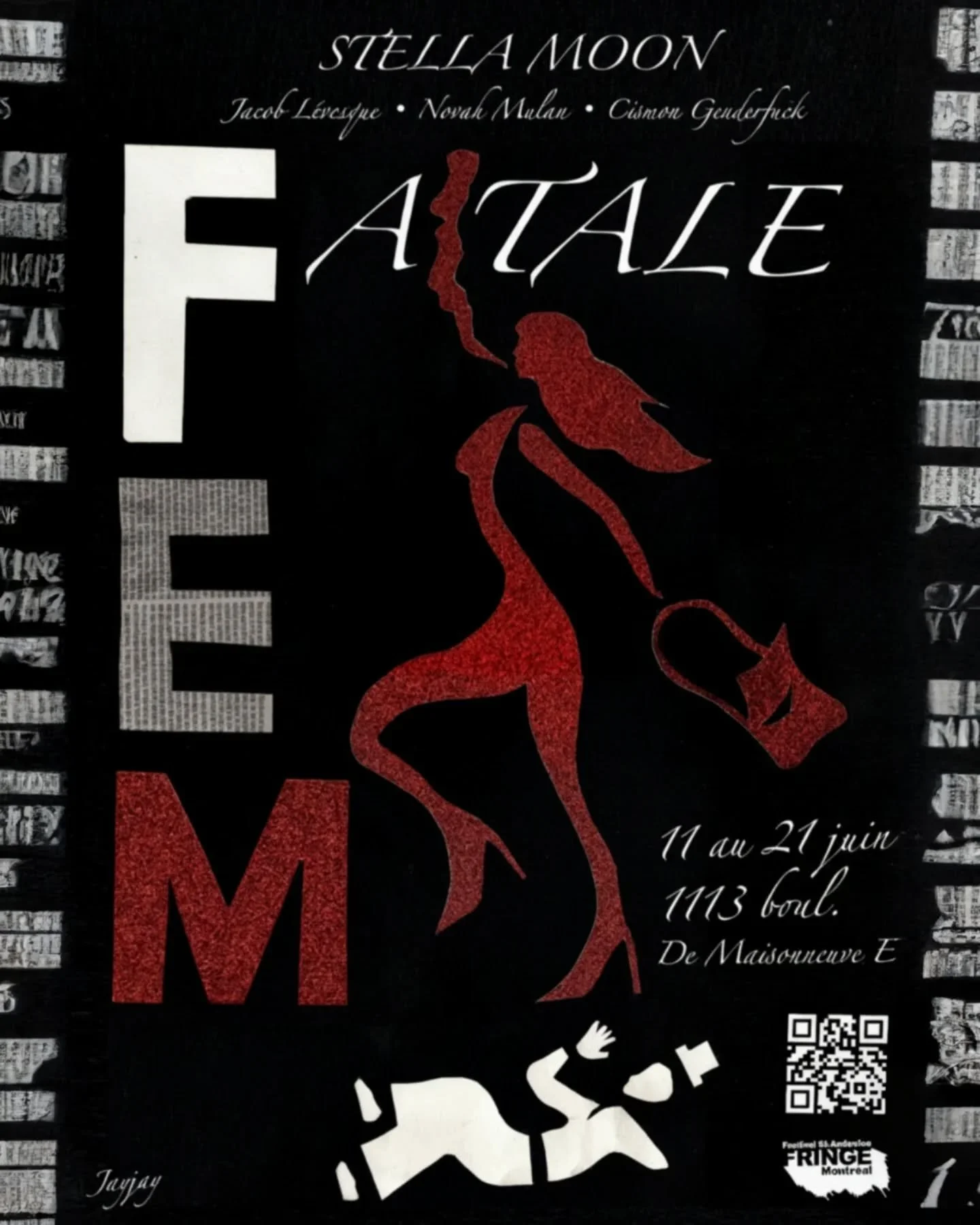
FEM FATALE
I must have known Fem Fatale was in French before I arrived at Théâtre La Comédie de Montréal, but had forgotten. I also forgot what time opening night started, and after realizing my mistake twenty minutes after show time, had to buy myself another ticket to the next show. The theatre is inside of the kind of boxy, low-profile building I am most used to seeing as hosts for dépanneurs and tow truck companies in the suburbs: all storefront window below interchangeable sliding signage space. There is a spate of these in the otherwise-cunty stretch of the village near Beaudry, and I am impressed by the effort put in by owners of Japanese fusion restaurants and the like to make context-appropriate-cunty use of them. The theatre is fun-looking and very big. The sound kind of sucks, but that’s not the production’s fault.
Fem Fatale is an original drag theatre piece written, directed, and starring — as drag persona Stella Moon — Francis Fontaine. Fontaine is babyfaced, motivated, and — I would soon discover — absolutely ferociously talented.
Initially a drag show, we begin with a small collection of conventional performances. Despite being prompted, nobody tipped the performers during their numbers, including me, who did not think to bring cash and instead smuggled in a purse filled only with Diet Coke.
Dear reader: bring cash.
Performers: I’m sorry. I owe you each a Diet Coke.
Drag has a long intellectual history. As satire, the art has always functioned as commentary about gender, social issues, performance art, and the culture of storytelling while also being sincere examples of each of these things. Following in this tradition, Fem Fatale finds cracks in the format of drag performance in which to muse, in five tableaus, on the relationship between drag performer and drag persona. We meet Stella Moon, a self-described fem — a term, she says, which has no gender, which is simply a natural state we either find ourselves in or do not. We soon find out that our heroine is haunted by a suited figure named Frank. The two are in a lover’s quarrel, or they are deadlocked in their artistic differences, or they are trying to kill each other. Their power struggle builds, and then comes to a head. It slowly becomes clear that Frank is not who he first seemed to be, and that Stella’s going to have to use a force greater than a gun if she’s going to make it out alive.
For the last several years, for personal reasons, I’ve been thinking a lot about the tragic levels of gender dysphoria faced by cisgender heterosexuals — the cis men hopped up on enough internet-industrialized misogyny, steroids, and supplementary testosterone to cause a dissociative brain disease in a silver-backed gorilla; the middle-aged conservative women with their faces stapled as taut and shiny as a frog’s ass, trying — and failing — to prevent the philandering of their cross-dressing Christian nationalist husbands. How, in an attempt to render a civic scaffold from some of life’s most ephemeral bioactive mythology, they have not noticed they’ve constructed their own prison bars instead. The biggest gift my queerness has ever given me is also the foundational strength of drag: the way it lets many things be true at once, the sacred yoked with profane, the mirthful despair, the embodied capacity for disparate forces — performance and non-performance and being and non-being — to suspend the truth in dynamic tension.
The endless becoming of the polarity present in all people is, in Fem Fatale, explored with both its playfulness and its violence intact. The acting is superb, with Jacob Lévesque deserving specific praise as a character that embodies the anxieties and cruelties and coping strategies of queer masculinity in a way that was so tender and compelling I wanted to text my blocked situationship again. Fem Fatale is funny and it is fun and it is sad and it is beautiful. I am loathe to use a word like “metatextual” to describe this, because I’m bored of the word and because it seems obvious to me that an art form for which satire and self-deprecation is so fundamental would be metatextual as a baseline. What I will say is that Fem Fatale did manage to do this in ways I found novel and exciting. Or at least I think it did. French is my second language, and the sound in the theatre sucks. Go check to make sure I caught everything and get back to me, okay?
Buy Tickets
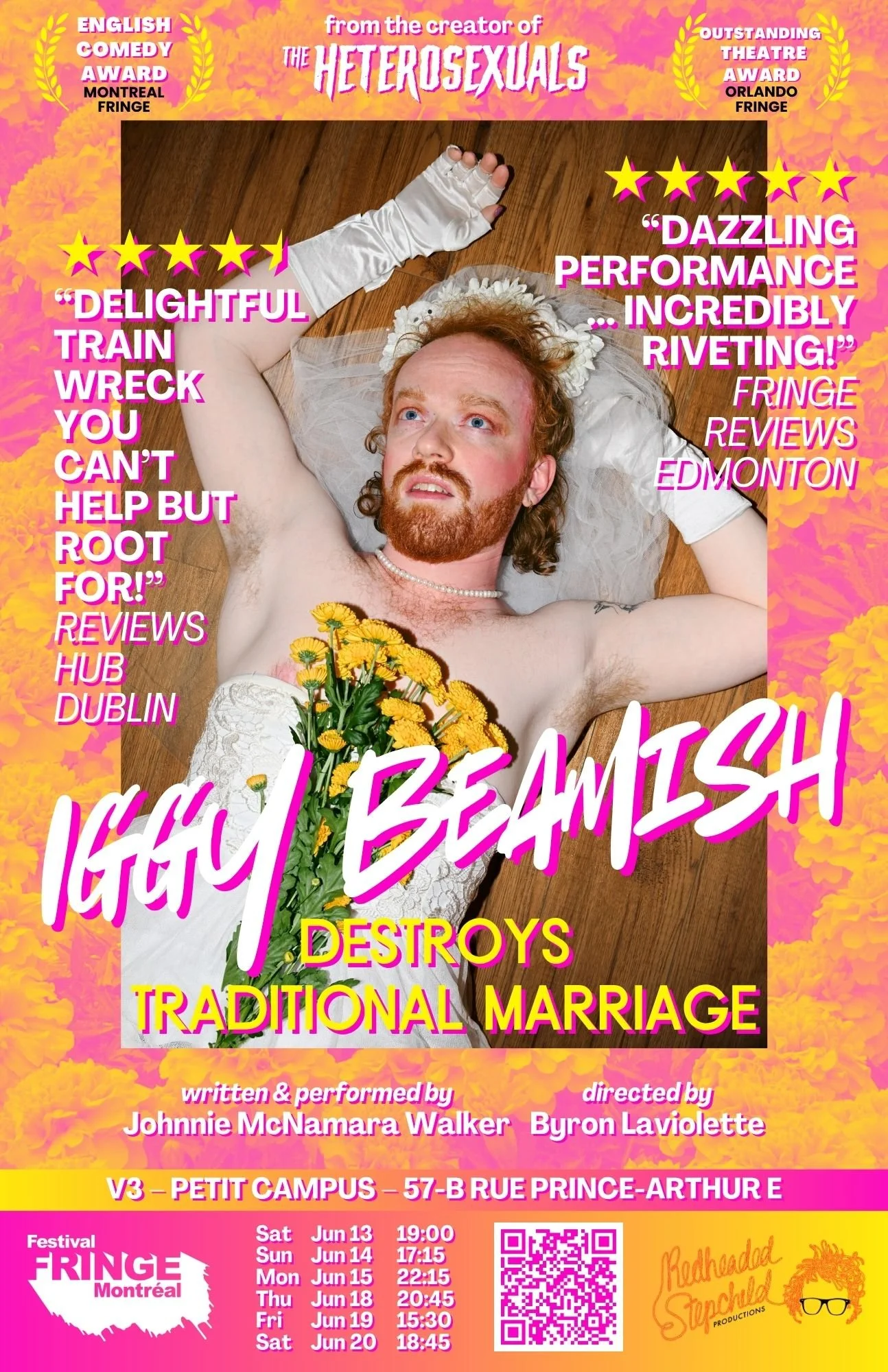
Iggy Beamish Destroys Traditional Marriage
My last professionally-mandated Montreal Fringe show of 2026 began at 10:15 on a Monday night, which is not that weird of a time for a basically-still-young creative woman to be out in Montreal, the Peter Pan Syndrome capital of North America. I had work at eight the next morning, but sure. What could possibly go wrong?
A little under a year ago, I came to the painful realization that the full-time artist life I’d been living for five years had made me self-obsessed, neurotic, irresponsible, and boring. Also, very broke. Soon after, I begged for an educator job, and managed to land a five-month contract as a specialized social and educational support worker in an alternative high school. I spent the cold part of the year presenting myself to a house of learning at 8 in the morning to be of service to at-risk children. It strengthened my root, brought me back down to earth, pulled my eyes somewhere that was not my own puny life with its puny sorrows. It was an honour and a privilege that I never once regretted. Until Tuesday morning.
I apologize to the whole Iggy Beamish Destroys Traditional Marriage team for their patience with this late review, as every scrap of energy I had this week was directed towards body doubling baroquely traumatized teenagers through extended three-hour panic attacks while they wrote government exams. I have only just recovered.
Iggy Beamish Destroys Traditional Marriage is a story about a (gay) professional (straight) marriage officiant who will do anything — even DJ — to avoid processing his (gay) divorce. The piece is written and performed by “openly ginger” Toronto-based Fringe vet Johnnie McNamara Walker and directed by Byron Laviolette. It is a tightly-written, slickly directed piece that demonstrates a well-studied fluency in effective storytelling.
One-person shows get cornball really easily, and Beamish manages, for the most part, to avoid this, and to keep the energy up and building throughout. I thought that the piece played with current and contemporary dynamics in queer community in a way that was cute and funny: Iggy has to learn to DJ in a few hours and hilarity ensues, because how hard can it be? Answer: harder than it looks but nowhere near as hard as mid DJs, who like to talk about it like they have to paint the Sistine Chapel ceiling anew at every Venture-capitalist-owned organic wine bar opening, will have you believe it is. Iggy falls from grace as a result of a gay divorce which is not completely his fault but is overwhelmingly his fault, and can only fall so far because he’s queer! Our community has been keeping each other alive since like the gay dark ages when like 80% of us died a violent death! How far will your community really let you fall? Answer: not very far, and we will help you claw your way back up, but we will also all be so annoying the entire time.
Iggy Beamish is a feel-good romp that I genuinely think you’d be dumb as bricks to miss, which leads me to my only real critique, which is that this is a safe show. It’s slick and it’s shiny and it’s charming and it’s good, but it pushes no envelopes, strays really only once anywhere close to darkness (Iggy’s marriage ends for a reason that’s really pretty bad! But his single mistake is so couched and padded on all sides by his #relatable-ness that it hardly registers as a real character flaw). As much as Fem Fatale, another play in this year’s festival, could register as a little cerebral and lecture-y, I appreciated how much the piece was trying to subvert and disguise its structure at every turn. I think that’s what we’re supposed to do. Iggy Beamish doesn’t do this.
Still, this is a talented creative team that has not hit their peak when it comes to the kind of work they can produce. They have two more shows at Café Campus — neither of which are after ten! Or on a school night!
Buy Tickets
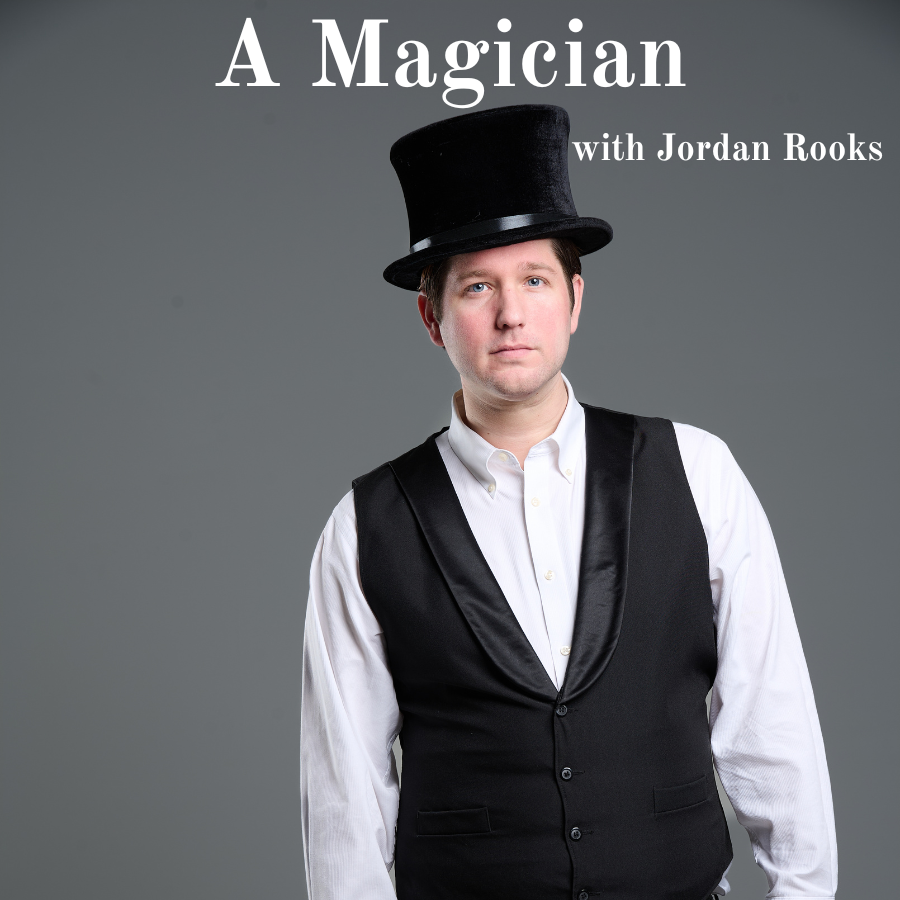
A Magician
Two things to know about me: the first is that I fucking hate magic shows. The second is that I hate hating things. Hatred of anything registers to me as a character defect, a wounding on the level of the soul. Hatred isn’t fun for me, okay? I’m not one of those people! I wish I was. At least then my hatred would not come accompanied by an existential terror I am desperate to leave.
When I hate something, I am also actively searching for a saviour — some perfect version of that thing which will direct me back to the fold of humanity. O, counter-evidence, deliver me into the warm bosom of appreciation. The tepid sternum of neutrality, at least!
So, dear reader, I want you to know that this was the attitude with which I entered Mission Santa Cruz. My heart centre? Softened. My mind? Open. I had just chugged a medium chicken Pho and, at least twenty minutes early, I sloshed through the pissing rain in the streets around the church as clouds hung heavy over the mountain. I was here to see A Magician, by Las Vegas entertainer and consultant Jordan Rooks. Rooks has a hundred and thirty-two thousand instagram followers. Rooks has worked with David Copperfield and Cris Angel and has at least met Rowan Atkinson one time. He was going to save me. I could feel it.
Distracted as I was by being very full of soup, I accidentally blanked the man as he greeted me personally as I entered the theatre (sorry Jordan). Jordan is very tall, nerdy in an adorable way, earnest and friendly. My best friend grew up in Brooklyn, New York, where she also trained as a Sunday school teacher, burlesque dancer, and nanny. She has had sex with more than two magicians. I have never understood why.
So imagine my surprise when the first trick of the night genuinely wowed me. Without spoiling it too much, I’ll say that there was a wardrobe change so complete and instantaneous I immediately sat up straighter in my seat. Oh my God, I thought. He’s going to fix me!
Unfortunately, dear reader, this enthusiasm could not be maintained. Jordan gave us a run-down of the origin of his consulting work, which — worrying on the level of child labour exploitation it may be — was also very impressive. He proceeded to move into an extensive sequence in which he mimed playing an invisible piano, breaking only to instead mime playing an invisible synthesizer. The problems with this bit were immediate: he displayed a truly remarkable level of white boy rhythmlessness, stumbled and then kept stumbling. Riding out the established audience goodwill from the first trick, however, I assumed he was falling behind in order to wow us with some kind of immediate and acrobatic return to form. This, dear reader, did not happen — and in fact, as time went on, Rooks seemed instead to understand less and less how a piano worked.
It’s here that I am going to stop with the specificity of my critique. I hate hating things. That my hatred of magic was not cured by this show is devastating to me. Rooks is a professional, and has had plenty of experience — and a lot of success! I’m sure he knows where his act has room for improvement. I’m sure my opinion is not important to him. Plus, the pathos in the memoir aspect of the storytelling part of his act managed to elicit in me the most profound level of misplaced, psychosexual maternal tenderness for this poor, adorable, groove-deficient midwestern white boy, that I would never forgive myself for being mean to him. And also kind of understood why my friend had sex with all of those early-career New York City magicians.
While I was delivered back into the wet summer night not feeling any more positive or even neutral about the profoundly unfortunate compulsion towards magic tricks that, for reasons I still do not understand, beset some very weird men, I suppose that it would be a lie to say that my hatred of magic had not been tempered by the brave, adorable, pathetic humanity of the cute nerds still trapped in magic’s dorky grip. Tonight, for this reviewer, that will have to be enough.
Buy Tickets
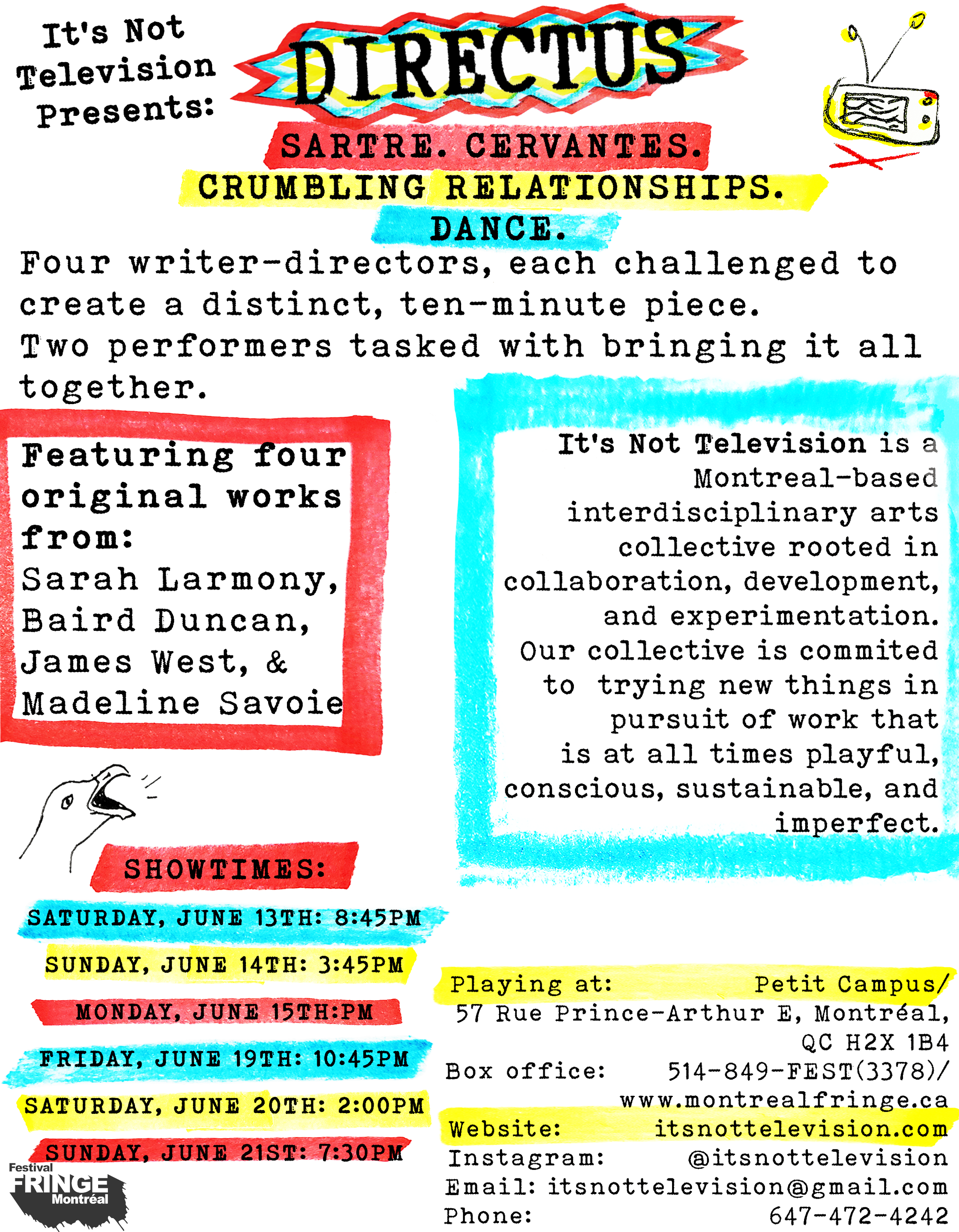
DIRECTUS
I’m two cocktails deep and physically restraining myself from texting my blocked situationship when I arrive at Café Campus. I have not set foot in Café Campus since I fell down their stairs during Fringe 2022. It’s worth noting that Café Campus is wildly inaccessible if you are physically disabled, or if you get clumsy when you’re very hungry.
Inside the venue, I begin the process of choosing a seat. I generally like to sit as close to the stage as possible — until the training meeting for this very Fringe festival, when my Creative Director said, as though it was the most obvious thing in the world: as long as you’re not sitting right next to the stage, you’re fine.
There was a trill of knowing giggles among the team as everyone delighted in their mutual knowledge of what was clearly, to all of them, the most obvious piece of theatre critic advice in the history of the universe. My eyes wide, I scribbled stop sitting right next to the stage in my notebook as discretely as possible. You really do learn something new every day.
Not right next to the stage, I put my purse down next to me, and it immediately falls off the chair. My laptop, a metal gua sha, and three tampons fall out of it, and the tampons begin rolling towards the men seated immediately behind me. As I scramble to pick them up, I think about how in addition to not freaking the actors out, sitting near the back also allows me time to minimize the number of people who can see tampons fall out of my purse. Fringe has been a very educational experience for me.
I am at Cafe Campus, learning things, to see DIRECTUS, a production of It’s Not Television. The show is a showcase of four completely original ten-minute plays. DIRECTUS is creative directed and curated by Eve Dinary, and performed by actors Ryan Litvak and Emily Bartlett.
James West’s Afters
Afters is a monologue about a young man who, not too unlike my blocked situationship, can’t figure out how to be good enough to his partner before he ruins everything. The set is sparse: a single potted plant hangs behind Litvak throughout. He is resentful and hostile in spite of his efforts not to be. His partner does not deserve this, which only seems to make him more resentful. We watch as he dissects the series of commonplace hostilities from which he learned to be the way that he is.
I think that the opening few seconds of this sound a bit canned, like Litvak was still in the process of waking the character up. There is also a part in the middle about an uncle which, in spite of being load-bearing plot-wise, dragged to the point of my mind wandering (to blocked situationship. Thank you for asking.) As Litvak warms up, I connect very deeply with this physically harmless but emotionally pointy protagonist. This play is my favourite on the level of writing.
Bartlett arrives only briefly at the very end of Afters, but she makes an impression, as does her dope haircut. Dang. I miss having short hair in the summer.
Madeline Savoie’s Elevator Piece
The set changes quickly. Hanging where the single potted plant once was is, instead, a set of elevator buttons. Litvak and Bartlett now play two people who, on their way home on a Friday evening, find themselves stuck in this elevator due to a mechanical failure, and have to work together to escape.
Bartlett's character is animated and neurotic in a way that sets off Litvaks’s charming deadpan, which gives the understated nature of his delivery a container in which it can truly register to me. This makes me understand the subtlety he’s playing with, his remarkable depth as a performer. Bartlett is clearly the kind of actor that knows how to mirror and amplify other performers, and I am absolutely delighted by the banter between the two — their echoing strangeness, way they annoy each other while also looking out for each other, the way I can see both characters try very hard not to be mean even as they lose their cool. It all strikes me as very Canadian. This is my favourite piece for the dynamic between the two actors. I like it so much I only think about my blocked situationship right at the beginning, while armchair diagnosing Bartlett’s character with obsessive-compulsive disorder.
Sarah Larmony’s Captain Norahye
In Captain Norahye, which features a hanging lantern and a trunk as far as set was concerned, Litvak’s character contends with the sudden and unexplained transformation of his colleague (boss?) from Nora, unspecified business lady of some stripe or another, into Norahye the pirate. The piece is original and exciting, fast-paced and really quite touching. Bartlett and Litvak played off of each other in the most surprising way so far in the collection, and I start to really appreciate Dinary’s art direction, the way the vibe of the different pieces built on each other in sequence. I come away feeling like Captain Norahye is a kind of capitalist fable. This is no comment on the quality of the art — which was very high, I enjoyed this section and the whole show very much, and if it’s not clear recommend people go see this very strongly — but I am just saying that back in my day, a play this arguably capitalist-optimistic would have gotten you beaten with sticks and run out of the city. Times have changed!!
Baird Duncan’s FOILED AGAIN
I don’t want to give anything away, so I’ll just say that this left me literally shrieking with delight. Block your situationship immediately and go see this show.
