
Rachel’s Rampage Reviews - FringeMTL 2026
Rachel Levine is the Editor-in-Chief of Montreal Rampage, where these reviews are originally published.
Discover Montreal's cultural scene with Montreal Rampage, a fantastic local source for the city's festivals, arts, nightlife, and culture.
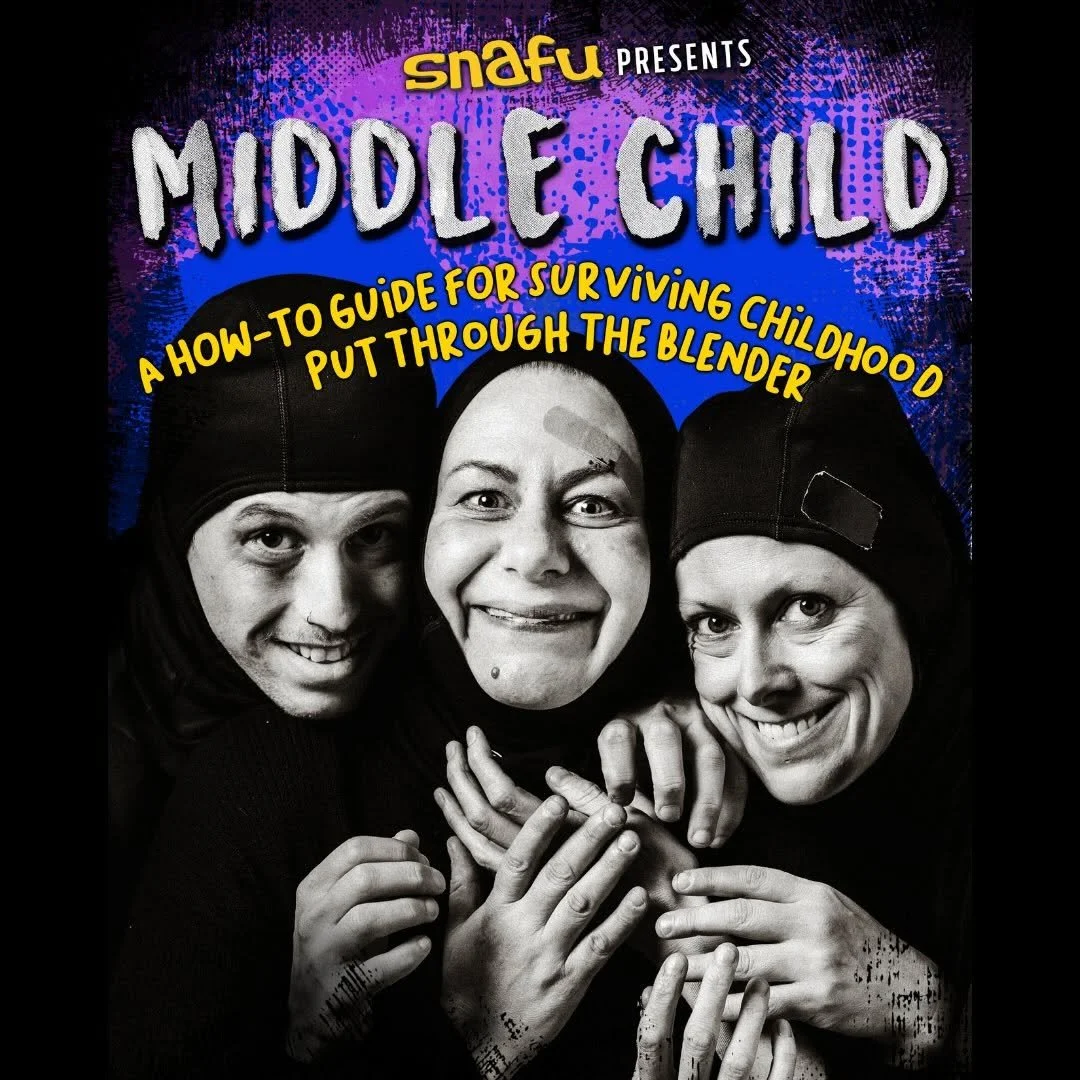
Middle Child
Much truth is said in jest. Or perhaps, much trauma is processed in
jest. There should be a meme. I’m sure it exists. SNAFU’s The Middle
Child led the audience into some heavy territory — death — and did so
without even letting us know we were headed deeper and deeper into
unknown territory. The show is a journey and one that left me deeply
moved, even though I laughed the whole way.
In premise, the show is a funeral for the loss of the middle child.
Basically, with smaller families, the middle child is disappearing.
Three characters – the golden older child, the neglected weirdo middle
child, and the beloved attention-seeking baby – shoot a film to
explore their family dynamics with each other and their parents. The
audience is regularly called in to participate, which is part of the
seduction. An audition is held for the role of dad. We are told to
laugh or whoop during specific scenes. But underneath, this show is a
journey through life’s most painful experiences: death, bitter
divorce, alcoholism, body shaming, and separation. The three siblings
fight (as one expects) and love each other (as one also expects) while
still being unique individuals. It is a masterclass in ensemble
acting.
With high energy, inversions of expectations, and a hodge-podge of
storytelling and dramatic techniques that seem to come out of nowhere,
in the hands of lesser actors, this would be chaos. But SNAFU excels
at getting to that line of
how-far-will-they-go-before-this-makes-no-sense without ever crossing
it. Maybe they touch it for a moment, but this bacchanal happens
within meaningful parameters. The restraint, endurance, and confidence
it takes to sit at that point are borne of experience and a deep
commitment to excellence in performing. I’m so glad the team of SNAFU
is back with an innovative production that is captivating from
beginning to end.
Buy Tickets
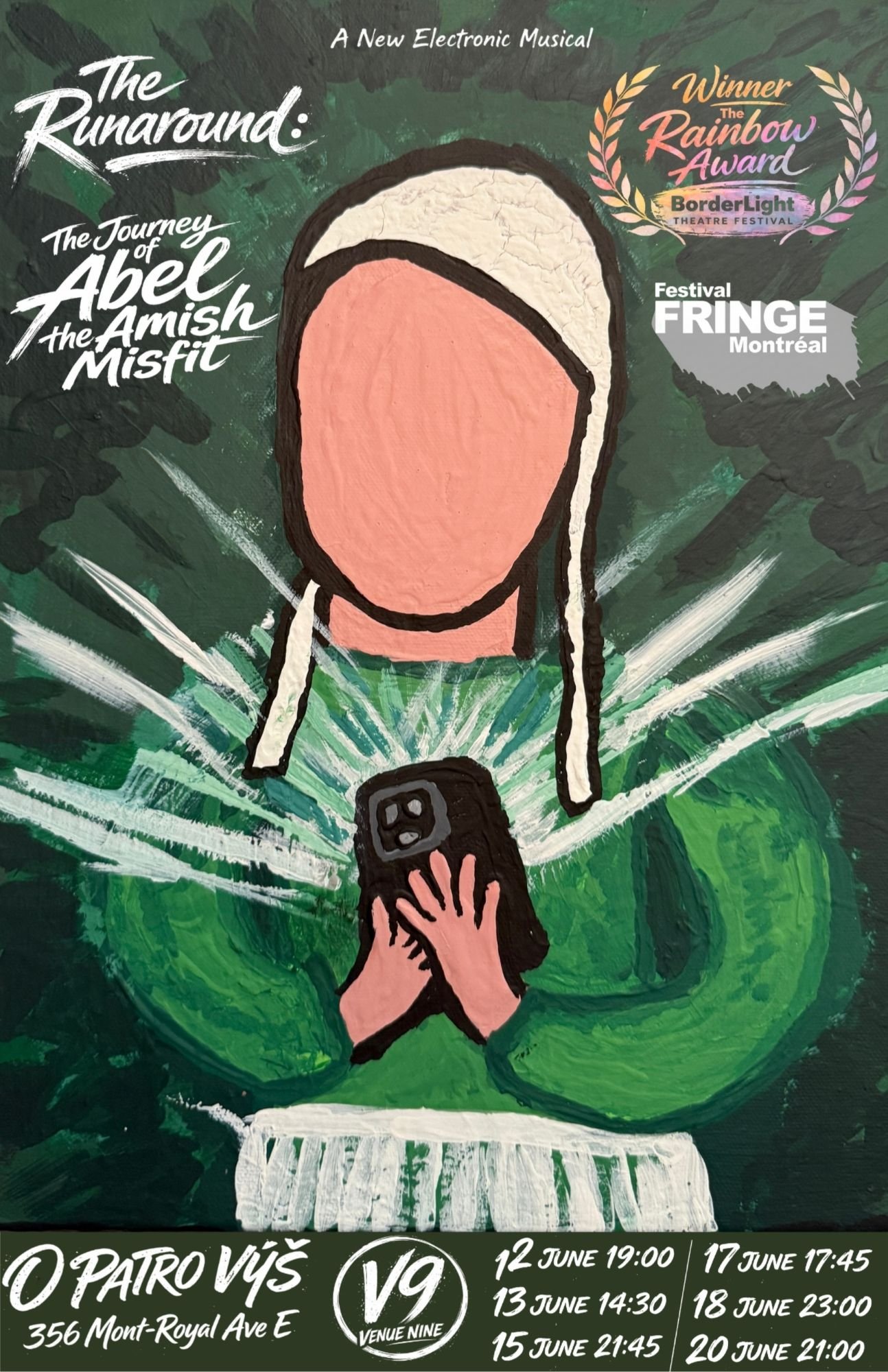
The Runaround: The Journey of Abel the Amish Misfit
Some shows at the Fringe could easily find their best home at improv
theatres or stages for stand-up storytelling, sketch comedy, and
theatrical productions. But some shows find their true home at the
Fringe. For example, an electronic hero’s journey, one-man musical
with a full cast of characters played by Stewart Alden Tabler using
audio looping, sequencing, and vocal processing.
The Runaround: The Journey of Abel the Amish Misfit is about Abel, an
Amish man whose sexuality and “creativity” are at odds with the
community he lives in. He acquires a phone and begins making social
media posts about his life among cows and barn-raisings, developing a
following. His posts attract the attention of a psychotic from the
“English” world, who arrives at the community schoolhouse with a gun.
While the criminal is forgiven, Abel’s proclivities lead to his
shunning, and he must figure out how to survive in yet another world
that rejects him.
For such a small show with very restricted movement as Tabler mostly
stayed behind his electronics, the show felt enormous. Tabler’s
gorgeous voice and emotional range, along with his audio samples
create a tapestry of people – a bishop, his mother, his father,
commentators on his posts, students. He sings his heart out with
passion and sincerity. Abel is a lovable character, slightly naive but
earnest. His intent to do good and still be himself is universal.
The lyrics of the songs are especially clever. I kept thinking of
William Finn’s In Trousers, a musical about a cis-man married to a
woman who comes to terms with his closeted homosexual orientation.
Abel has a signature pun on his name that he uses for each of his
posts and says things like, “Who says an Amish people can’t be
snatched”. All in all, this was a sweet show with a big heart.
One note, like a lot of musical theatre, Amish-ness is more a veneer
for Abel’s journey. Yes, Abel looks Amish and the context is an Amish
community. There are a mentions of Amish cultural things such as
rumspringa. The show draws on the tragic event of the West Nickel
Mines School shooting. But, culturally it sits about the depth of an
Amish romance novel. I suppose expecting more cultural nuance from a
musical is a bit much. No one complains that West Side Story doesn’t
reflect the realities of a Puerto Rican gang life in 1950s America
accurately.
Buy Tickets

Jimmy Hogg: MASHED
If he hadn’t said it, I never would have known this show is brand-spanking new. It is. So get on it and brag that you’re among the first in the world to see it.
Mashed is about Jimmy Hogg’s journey from Plymouth to Rugby to see his middle class (British middle class, that is) university girlfriend while projecting cool. Since he comes from seedy Plymouth and is responsible for an outbreak of nits (lice in Canada), Jimmy has to double down on being cool. What is cool? Not caring. But also some posturing. He plays guitar, wears a thumb ring, grows his hair long, and half-sits on chairs. What isn’t cool? Caring. Revealing one’s interior life. Not being on. However, life has no problem throwing all sorts of spanners in the works, and this journey to meet the family proves no exception. Can Jimmy remain the sort of guy he aspires to be?
What makes Mashed and Jimmy Hogg’s entire repertoire of shows so engaging is him. He is a riveting storyteller who weaves tales in tales so expertly that even the last moment of the show is fully interconnected with all the others. His high energy (“I don’t drink coffee,” he says. “My brain would explode.”) and non-stop banter is electrifying. Jokes come fast and furious, relying on wry observations about life, people, and the situations in which he finds himself. As only people from the UK can do, he manages to tease while developing a warm relationship to his audience. Highly recommended show!
Buy Tickets
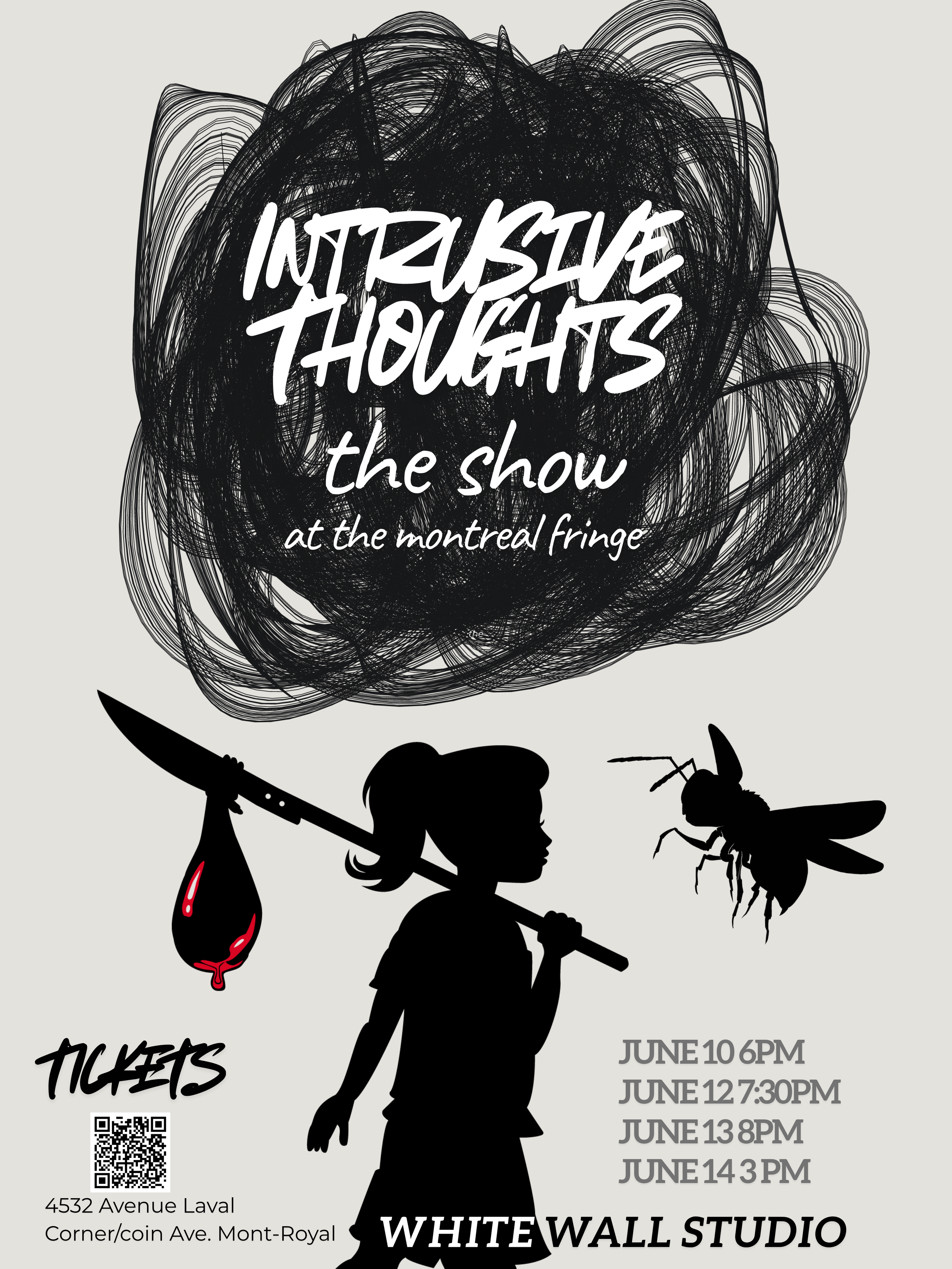
Intrusive Thoughts
What do therapists think about during sessions? Show creator Andrea Thring gives a glimpse into what one particular therapist, Annie, thinks about — revenge. From battered wives to abused children, she fantasizes about taking the perpetrators of violence and giving them what they deserve: violent deaths. But Annie’s “intrusive thoughts” are rooted in her own experiences growing up. Her compounded traumas and wine-swilling, dismissive mother are good training for this secondary career extracting vengeance, even if only in her mind.
Intrusive Thoughts is a beautifully executed performance. Thring brings Annie to life as a curious child whose world is rich with magical thinking. We then meet her at different stages of life all the way to her role as therapist. Periodically, Thring takes on the persona of Annie’s mother who waves her wineglass to make flamboyant dismissals. As flawed as the mother is, she also seems a product of her own demons.
The physicality of the show borders on dance. The natural world of logs and creatures around young Annie is communicated by her movements. Her tormented face and awkwardly held elbows scream the discomfort she feels at being hugged by her stepdad. She scales trees, runs through creek beds, and enacts dramatic death scenes.
The heavy subject matter may not be for everyone (major trigger warnings for those who need them). The show doesn’t disguise or abstract the cruelty and unfairness that victims suffer. It doesn’t try to offer answers or hopeful endings either, which for most victims of violence and abuse is a stark reality. Rather, the show is a witnessing, and in witnessing there is the possibility of catharsis.
This is a beautiful and intimate show that poetically goes for the jugular.
Buy Tickets
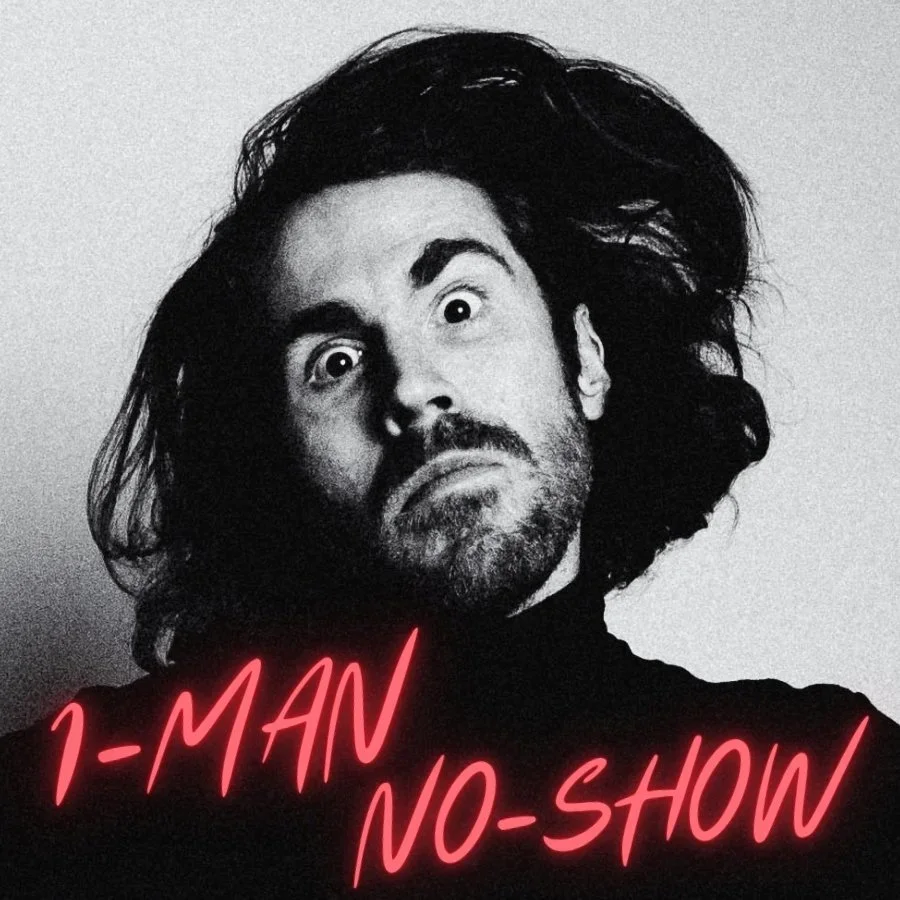
1-MAN NO-SHOW
At last, something registering high on the Alejandro Jodorowsky absurdity scale. Short bits make up an hour of balls-out insanity. OK, no balls were out. But Isaac Kessler definitely did some things with a Barbie doll and bananas that might qualify as high art at the right Bienniale (I’m thinking of Comedian from Art Basel Miami, but you’d likely have to see the show to understand my reference).
Kessler excels at interacting with the audience, whether it’s imitating their laughs or getting them to join him on stage for a coordinated dance without using any words. His trust that they will eventually do what he wants them to doubles the absurdist fun. There are ridiculous puns and slapstick, ridiculous costume changes, and ridiculous props, all used in the service of surreal comedy.
It’s Kessler’s shameless/fearless commitment to entertaining with a good dose of self-deprecation that easily brings an audience in on every joke. I couldn’t stop laughing and spent a good deal of time afterwards wondering where he sources his ideas. “Drugs and sugar,” was one shouted audience response to Kessler’s question about what causes pain. Perhaps those?
Buy Tickets
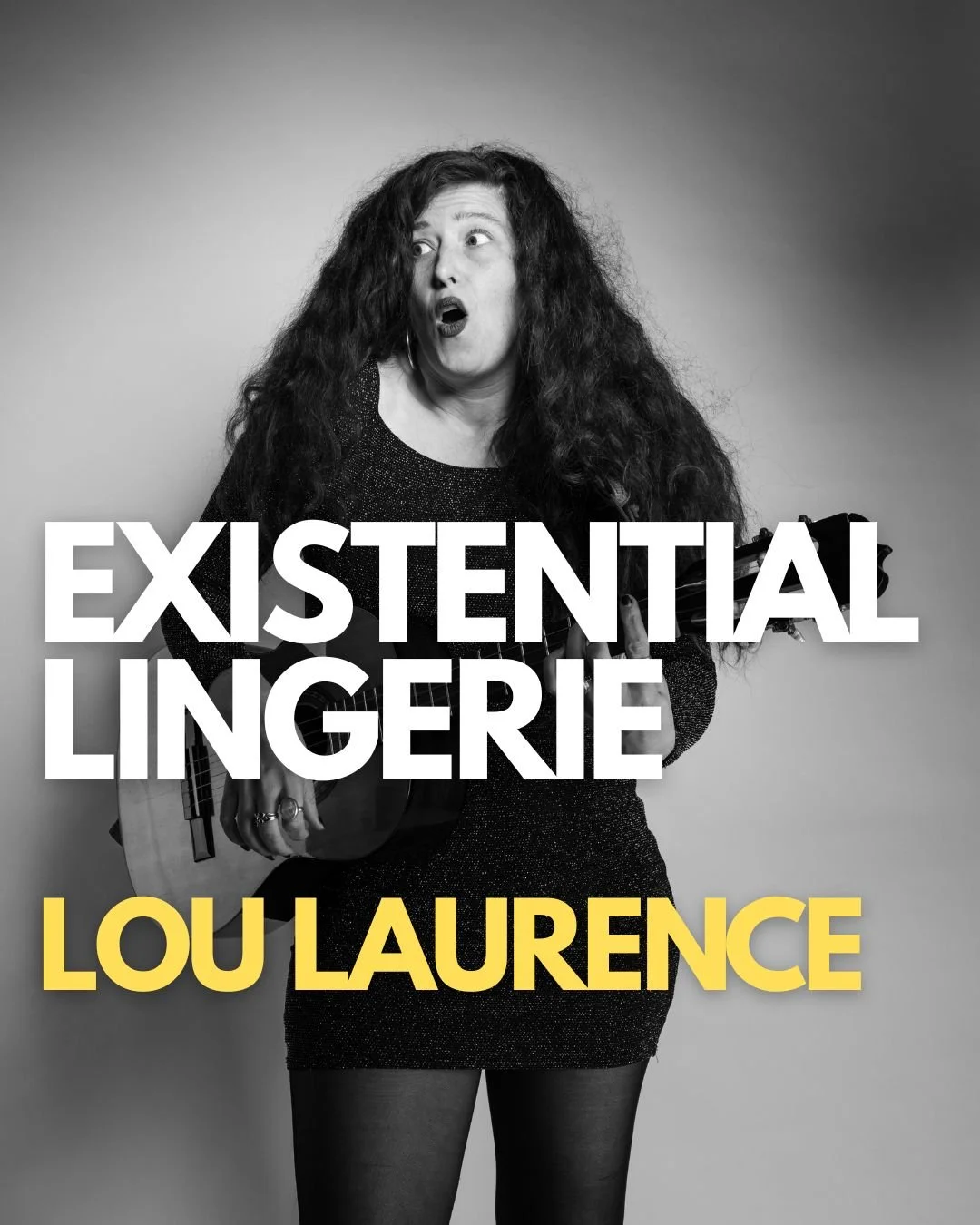
Existential Lingerie
Lou Laurence is an award-winning singer, songwriter, comedian, playwright, host, producer, and improviser. And, as many successful artists will tell you, those things usually don’t pay the bills. So, Laurence has a jobby-job, writing for AI so that AI can write articles. Her jobby-job comes through with a very “enticing” offer — full time work with full benefits, just so long as she doesn’t sing about relationships or anything that might compromise the corporation .
It is a dilemma.
Laurence shares her problem with her date Karl, a somewhat clued out tech worker who doesn’t get it. Fortunately, the Fringe festival audience does and we’re along to hold space for Laurence’s struggles. After all, many people in the audience live those struggles.
Laurence’s show is a gem. She sings, plays guitar, talks to the audience like we’re her best friend. She explores the thorny problems of her romantic and professional life through smart lyrics as much as she does through key signature changes. I’m talking sultry ukulele ballads. How often do you get to hear that? It’s a delicious production with an easily relatable Faustian bargain. Laurence is easy to adore, and the audience makes no secret of its feelings for her.
Buy Tickets

1 Small Lie: Martin Dockery
A year ago, I found a wallet tossed onto what is quite possibly the only bit of lawn on Peel Street in the concrete jungle of Griffintown. It was early Sunday morning and the only thing open was Starbucks. I looked up and down the street and yelled, “Anyone drop a wallet?” No one answered. A dog walker shrugged, “Not me.” Perhaps the wallet belonged to someone who lived in the apartment, tossed out a window during a rowdy party or dropped while rushing to work. I thought nothing about looking inside for an address. There was no money, but definitely bank and credit cards, a license, and pictures of his wife or girlfriend in her hijab. Unfortunately, the address on the driver’s license was somewhere far on the south shore. I vaguely recalled some old saw about putting a found wallet in a mail box, but I wasn’t entirely sure if that was true. In a no-good-deed-goes-unpunished way, I spent the better part of that Sunday trying to return it to the police. I stupidly walked past a fire station — perhaps they would take it — because a police station wasn’t too far away. As it turns out, it had moved, and the local police station of Griffintown wasn’t really a police station where one one could go and drop off a wallet. It wasn’t even open. I tried to find police cars and police working traffic lights, yet for whatever reason, no one took the wallet. In the end, I had to hoof it to the station near Concordia, Poste Quartier 20, wait around for someone else to report a theft, and then turn over the wallet. I was required to give a statement, something I wanted to avoid. “Just in case they want to contest the money.” “There was no money,” I said. “And if there was, I wouldn’t touch it.” Needless to say, the officer who took my statement confirmed that a wallet could be put into a mailbox, but the police were the better option.
My attempts to return that wallet to its owner ran through my mind while watching 1 Small Lie, a solo storytelling show about the time Martin Dockery found a duffle bag of money in the back seat of a crashed car. Dockery’s story sounds too crazy to be true, but some part of my brain itched: could it be true? Or partially true? And if so, what part? It’s not the kind of question one asks — it’s like asking a magician to reveal the trick.
With absolute commitment, Dockery tells the story of escaping his wife, daughter, and life in Brooklyn during the COVID pandemic by staying at his godmother’s home in Montauk, at the southern end of Long Island, New York. Long Island’s deer over-population is a known problem and anyone from the area (yours truly) would recognize that only a Brooklynite would attempt to rescue an injured one. Also, Long Islanders are well aware that touching a deer is a sure way to pick up tick-borne ailments like Lyme Disease and Alpha Gal. Hard pass. But, Dockery is not a Long Islander. Enter bad decision #1; Dockery can’t let a half-dead deer lie. He begins to cart the animal home on his daughter’s neon green saucer sled and en route finds the likely culprit pinned in the driver’s seat of a crashed car. In the back seat — straight out of a Coen brothers movie — is a duffle bag of money. Enter bad decision #2; Dockery grabs the bag and stashes it in his basement. The story spools out from there into a true-crime yarn worthy of being made into a podcast. There’s a femme fatale neighbour, a murdered(?) husband, pokey cops, an adorable innocent child, a kidnapped child, and a few criminals.
Dockery is a slippery character. His questionable decisions drive the story even though he wants to be a hero. His moral compass is pointed off true north and he’s definitely more chaotic netural than the good family man he thinks he is. This unreliable narrator gives the show a very distinct veneer and put me at a remove. I didn’t feel commonality with Dockery, but I did feel that “and then what happened” sensation. I’m not sure if storytelling is just different in the States, but American storytelling is less confessional, less “I-am-everyman”. In most storytelling shows featuring Canadians, the storyteller is well-intentioned, sometimes naive, and put into impossible circumstances that they make peace with. Americans are more morally ambiguous and their characters make decisions that shape their circumstances. Well, my observation applied in this show.
While Dockery made me uncomfortable, the show is very polished. In particular, music and lighting are incorporated into the performance with a great deal of attention to details. Using his phone, Dockery controls a stage full of lights to give atmospheric effects allowing him to glow sickeningly green or be bathed in warm golden light as the character requires. Music lyrics arrive at key points in his narrative. The suspense and drama that is inherent in every podcasted true-crime story is present here, making this a very gripping experience and each new piece of information laid down changes the narrative.
A good show, but I would never have swiped a duffle bag of money from the back of a car and I’d definitely not touch an injured deer on Long Island.
Buy Tickets
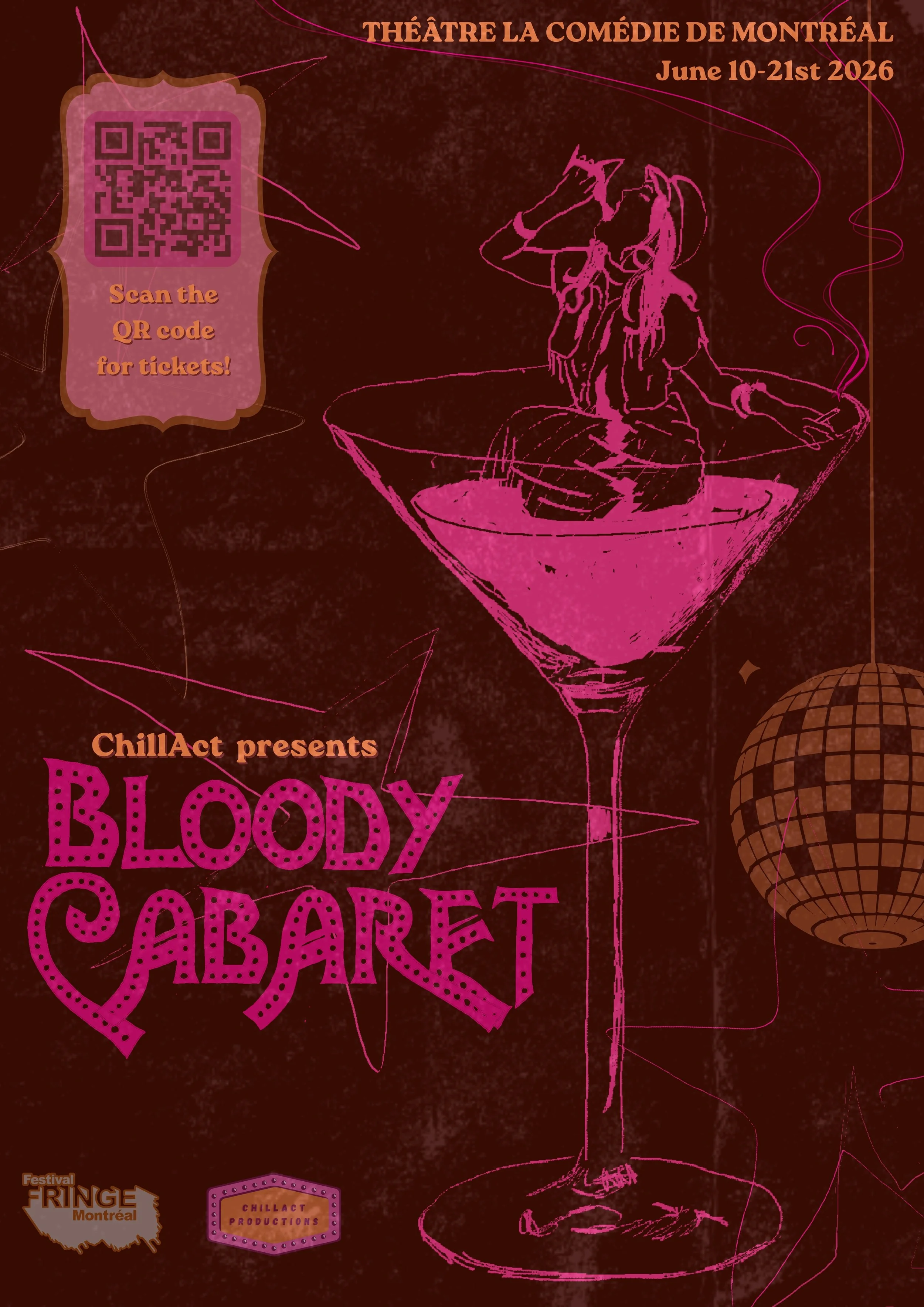
Bloody Cabaret!
1970s London and not a spy to shag in sight. But, at the Polari Closet, owned and hosted by drag queen Zion (Mazdak Darvishi), death is about to interrupt a night of sultry jazz standards. In the house are famed fashiond designer Amanda (Dalia Leblay) and her prize-winning chemist husband Thomas (Griphon Hobby), as well as performer Désirée and her former French lover Cami. Newbie singer Rosalind is going to have her first night performing in front of a full house. Sparks fly across the room, as every character seems to be hot for every other character. Cami licks her lips, Thomas can’t stop staring, Amanda is getting plastered on a Bloody Mary. Then, mid-song, Rosalind drops dead. Has she been poisoned? She’d been given drinks, food, and cigarettes, and everyone has a potential motive — jealousy, hidden secrets, lust.
The silly but entertaining plot keeps this murder mystery in motion The three-piece jazz band is excellent as is the singing. The acting is good too, just the right touch of camp. Special kudos to Anita Orsel for Cami, who just seemed to be in full command of her character in each gesture and facial expression. Leblay was good fun hamming it up as over-the-top drama queen Amanda, something of a Karen but a bit more daft. Leblay breathed life into her. Hobby gives a tantrum that could rival any five year old’s. And Darvishi and Vanessa Alcaraz sang like they’d stepped out of a noir novel.
Buy Tickets
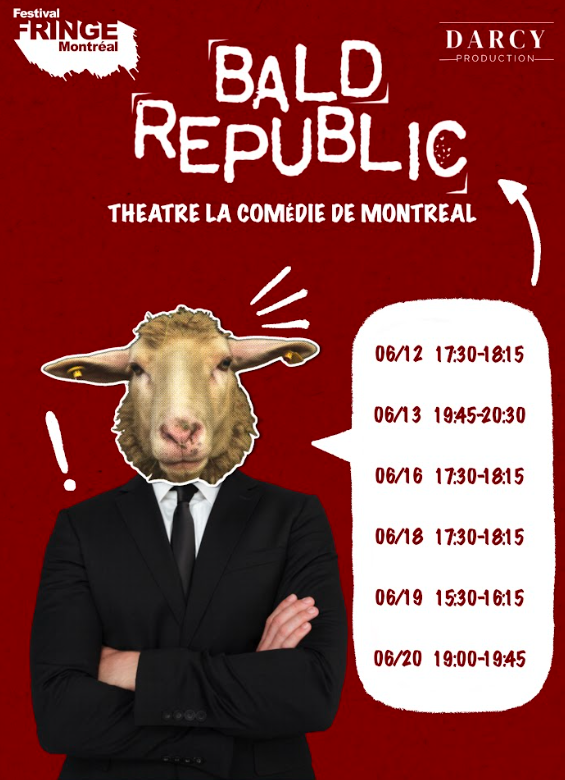
Bald Republic
I thought 1-Man No-Show was going to be the weirdest / most creative thing I’d see at the Fringe this year. I found its rival. The political satire Bald Republic is art. Art with an e, and maybe a silent Q. I could not stop laughing. I wasn’t sure if I was the only person laughing, but I love absurdity, dry humour, and conceptual performances.
The premise is a televised debate between four political leaders, presumably two different sides. Each one stands at a dais, with a moderator at a table in between. Mr. Denis, who seems to be the most powerful of the four, begins with a lengthy monologue in which he says a lot of words that could be pulled from a Harvard Business School Leadership textbook, but mean absolutely nothing when strung together. It was genius. Samuel Beckett would be proud. James Joyce too. Each phrase was so close to making sense, and yet, total word salad.
Mr. Denis’ political speech is challenged by a fierce and very loud opponent, whose round glasses and oversized pearl necklace emphasize her seriousness. Her ongoing outrage is dismissed or perhaps just hard to follow through the shouting. Yet the tiny tics of her head and her no-nonsense frown was unmistakable. Much like Mr Denis, though, the words from her mouth took the shape of something familiar without fully making sense.
I can only describe the flow of things, because what happens doesn’t quite have a narrative plot. The debate descends into a slow motion ballet of violence. One character knees another in the balls. One backstrokes across the stage. It’s as beautiful and hilarious as it is insane.
I won’t reveal much else, but the ending provides yet another murderous Fringe moment, Pagliacci-style.
Any more description I give will do this wild piece injustice. It won’t be for everyone and it has to be seen to be understood. Those that go with an open mind can delight in a piece of conceptual art that has a lot to say about politics and the absurdist solution to the impasse of disagreement. It takes endurance and a fearlessness to make a piece like this work. Bald Republic succeeds where few dare to tread.
Buy Tickets
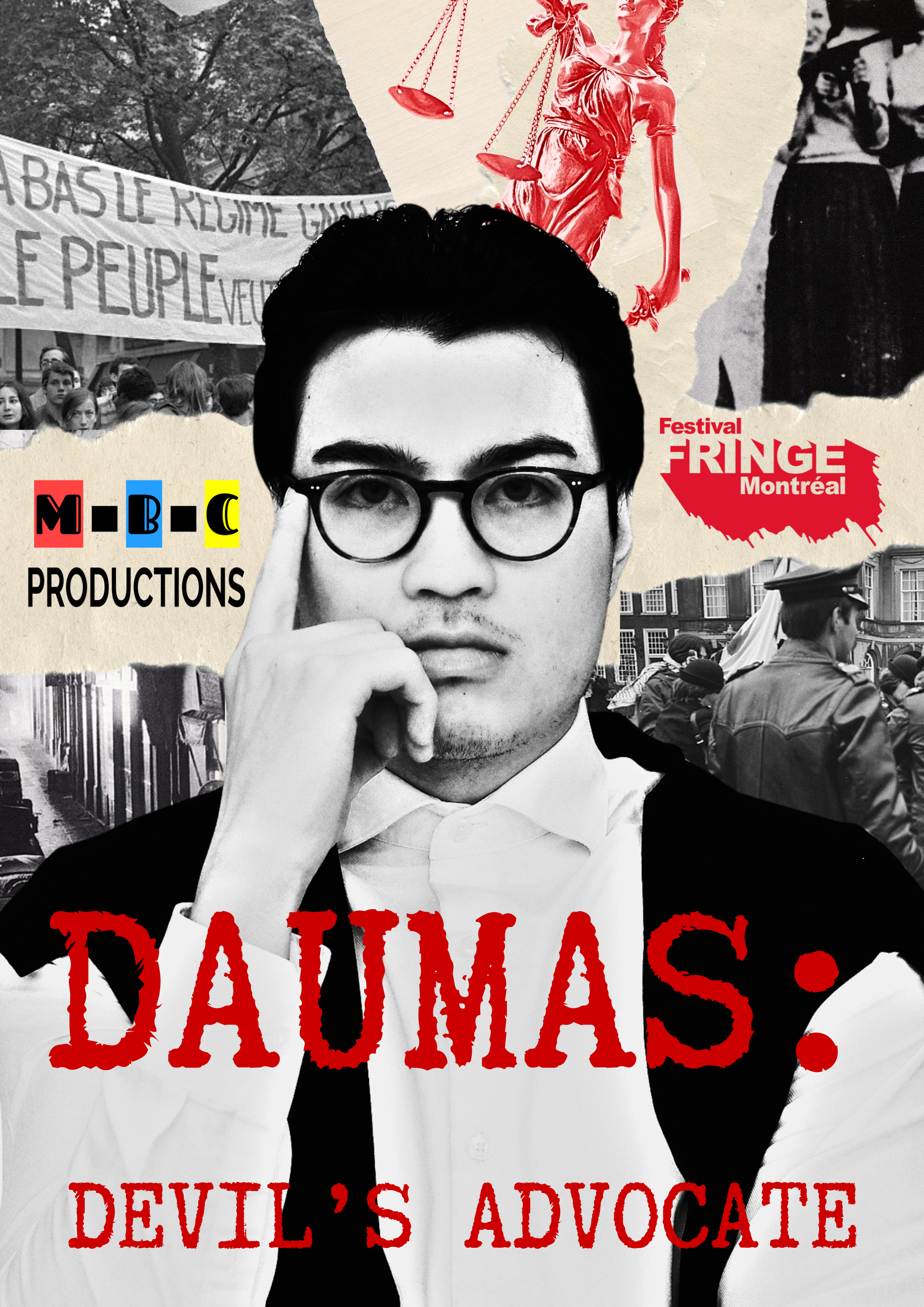
Daumas: Devil’s Advocate
Last Sunday evening, I was invited to attend Daumas: Devil’s Advocate, an interactive courtroom drama written and directed by Fred Azeredo. Presented as part of Fringe MTL, the production was staged in an auxiliary building of Mission Santa Cruz. Roughly sixty people braved the rain for this performance; they were all looking forward to becoming jurors and actively participating in the trial. The show was conducted in English.
The unique approach that Daumas: Devil’s Advocate takes is that the audience does not simply observe the trial; they get to determine the verdict and the ending. Cast as members of the jury, we, the audience, are asked to decide the fate of Daumas, an anti-colonial lawyer accused of treason. The character is inspired by the real-life French-Vietnamese attorney Jacques Vergès, who was reputedly controversial for his defence of politically charged clients and confrontational legal tactics. While Vergès’ historical background influenced the overall synopsis of the show, the trial of Daumas itself is entirely fictional. Our collective decision leads to one of two possible endings: declaring Daumas either guilty or innocent. In that regard, the production embraces what it truly means to be an interactive play!
The set itself was minimalistic, consisting of two tables on stage: one representing the prosecution and the other the defense bench, with a tall podium for the judge at the centre of the stage. Once the actors entered the stage in their judicial robes, the visual setting evoked a courtroom.
Three principal characters in the narrative—Georges Daumas, Étienne Rigault, and the Judge—drive the trial forward alongside several witnesses who trigger flashbacks to Daumas’ past. Daniel Wan skillfully captured the arrogance, charisma, and provocative confidence of this fascinating defendant. Even when making risky statements, the character remains incredibly compelling to watch. This in turn triggers prosecutor Rigault’s gradual transformation from a firm opponent into someone increasingly persuaded by and fascinated with Daumas’ rhetoric and personality. I loved that this shift never felt too abrupt. Rather than strictly relying on dense legal arguments, the production uses elements of comedy, friendship, romance, and betrayal throughout the storyline, which was very much entertaining. The author demonstrated great skill through smooth transitions and sharp character dynamics.
During the performance I attended, the vast majority voted that Daumas was not guilty, which was followed by a startling finale. Looking back on it now, I wonder how the ending might have differed had the audience reached the opposite conclusion. That being said, I personally think it was a smart choice to maintain some ambiguity surrounding Daumas’ alleged crime. The trial revolves around accusations of Daumas’ treason, yet the truth and specifics of the offense remain vague even towards the end. This may have been an intentional choice, encouraging us to reflect on our assumptions before rendering a decision.
In Daumas: Devil’s Advocate, we are encouraged to evaluate, judge, and reflect on the “justice system built on injustice”. When the Judge ultimately called for a show of hands and delivered the verdict, I was already deeply immersed in my role as a juror.
