
Sophia’s Reviews - FringeMTL 2026
Marthe Jeanne Charlotte Ariane
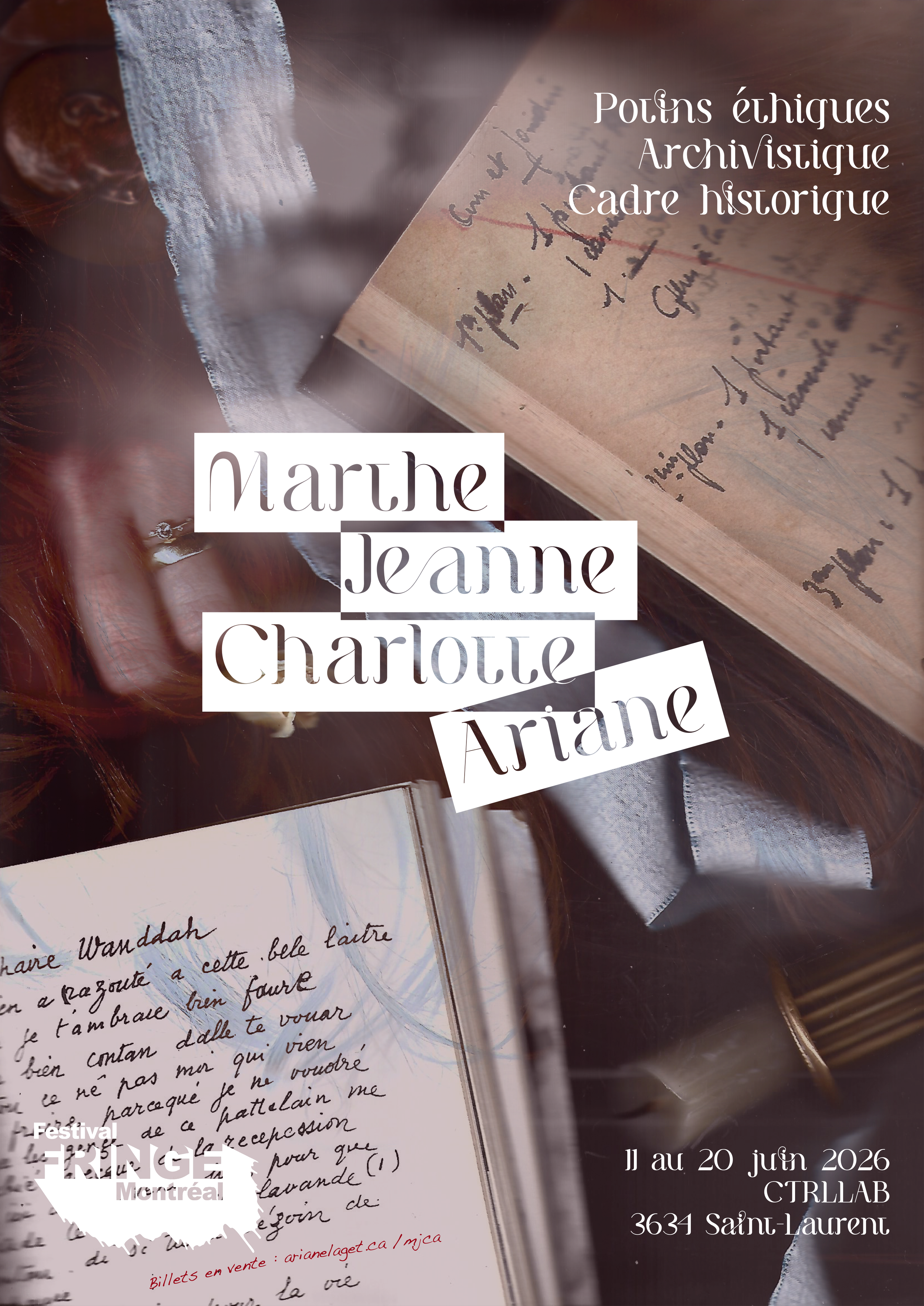
Marthe Jeanne Charlotte Ariane is a mostly one woman show about Ariane who’s going through a rough 2026 and leans on her obsession with Louis Jouvert as a way of dissociating. For those of you who are unfamiliar with French theatre, Louis Jouvert was a playwright from the early 20th century whose work was hugely influential. Through this obsession, she starts looking deeper into Louis Jouvert’s life and learns about the women who inspired him: Marthe, Jeanne and, Charlotte. She digs through archives, reads biographies and evokes their spirits to teach us more about these women.
The stage is set like someone’s messy office. Books are sprawled out on the floor, there’s a ladder at one side of the stage and there’s a typewriter set up on a desk. You already get an impression that our main character has been going through something as soon as you walk in. But it also feels calming. As if we’ve walked in just after she’s crashed out and is now reflecting back on it. Then she starts the play by explaining her reasoning behind why she wants to call out to these women’s ghosts.
Each of the women teaches Ariane something new about life, and by extension, the audience. She also puts on one item of clothing before evoking these women’s spirits. The play mostly focuses on their life around WWII. An era that feels unnervingly similar to the one we’re living in and I’m sure wasn’t chosen by coincidence. First she calls to Jeanne, Louis Jouvet’s secretary, for which Ariane slides into a pair of red shoes. Charlotte was a member of the resistance, and worked for the company, as well. For her, Ariane puts on a pin. Marthe worked for Jouvert’s company both on the stage and behind the scenes. She’s the one who keeps his legacy alive long after his death in 1957. Most of the biographies on stage were written thanks to her contribution.
The set design does a lot to immerse the audience into this world. The books on the floor aren’t just there to show how Ariane has become obsessed with these women’s lives, she reads from them throughout the play. The lighting shifts from blue to orange to let us know that she’s being possessed. Each prop is thoughtful and doesn’t go to waste. The effort put into the show alone makes it worth seeing. The accents are believable and the costume pieces add detail to the story without being distracting.
This play is interesting because it starts with telling the story of a man, Louis Jouvert, as a way to recenter the stories of women that history forgot to tell. You don’t need to know about Louis Jouvet’s life to understand the lives of his muses. Marthe Jeanne Charlotte Ariane is a play for history buffs who are interested in learning a niche part of theatre history.
Buy Tickets
Double Vie
I arrived at the Conservatoire de Musique de Montreal early; eager to get out of the sweltering heat and inside the theatre. I follow the signs that say “FringMTL” upstairs to the multimedia room. There, I check in for the show, but I can’t go in just yet since we’re still 20 minutes away from show time.
“We’ll let you in in 15 minutes,” I’m told.
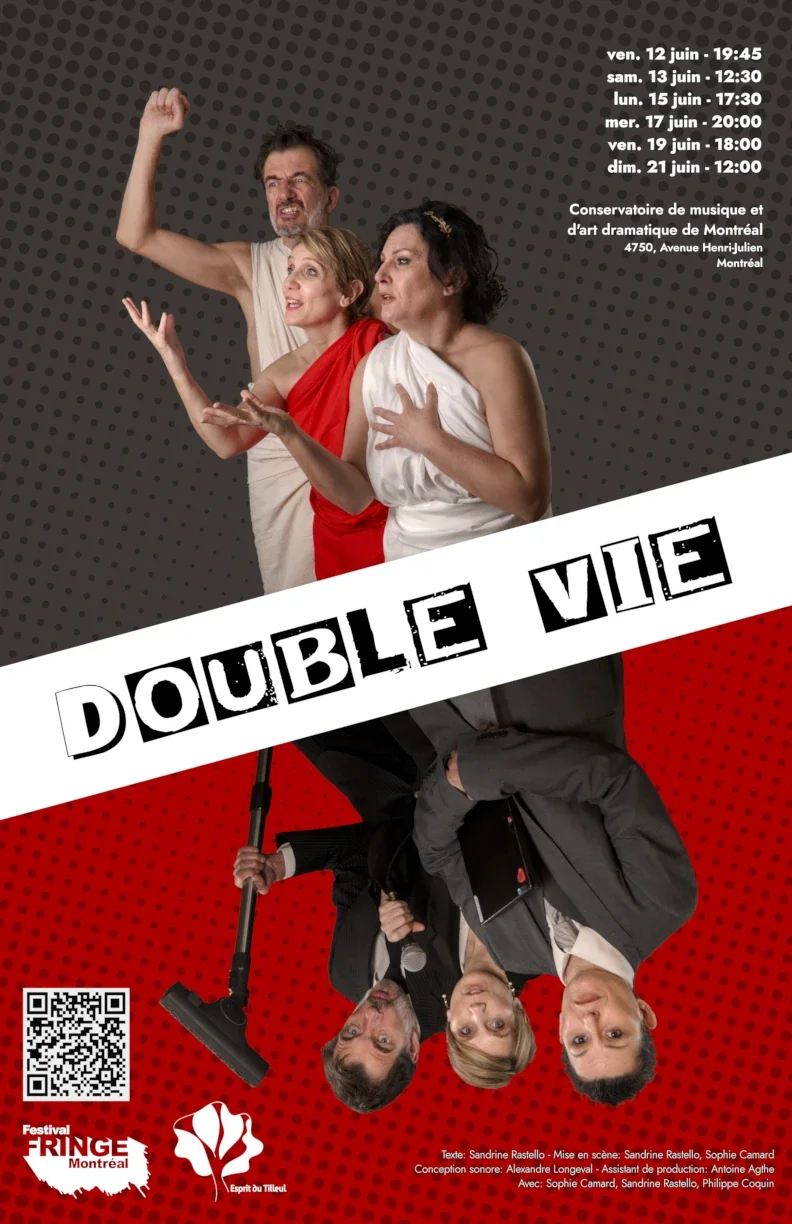
So, I decided to walk around the conservatory. As I take in my new surroundings, I think about what a play called Double Vie could entail beyond the synopsis written on the Fringe Festival website. Would it drop the comedy aspect halfway through in favor of a more dramatic take? The poster didn’t seem to sway my thinking either way. 7:30 rolls around and I head back upstairs to take my seat and…
Yes, Double Vie does explore the life of a starving artist, a tale as old as time. But it takes a comedic route from the mouth of the artist herself. Sandrine Rastello recreates her career in an almost hyperbolic way. If you’ve ever met a theatre kid, you know that I’m being very realistic in my description. They’re always ready at the drop of a hat to recite their favorite lines and move their bodies in a way that makes you think “should the human body do that?”. Rastello uses comedy as a platform to create meta commentary about her time as a student to an amateur actor trying to make it in a cut throat industry; hence the name. Because becoming a serious artist takes a lot of hard work before you even get the chance to play into those stereotypes.
Not only that, but the play also uses theatrical elements to drive the point home. For example: audience participation and breaking the fourth wall. The play starts with Rastello miming behind a red curtain while testimonies from her actor friends fill the room. Then, she steps out to an audition where she gets told that she’s not convincing enough. After getting interrupted by the director for the third time, she talks to the audience about what it took to get here. How years of of classes didn’t prepare her for how hard it would be to become a professional actor. Nor did it give her clear indication of whether or not she’d “make it” to the big leagues. Yet, she still pushed forward, because making art, or creating in general, is something intrinsic that can’t be pushed down. Life, uhh, finds a way.
The play constantly goes back to this idea with more testimonies about the difference between an amateur and a professional, while playing theatre games. It’s a play for those who love theatre and want to hear more about the life of an actor beyond the success stories of those at a big theatre company.
Buy Tickets

RAGE BECOMES HER
In the last few years, female rage has been a hot topic in feminist circles. Countless articles and TikToks have been published describing what it is, with examples from popular media for women to embody. For those of you unaware, female rage is when a woman lets out her suppressed anger after an entire life of appeasing everyone around her. In media, it’s often portrayed as revenge against an aggressor that’s typically a man. So, when I saw the title of this show, I got really excited. What I got was exactly what I wanted and more. RAGE BECOMES HER is about a girl's fun and innocence being interrupted by the gender based violence in the world.
Our main character comes on stage in pyjamas while singing “Celebrity Skin” by Hole into her hairbrush, which was a great way of setting the mood. If you’re familiar with the band, it gives you an idea on how this character will grow angrier as the show progresses and how she’ll use it. When the song gets interrupted by a recording of several news broadcasts, she drops the brush and becomes visibly frustrated. But instead of feeling paralyzed, she grabs a spell book from her trunk and looks for a spell called “Rage Feminine”. This spell not only gives clear instruction on how to embody female rage, but also gives a clear warning that the caster will lose their humanity.
This is my favorite aspect of the play. RAGE BECOMES HER is actively criticising the idea of female rage all throughout. It’s not a criticism that lets men and the patriarchy off the hook. It’s a message to women and feminine presenting people that we need to do things differently so as to not perpetuate the same violence that’s been done to us. Anger is a normal human feeling, yes. However, it’s always important to know how to handle emotions in a healthy way.
This is well represented through the costuming and performance. As the character starts to embody different goddesses like Morgan and Lilith, she adds something new until she’s completely transformed into this human-bird hybrid that moves through the crowd like a wild creature. It is this overall burlesque quality, along with the lip-synching, that gives the show a very unique feel. At the climax, this embodiment becomes too much and the man character removes everything but her under garments. Then, she grabs a pillow from the floor and starts hitting it with a bat. It’s at this point that I wished she wasn’t doing this alone. A few moments later, she grabs a few more bats from her trunk and invites members of the audience to also hit some pillows.
The whole show ends with a pillow fight. Which was a great way to let go of all the tension in the room. Everybody got a chance to live out a part of girlhood that’s long passed. I’m pretty sure I’m in a cult now; the one thing my mother warned me not to do in life. But I think it’s worth it. I also think this play is worth seeing if you have the chance.
Buy Tickets

514: Trash Chaud
Before my presentation of 514: Trash Chaud started, the creator/choreographer, Anne-Marie Latulippe, came out and made a speech. She explained her original inspiration for the show (roller skating) and how the process of creating was just as important as the final product. What really stood out to me was how the message of the show was slowly developed, not just to reflect how many see dance, but also the city of Montreal. A lot of people are afraid to dance, not just in public, but even on their own for fun and that broke her heart to hear.
While watching the show, I found a new appreciation for performers, because performing in itself is cringe. Yes, even your favorite Oscar or Tony Award winner is cringe. To me. But it takes a lot of vulnerability to get on stage and act ridiculous, and on top of that you have enough talent to convince people to join in. The dancing starts off very stiff, moving in a way that reminds me of dolls with their hands permanently in place, what I would describe as Barbie hands. They also topple over constantly to show that they’re not used to moving their body in a rhythmic way. With each new song their movements become more and more fluid.
While they dance, there’s also footage of past rehearsals being projected like a mirror. It’s like the show is a character itself reflecting back on what it took to prepare for the first show; the amount of mistakes that were made. Even if a rehearsal looked right, it still needed some small tweaks, and even after this first showing there are probably some changes that will be made. That, too, takes a lot of bravery. I can only imagine how the dancers felt, aware that the audience was also watching less-than-confident versions of themselves being exposed.
A big development comes halfway through the show when they do finally synchronize for the first time. They do this several times after, and even end the show by dancing to “Pieds de Poule” by Dolbie Stéréo. It shows how comfortable they’ve become and now aren’t afraid to look ridiculous. In fact, the ridiculousness is intentional. I wish that for everybody, even if it’s not on a stage.
You might hear a title like 514: Trash Chaud and think that the creator is either setting themselves up for failure, or it is so pretentious that they came up with something ironic to catch people’s attention. Yet, I would argue that the title is accurate (and I mean this in a very complimentary way). The narrative is intriguing and the ending is satisfying. You won’t find long dialogues about what it means to be human, nor are there any quippy one-liners. As a matter of fact there is no dialogue. It’s an art piece masquerading as a dance show about people learning the joy of dancing. Sure, it’s abstract in ways that could make it “not for everybody”, but I think anybody with an open mind will come to enjoy it; if not appreciate the message.
Buy Tickets
Le Cimetiere des voitures
Le Cimetiere des voitures is one of the few adaptations at Fringe. The original play was written by Fernando Arrabelo and was staged for several years before Arrabelo wrote the screenplay for a French made-for-tv movie of the same name. The story takes place in a dystopian future where an asteroid hits earth forcing poor people to live in a car graveyard awaiting for the next messiah to rescue them from their lives. Adaptations aren’t the easiest, especially when the script is several decades old. The director has to pick their battles by choosing what themes they want to focus on and what to leave out so a story stays culturally relevant. This adaptation has some interesting ideas, but it needed a little more work to be a cohesive story.
The original story takes place in a car cemetery. It’s not just a bleak place to live, but it’s also symbolic of how the characters are in a stage of waiting. They’re hoping that someone will come along and fix their lives. But many of the shows at Fringe are on a limited budget, but not limited creativity. How do you create this set in a way that captures the idea? Tents. The stage is set up with four tents where the characters live, clearly leaning on our current visual cues of homelessness. There are many encampments right now, in and around Montreal, being threatened to be taken down with no real solution. It’s a setting that works for the overall theme of the original story. I also thought it was interesting that everybody was already on stage, inside the tents, when the audience arrived. It was a pleasant surprise when the play started and they popped out.
What about the structure? Well, the original story was an hour and half long. FringeMTL has a limit of an hour and 15 minutes (last year it was an hour and a half) and once in a while the time written on the site is an overestimate and the shows run for less. Le Cimetiere des voitures ran for 45 minutes. The play starts with a man being brutally murdered by three of the characters. It’s a jolting scene that makes you understand that this world is extremely cruel, and it doesn’t let up. One of the female characters, Dila, is constantly being verbally abused, to the point of it feeling gratuitous. The messiah metaphor, if you can call it that, is very explicit, down to the kiss of betrayal. The biggest difference was that Emanou, our saviour, starts losing hope near the end of the play.
The performances themselves are quite convincing. Not only is everybody perfectly cast in their roles, they give it their all. The stand out to me, however, was Elodie Maher as Dila. She had a great range that made the character feel realistic even when her motivations weren’t always clear. Maher used subtle movements and nuanced ways of expressing her dialogue to make the audience easily empathize with Dila.
On my way home, I thought a lot about the script, about what was intriguing enough that the director would want to adapt this play. I’m sure there are many reasons, but the most relevant to me was the idea that we all need something to believe in when times are tough.
