
Holly’s Reviews - FringeMTL 2026

Becoming Psychic
The night I attended Becoming Psychic, Montréal was in the middle of a 31-degree heatwave, though thankfully the 8:45 p.m. start time meant things had cooled off a little. St. Laurent was in full street fair mode, lined with vendor tables and packed with people, so finding Ctrllab took a moment. The trick is to look for the ticket table. Once you've found that, you've found the venue: an almost-hidden doorway leading up a flight of stairs to the second-floor theatre. Unfortunately, the space is not accessible.
By the time I made it upstairs, the house was nearly full.
The staging is a spotlight and a chair. Gada Jane is alone with projected light and cutouts standing in for traditional visuals. It's a strong concept, though I think it could be pushed further. It only really clicked into place near the end, when the audience was asked to breathe along with her and church-style light poured through the cutouts. I'd love to see that idea built out more across the whole piece, because there's a surreal quality to what she's doing underneath the comedy and self deprecation, and the visuals could carry a lot more of that weight.
On vacation in Europe with her pregnant sister, Gada finds herself confronted by experiences that don't fit neatly into the skeptical worldview she was raised with. Figures in paintings and religious statues begin moving and speaking to her, including St. Romaine, who shares details that seem entirely outside Gada's own knowledge and interests. When she later researches him, the pieces fall into place in ways she can't easily dismiss. Vacation, as Gada describes it, leaves you with nowhere to hide. No grades, no accomplishments, no right words for recreation. Just yourself and whatever is happening.
From there, Becoming Psychic follows Gada's attempts to make sense of it all. A psychic gets something uncomfortably right. Friends, family, and dates react with varying degrees of concern. A schizophrenic friend suggests she could probably get a diagnosis if she wanted one. Her mother, having witnessed psychosis firsthand, struggles with her daughter's growing interest in psychic work. Yet through it all, Gada remains funny, self-aware, and remarkably grounded.
The show spends time in the uncomfortable space between spiritual experiences and mental health without trying to force a conclusion. Instead, Gada offers stories, observations, and questions, often finding humour in places where many performers would reach for certainty.
The fans in the venue did distract a little, and I'd love to see this one in a cooler room, but credit to Gada, I still felt pulled in, and so did everyone around me. For an hour, in that heat, there was a feeling of curiosity and unity. People stuck around after to share their own experiences and make more of a connection with Gada, and I was one of them. She's real. Her experiences are real. We're all real, all stumbling through the world with different maps, and that's beautiful.
Buy Tickets

Bloody Cabaret!
It was a warm, stormy kind of night when I made my way to Théâtre La Comédie de Montréal, which sits more on the edge of the Plateau near Berri-UQAM than in the thick of the Fringe cluster. There was a bit of confusion around the box office, but the venue itself is spacious and welcoming, and it turns out to be a perfect fit for this particular show, giving the cast room to actually make you feel like you've walked into a cabaret.
And they commit to that fully. The set is detailed, with signage, tables, and space carved out for the live trio, trumpet, guitar, and bass, who double as the house band of Polaris' Closet, the 1970s London jazz cabaret where the whole thing unfolds. Before the show even starts, Zion, the club's flamboyant owner and emcee, is already working the room, chatting up audience members, making everyone feel like a regular. It's a great touch, though they did push it a little long before the show actually got underway, to the point where I was starting to wonder if we'd ever get there.
Once it does get going though, the premise delivers: the evening's entertainment is barely underway when Rosalind, the young ingénue celebrating her 18th birthday with her debut performance, drops dead on the stage. Poisoned, everyone suspects. From there, the suspicions and dirty little secrets start spilling out of everyone in the room, and the cast is genuinely terrific at wringing every bit of comic and dramatic potential out of it.
Desiree, the club's headliner, has a gorgeous voice, and so does Rosalind. You can hear everything she could have become, which is what makes her the perfect victim. There's a compelling triangle running through the story involving Desiree, her lesbian lover, and Amanda, whose husband Thomas is tangled up in all of it. Amanda, played by Dalia Leblay, was truly outstanding, her emotions resplendent as a jilted wife and impassioned career woman thrown into an increasingly unhinged situation. She has a crashout midway through that is genuinely epic.
A couple of small, nitpicking thoughts: the glasses used for drinks were clearly props, and when actors hold them tipped sideways without the liquid moving, it pulls you out of the scene a little. Also, with so many characters whose pasts turn out to be deeply intertwined, you do find yourself wondering how none of them recognized each other sooner.
But! These are minor things in the context of a show that is, overall, an absolute ton of fun. The cast works hard to keep you inside Polaris' Closet for the full hour, and they pull it off. Highly recommend.
Buy Tickets
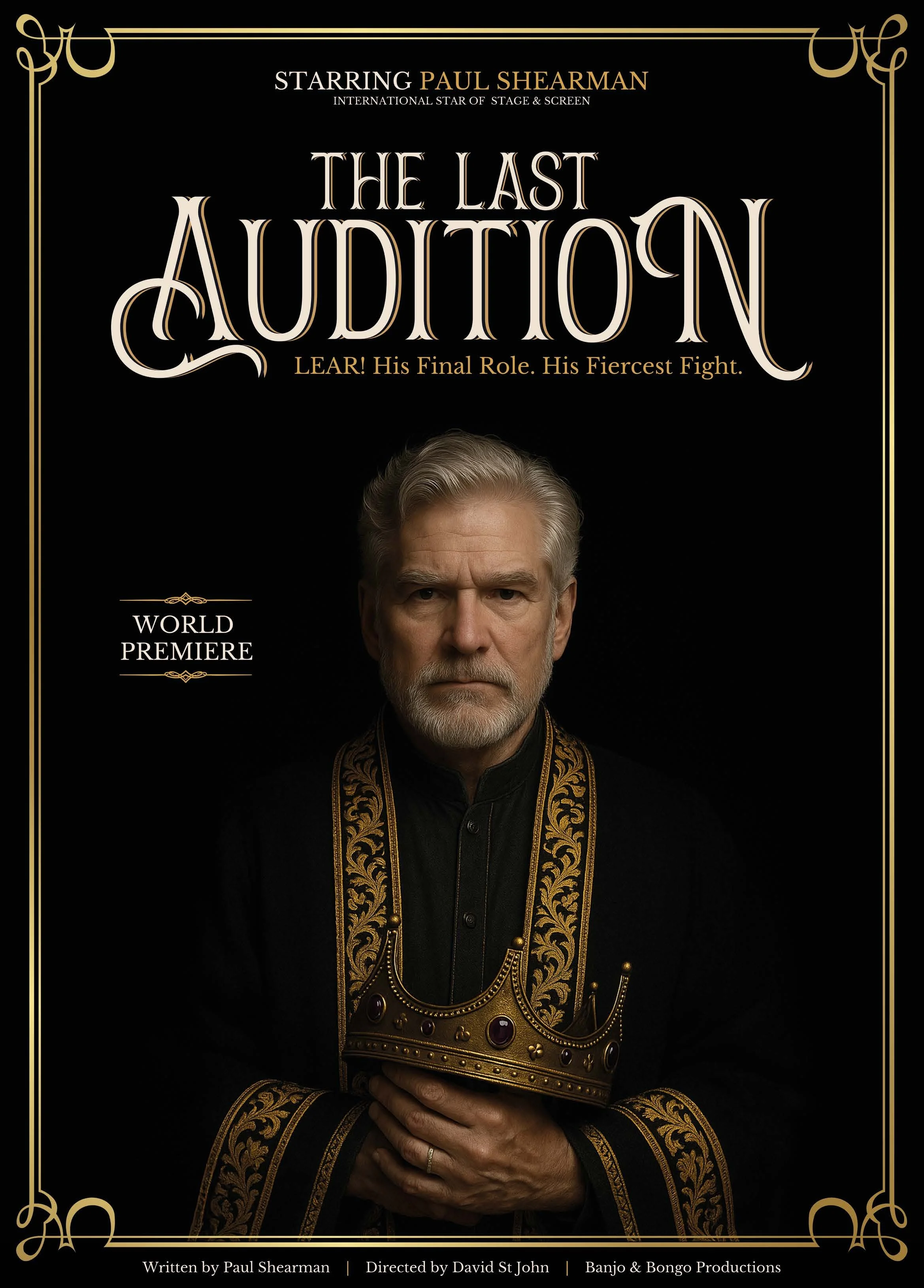
The Last Audition
O Patro Výš is not the easiest venue to locate. The signage is a narrow vertical panel mounted high above the entrance, and the door itself sits to the left of Billy Kun's, requiring a climb up a flight of stairs before you reach the event space. Once inside, the room is small enough that nobody ever feels far from the stage, even from the back tables. For my part I was very grateful to have a surface to write on.
What unfolds on that stage is a one-man performance by Paul Shearman, who also wrote the piece. He plays Sebastian Drake, an aging actor preparing what he intends to be the crowning achievement of his career: his King Lear. The play opens with Drake striding out under a ghost light, addressing Steve on the comms and warming up a voice he insists is still very much present, "just covered in dust."
Shearman draws the audience in with care, acknowledging the crowd early and reassuring them that participation will not be required. There are laughs in the opening, enough to settle you into the space, but this is not a comedy. The tone deepens steadily, and the play builds in layers toward a harder conversation about memory, ambition, and what it costs to refuse help.
Drake weaves Shakespeare into contemporary monologue with real fluency, turning the audition into a reckoning with the self that survives when the roles that once defined you begin to dissolve. His daughter calls throughout the performance, urging him to visit a care home with her the following day. He ignores her, again and again.
The production's technical choices are thoughtful and restrained. Sound direction integrates the phone and other ambient elements to extend the solitude of the stage rather than interrupt it. A disco ball lights up at an unexpected moment and lands in conversation with a line about Shakespeare needing only truth, not tricks or mirror balls. A crown on an empty chair hints at a loss so specific and so private that it feels almost intrusive to watch.
Shearman's performance cracks open in the final stretch. The bravado falls away, and for the first time Drake has nowhere left to hide. I attended with my mother and we both wound up teary-eyed. The standing ovation that followed was Shearman's first, and a thoroughly deserved one. Shearman then shares a vital message about dementia prevention that serves as a fitting coda.
The Last Audition has already travelled from China to Adelaide to New York, and will move on to Edinburgh following Montreal. Do not miss this one.
Buy Tickets

Murder On The Mission To Mars!
You walk through a café to get to Théâtre Sainte-Catherine, which already sets a good tone before you've even seen anything. The theatre itself is narrow and cool, a little crypt-like in the best possible way, and this afternoon, completely full.
The set is minimal but clever: two privacy screens, two stools, a water bottle, and a stack of signs that tell you where and when the action is taking place, "Aboard the Kepler Albatross Spaceship, June 2046," that kind of thing. There was also a program identifying each character, which as a reviewer I was particularly grateful for, given that David Jacobson plays all eight of them. Eight. One actor, 78 minutes, eight distinct characters, including Karmie the koala, who spends a good portion of the play floating in space chewing eucalyptus leaves.
The mic effects were great, the accents were great, and the character differentiation was genuinely impressive throughout, with the physical humour landing consistently on top of it all.
The premise is six elderly eccentrics aboard a Mars-bound spaceship, one of them murdered in a locked room, the rest of them suspects, with the mission sponsored by Kepler RV Industries, whose founder and CEO Rex has had, let's say, an eventful romantic history. Wives lost to a wood chipper, a geyser, piranhas, an active volcano. "You can still make your mark on this world by leaving it," he tells us cheerfully, which tracks, because as another line in the show nails it, "For billionaires, batshit is default mode."
Running through the whole thing is an AI that interrupts stressful moments with random fun facts, a bing bong preceding each one, which was consistently funnier than it had any right to be, and the sound design throughout was excellent, with the screens and pre-recordings used to great effect. There was a small mic issue at one point, but Jacobson handled it without breaking a sweat and frankly didn't need it anyway.
Without giving too much away, there is more than one murder and there is a brain transplant, and the reasons behind this particular mission are not entirely what they seem. But somewhere in the middle of all this gleeful chaos is a genuinely lovely idea: that the elderly were chosen for this mission because their experience made them the most qualified. "May you stay forever old" is the line that earns that premise, and it lands exactly as it should.
Buy Tickets

MORALITY BITES!
I arrived right as the temperature hit 31 degrees, a tough ask for someone who generally vetoes anything over 25, but this play was worth it. The venue is just up Henri-Julien, a few minutes from Mont Royal, and walking there meant cutting through the heat past the closed off street in full Friday night swing, that lovely feeling of being part of the creative fabric of the city for a few blocks.
The Studio Multimédia inside the Conservatoire de musique et d'art dramatique de Montréal is fully accessible, with rooftop gardens upstairs that looked like a nice spot to wait, but with the heat I took cover inside, where it was blessedly cool.
The production’s format is simple: a scenario is laid out, you get a couple of minutes to deliberate with the people around you, then the floor opens if you want to share with the room, with prompts to help things along. Due to Fringe constraints, the show ran with less discussion time than usual, and one of the team handed out snacks on the way out instead.
The first piece, Okay, Boomer by Ann Lambert, centres on a formal complaint filed against Dr. Joan Corbett (Laura Mitchell), a professor whose lecture on Angels in America keeps circling back through history: the AIDS crisis, Reagan, World War II. Her reasoning is blunt: how do you teach a generation with no use for history?
Across from her sits Morgan (Samantha Bitonti), an ombudsperson radiating the kind of self-possession that made me want to reach through the stage and shake her. Rounding out the trio is the long-suffering Ryan (Brian Dooley). What follows is a tug of war between generations, the older one insisting on being heard after decades of lived experience, the younger one frustrated by a curriculum that feels disconnected from their reality.
Underneath both positions is the same plea: "I have to matter."
The second piece, Secret Santa by Alice Abracen, is lighter in tone but no less weighty. Jamie (Samantha Bitonti, doing double duty) has been laid off, "sacrificed on the altar of mass capitalism" as she puts it, and is supported by her partner Casey (Ryan Bommarito), a lawyer. He buys her a small Christmas gift, and in the process discovers 50, no, FIFTY TWO, Amazon packages under the bed (her side, to be clear).
Casey understands the impulse behind what Jamie's doing even as he points out the legal reality of it, and by the end, the audience is left wondering whether he'll help her cause, or help her find a therapist.
Both plays come from writers of different generations, and that pairing gave the discussion segments real texture. My seating section had four of us roughly the same age, with a couple of "boomers" behind us eager to weigh in. Healthy debate like this is rare these days, and Ouest End deserves credit for creating a space where it happens naturally. I'd happily go back for the other mini plays in this series.
