
Arismita’s Reviews - FringeMTL 2026
We All Died At The Lesbian Bar
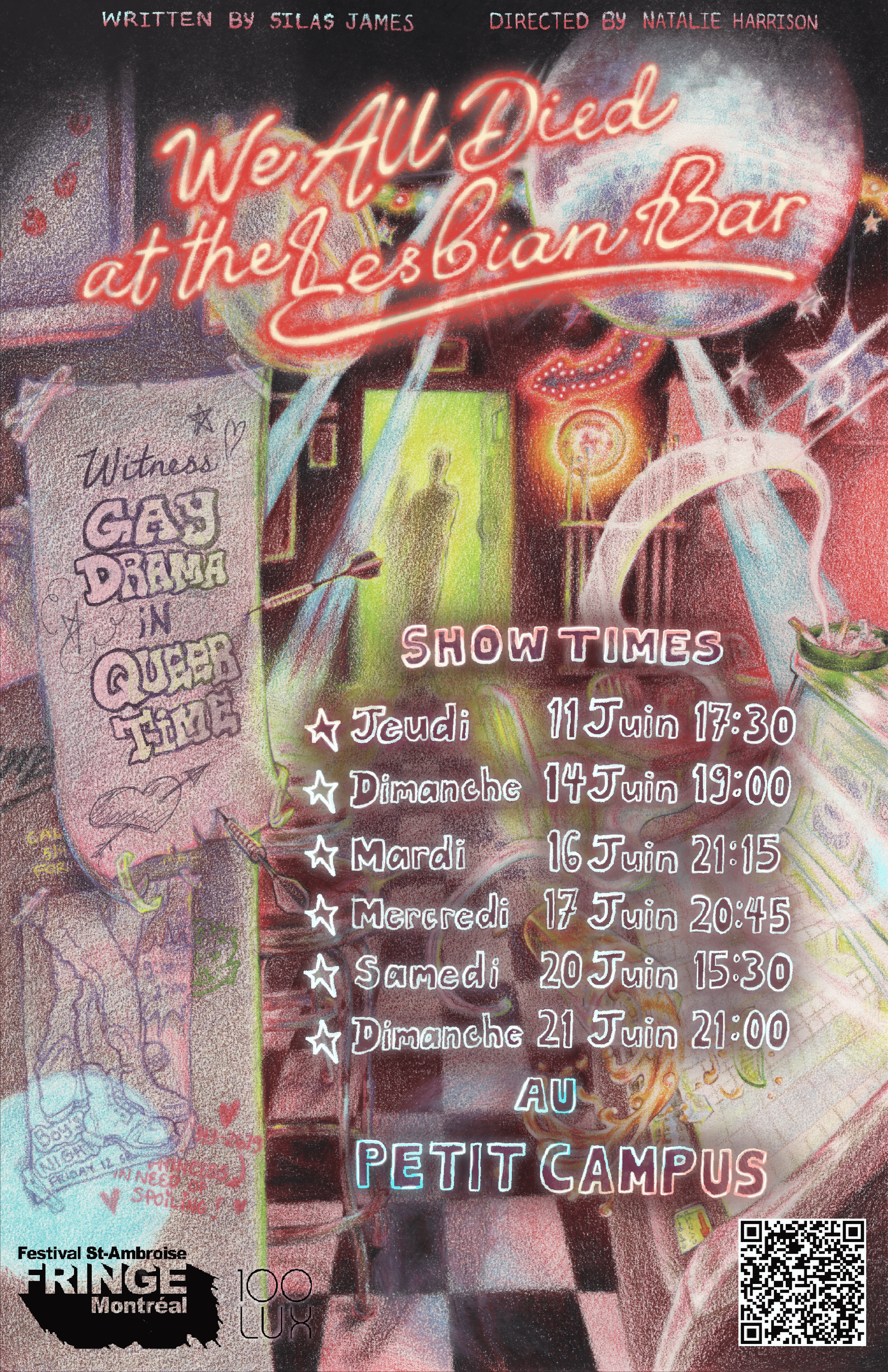
I hadn’t been to Cafe Campus in more than a year until I walked in to see perhaps my most anticipated play of the season: We All Died at the Lesbian Bar, which had me intrigued from the second I heard the title. After a lot of steep stairs, I headed into a room at Cafe Campus that I’d never been to before, Petit Campus, which already felt like I was stepping into a whole new bar. In many ways, I was.
The entire theatre was bustling as I tried to navigate my way around the cramped seats and tables, which only added to the illusion of arriving at a cozy lesbian bar. I reached fifteen minutes early and it was already pretty full; I’d say arrive as early as possible to get good seats. I got a proper look at the set—meticulously designed by Sofia Lopez-Asselin—when I sat down, and was immediately struck by how much thought had gone into making every detail come to life. Photos of what looked like bar regulars peeked out from behind the counter, colourful bottles and glasses lined the bartop, and the tiny jukebox in the corner added even more charm to the setup. It felt lived-in and real, and I was actually sad that I’d never be able to visit this place.
A few minutes before the show officially started, the actors—or, I should say, patrons of the bar—started filing in onstage to get their drinks and take their seats. It blurred the line between audience and actor from the very beginning, immersing us in the setting and making us feel like we were all part of the show. I could also hear the sounds of the actual bar behind me throughout the play, but I didn’t mind; it just made the setting all the more believable.
Victor’s, as the bar is named, is a tribute to all the gay bars we have in Montreal. (The name itself sounds like a play on Champs, just up the street.) The show features all the characters you would encounter at your local lesbian bar: Charles, the charming yet messy protagonist who knows everyone’s names and everyone’s drama; Simon, the tragic ex-boyfriend; Max, the insecure new boyfriend; the constantly on-again-off-again lesbian couple, two fabulous drag queens, and of course, the wise and grounded bartender at the centre of it all.
The actual story behind We All Died at the Lesbian Bar is hard to summarise. It’s about the relationship between Charles and his jilted ex, Simon, yes, but it’s also about control, truth, and performance. Playwright Silas James weaves in all these themes without any of them feeling out of place; they all come together masterfully under the blanket of queer relationships. The characters offer refreshing takes on tired topics, often talking directly to the audience. It’s all very meta.
The ensemble cast is definitely the play’s greatest highlight. There’s some stellar one-liners, delivered with just the right amount of emotion from Gabriel Gaston playing Charles. The chemistry between him and Sebastian Legault as Simon is palpable throughout the production—the two play off each other’s energy, pulling everyone in the audience into their world. Even the characters who are only on the stage for a few minutes leave a lasting impression: Spencer Dorsey as drag queen Antoine-Louis was one of my favourite performances of the night, and I kept wishing they would come back for another scene.
Another standout to me was the bartender, played by Emma Free. She is constantly in motion—picking up one glass and putting another down, wiping counters, pouring drinks—and yet she is the only one who remains completely tethered to the bar. She doesn’t move from her assigned spot behind the counter; all the action takes place around her. In a play with so many moving parts and such a large cast of characters, it’s important to have this touchstone to make everything feel consistent and well-connected.
At some points, the dialogue shoots itself in the foot a little by trying to be so open to interpretation that it becomes opaque. There are a few lines that might feel corny or almost embarrassingly vulnerable—but that in itself is a testament to embracing this sort of vulnerability that we’re usually too quick to shun. Throughout everything, We All Died at the Lesbian Bar remains unflinchingly earnest.
Where the writing shines strongest is in the show’s exploration of the characters’ psyches and interpersonal dynamics. I love the care with which each character is written. You never know who to root for, or if there even is a right person to “root for,” and the play subverts all the assumptions you might have already made about the characters. The most memorable character, of course, is the setting.
“All the best gay bars are like churches,” says Charles, and I can’t help but agree. Queer spaces feel increasingly like rare, sacred places of worship in today’s Montreal. Victor’s might not be a real place, but if you’re looking for a taste of that sweet queer community and want to lose yourself in someone else’s messy relationships for a night, then come on down to your new favourite (fictional) lesbian bar.
Buy Tickets
Are You Listening?
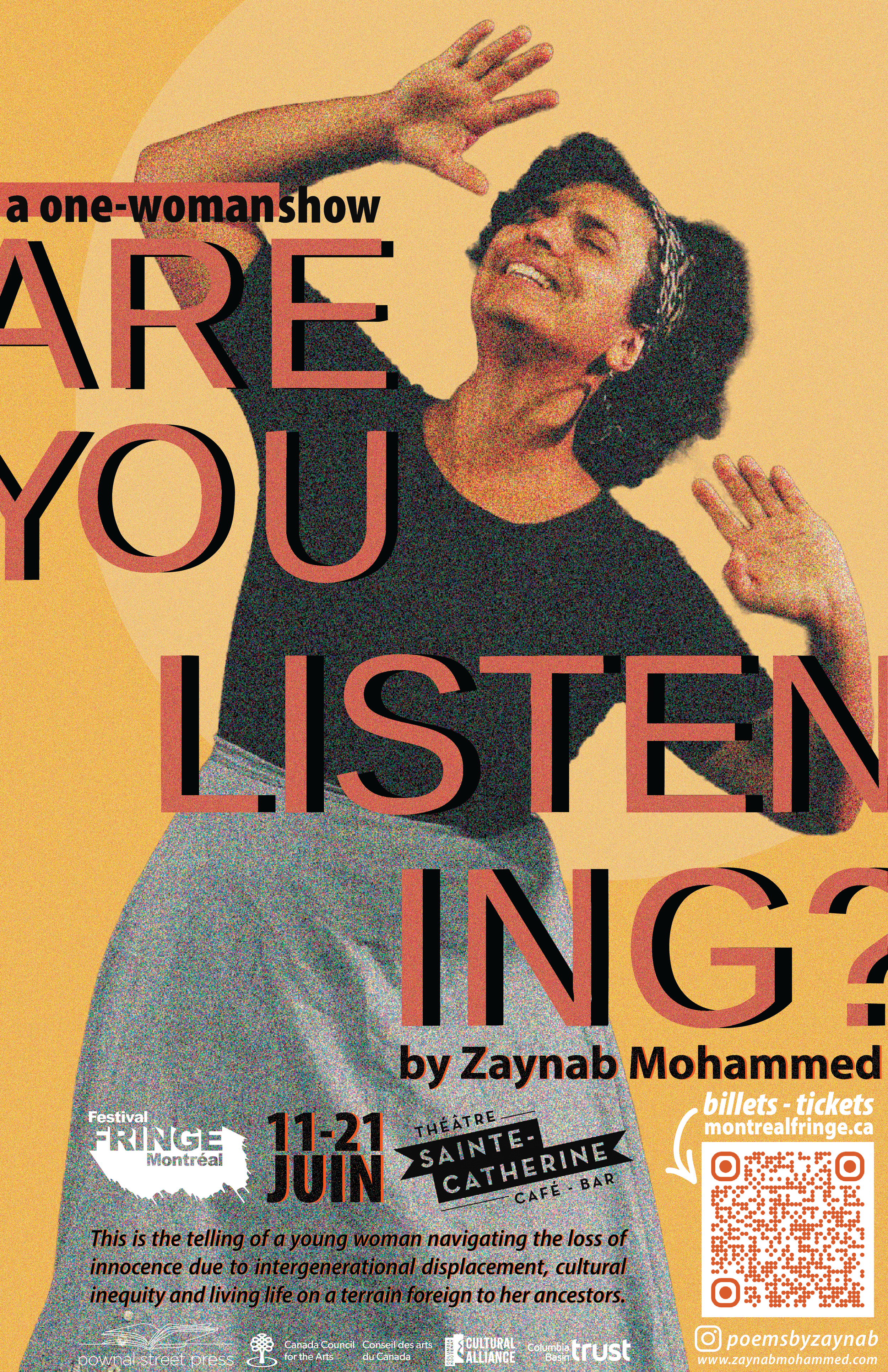
Soft Arabic music greeted me as I walked through the doors of Théâtre Sainte-Catherine for a late night showing of Zaynab Mohammed’s Are You Listening? I’ve been to the venue countless times before, but the quietness of the space paired with the familiar music added a sense of intimacy right from the beginning. I got there early, so I spent some time at the cafe-bar before heading into the theatre. The set itself was extremely minimal: just one rug and one barstool, an apt precursor to the one-woman show we were about to witness.
Zaynab did not greet us as she stepped forward onto the stage. She instead started with a prayer, kneeling and bowing her head in worship as if there was no one sitting in the seats at all. The microphone picked up the sounds of her deep breaths with every motion. It almost felt like I was holding my own breath in anticipation before she finally spoke.
Over the course of the next hour, Zaynab proceeded to tell us stories and poems in a voice that was equally as soothing as it was enchanting. I was utterly captivated. I don’t think I looked away from the stage during the entire 60 minutes.
She told us about her childhood, about her parents’ relationship, about her brother, about her anger, about growing up in Canada and Lebanon and connecting with her roots in Iraq and Palestine, and about every little thing in between that made her the woman she is today. Through it all, her voice remained steady and strong, even when speaking about things that would be enough to make anyone break.
The show experiments with lighting and sound as it shifts from section to section, appealing to our senses as we go on this journey. Zaynab’s movements are just as fluid and rhythmic as her spoken word; she glides across the stage with the practiced ease of someone who’s done this countless times. There’s nary a dead moment. Each word and each silence is meaningful, intentional.
Some elements might not be for every audience — her primary medium is storytelling, but it’s heavy on slam poetry. As someone who doesn’t usually seek out spoken word performances in this vein, I was surprised at how I hung onto her every word, even during the more abstract poetry sections. Her writing is in the vein of poets like Noor Hindi, brimming with rage and feeling and frustration that spills over the edge of the stage and into the hearts of the listeners.
I gave up on trying to take notes pretty early on during the show. All I wanted to do was lose myself in what she was saying, in making sure I internalised every word. There was point where Zaynab went off-script to speak about Palestine and the insufficiency of doing anything at all while a genocide plays out on our screens. Her whole show is built around being vulnerable, but this break from performance struck me as the most honest. She spoke directly and straight from the heart. It was the moment that brought genuine tears to my eyes.
By the end of the show, Zaynab was no longer telling a story to a faceless crowd. She was addressing everyone in the room. I was one of many sitting in the audience, but every time our eyes met across the stage, I felt like I was the only one she was speaking to. Are you listening?, she asked all of us, and I couldn’t help but nod. I am listening, I wanted to yell.
It was almost 12:00 AM when I stepped out of the theatre. My head was spinning with the weight of everything I had just heard and seen — it almost felt like I had been an active part of the show, not just a silent witness. Zaynab’s words stayed with me during my entire bus ride back, as I walked to my apartment, as I got ready for bed. Even now, while I’m writing this, her message weighs heavy on my heart.
I can say with certainty that Are You Listening? will stay with you, too. Don’t miss it.
Buy Tickets
Bald Republic
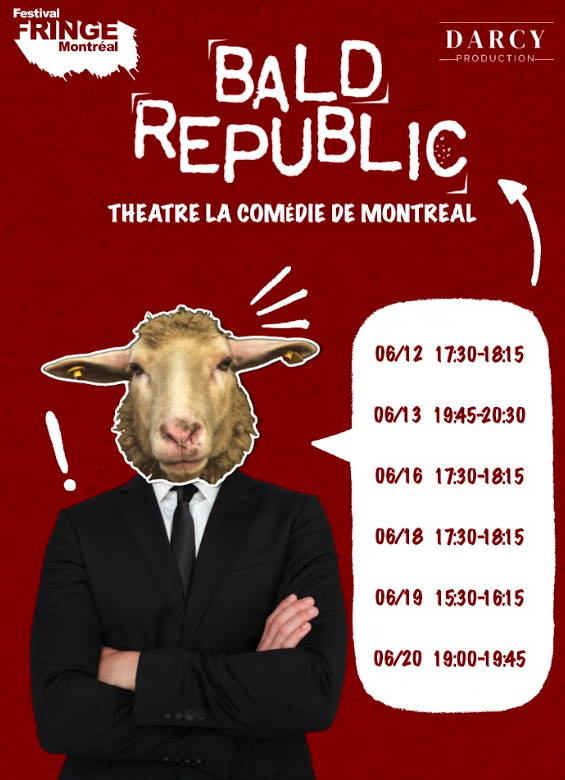
“Are you ready to be bald?!” was the first thing I heard someone say as I walked into The Montreal Comedy to see, you guessed it, Bald Republic. There were a few people handing out bald caps to those sitting in the front row, which made me smile as I took my own seat a few rows behind. The venue was decently packed for a Tuesday at 5:00 PM — the crowd was also especially energetic at this show, giving big reactions to whatever happened on stage, which made it all the more fun.
The set was pretty self-explanatory at first, with 4 podiums divided by red and blue lighting on either side, like any political debate set-up on television. The host sat at a table in the middle and kicked off the debate: immediately taking us on an absolutely wild 45-minute journey that I could not have predicted any second of.
In an interview, playwright and director Corrine D’Arcy describes her play as “Ionesco, but make it 2026.” I’m sure that if you’re familiar with this absurdist playwright—especially with his seminal work and the namesake for this one, The Bald Soprano—then Bald Republic definitely becomes more entertaining. While I didn’t have this particular context when I watched it for the first time, the play was no less engaging; if anything, I had more freedom to interpret it without any preconceived notions.
Bald Republic is nonsensical and absurdist in every single meaning of these words. Don’t go in expecting to follow everything that is happening; the play is not interested in feeding you a narrative, a plot, and digestible characters. What’s important is the visceral reactions that it pulls out of you. There were several points where the entire audience was gasping and laughing in unison, and managing to get those reactions out of so many people is the play’s greatest strength.
The cast is a talented group of people. All five actors delivered what were probably some of the strongest performances I’ve seen at this year’s Fringe. Everyone had stellar line delivery and comedic timing, fully embodying each character until I was ready to believe that I was, in fact, witnessing some crazy politicians absolutely have at it with each other. Sébastien Cimpaye was especially unforgettable as Dennis, from start to finish, bringing an almost eerie, unsettling energy to his political persona. The Host, played by Olivier Blais, also stood out with a masterfully delivered monologue that’s still fresh in my mind.
The actors’ physical humour was executed with excellence, overaggerated without being overbearing. I specifically have to praise the blocking and choreography: without giving too much away, there’s an extended moment where everyone on stage moves in slow motion, and it’s freakishly believable. I could tell that the director had an extremely clear vision and it paid off.
The strong acting also buoys what is already quite witty writing. It’s not what the characters are saying that is important; it’s how they’re saying it and who is saying it. Language serves as a medium, not a message. The dialogue itself is peppered with cliche phrases from modern politics: “Let me be very clear”, “I want to tackle the real issues”, and “This is how it all begins”. But as the play progresses forward, you see that much like modern politics, none of these debaters give two shits about what they’re saying — they’re all just interested in speaking the loudest and the longest.
You also see how easily control can slip away, and how language can become completely obsolete in the face of these epic power struggles. The shocking, high stakes climax at the end of the play is exactly what Bald Republic needed for all of its commentary to come to a head. It hits harder than a punch to the face.
As the lights turned back on, I heard people whispering, “what the fuck was that?” to each other more than once — let that be a testament as to why you should come watch Bald Republic. You’ll be confused, you’ll be jarred, and you’ll be left feeling like you’re going crazy. But you definitely won’t be forgetting it any time soon.
Buy Tickets
The Debate
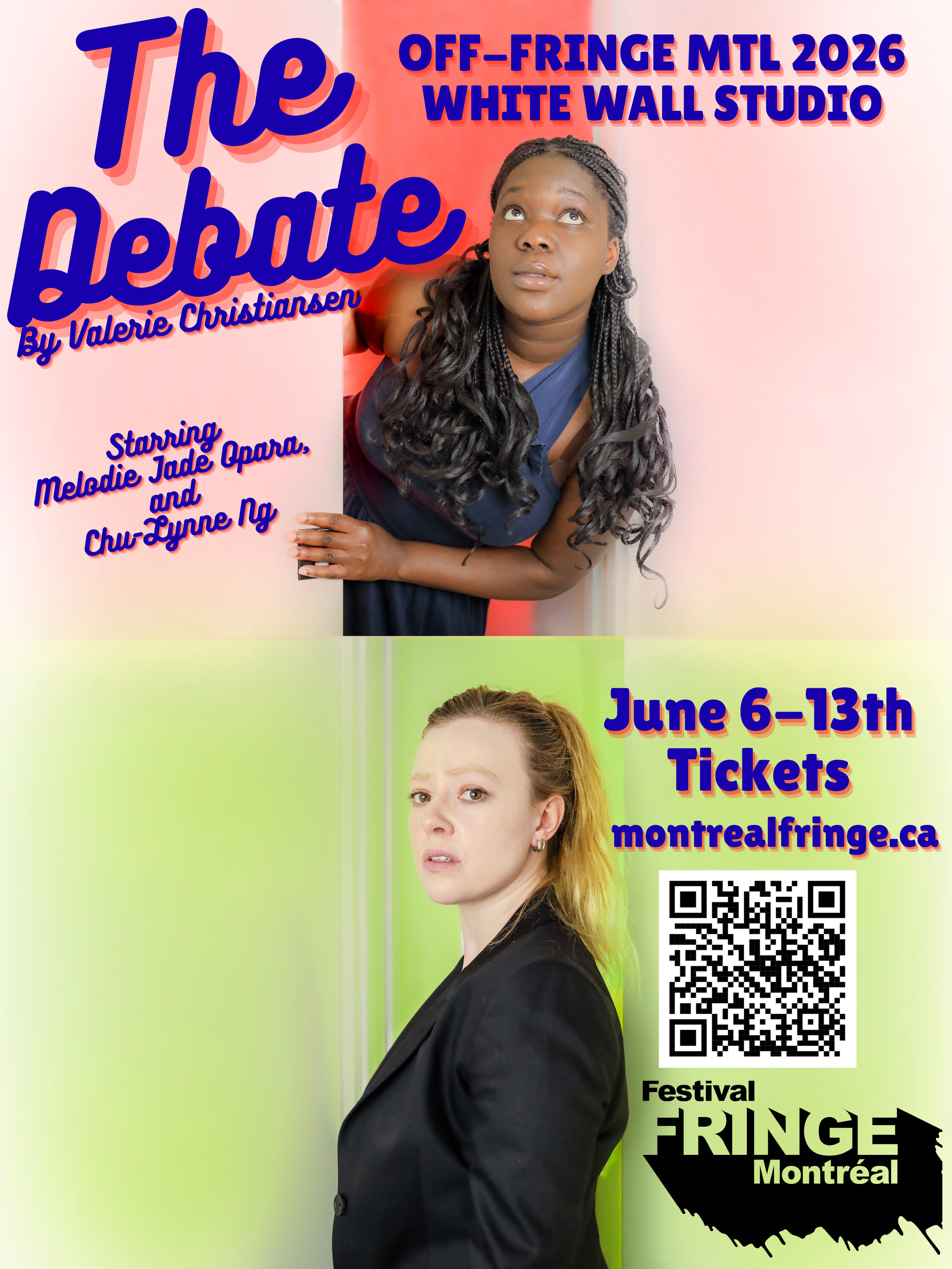
White Wall Studio lives up to its name — the eponymous stark white walls were the first thing I noticed when I walked up the stairs to see Valerie Christiansen’s The Debate, which only made the set’s bright red-and-blue colouring pop out more. We were asked to take off our shoes before taking a seat, with the actors greeting us at the door to offer everyone shoe covers from red and blue buckets respectively. Even the seating was divided into groups of red vs. blue, all of which combined made me feel like I’d already picked a side in this debate before the play started.
The show began not with a word from our debaters, but from the moderator, played by Chu-Lynne Ng joining us in the form of a pre-recorded video projected onto the screen. The actors then took to the stage almost abruptly, dropping the audience into the world of this political debate as if we were already familiar with its context. And in many ways, we were.
It’s hard to miss the symbolism of a red candidate vs. a blue candidate when it’s about as subtle as a freight train, though The Debate did not play into the cliches that one would assume. It instead forced us to cast away these assumptions and pay attention to what each candidate was actually saying, rather than focus on the colour of their clothes. While largely skewing towards the absurd, the debate topics that drew the most laughs from the audience were those that we could recognise from our political reality — such as arguing about painkillers, or women in power.
While the writing had its standout moments, there were a few times where the dialogue strayed away from the point it was trying to make, distracting from, rather than adding to, the performance. The intentional vagueness of the writing was a double-edged sword: while it was open-ended enough to relate to multiple real-life contexts, it also prevented the play from saying anything of true substance.
What stood out to me more than anything was the chemistry between both actors, and how they were able to play off each other using strong physical comedy. Melodie Jade Opara brought an almost eerily commanding presence to the role of Candidate 1, while Valerie Christiansen embodied the Fake Politician Persona to a T as Candidate 2. The quieter moments between them, where they both forgot their public facades for a brief second and reached out to each other as friends (or more), were my favourites.
Some of the technical decisions struck me as odd choices — for starters, the control deck was placed right next to the front of the set, which distracted me several times during the show as I found myself wondering what the tech was doing instead. The sound effects, while helpful in creating the immersive debate room atmosphere, were at times too loud and drowned out the dialogue from the actors. Some of the transitions felt a little clunky or mistimed, but I’m sure that these hiccups will be smoothed out as the show continues its run this Fringe season.
If you’re interested in watching The Debate, I’d tell you to come for the promise of absurdist comedy and stay for the will-they-won’t-they relationship between the two politicians. It’s sure to get a few laughs out of you, and you might end up surprised by what you discover.
