
Andrew’s Reviews - FringeMTL 2026
1-MAN NO-SHOW
I’m just going to say it: St. Ambroise Gluten-Free Blonde Beer tastes like shit. I’ve been to Petit Campus a lot this festival, and it’s the most convenient thing to drink (they’re not known for their cocktails), but goddamn it’s terrible. I don’t care what any sponsored shill tells you.
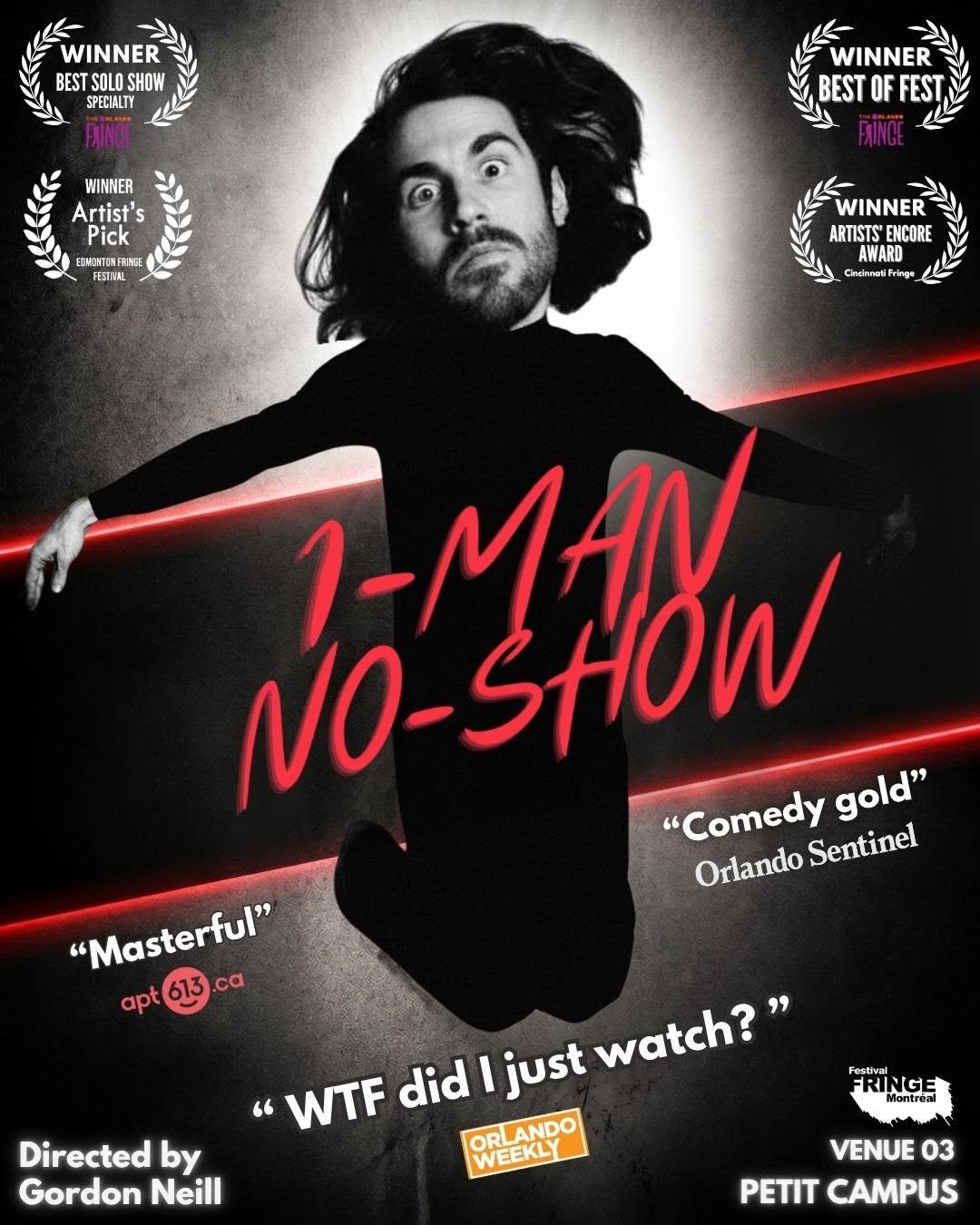
I’m at this venue again for 1-MAN NO-SHOW, the, well, one-man show… sort of… from LA-based performer Isaac Kessler. This production has no description on the FringeMTL website, but a hell of a lot of reviews. Rave reviews, really, but reviews that certainly help set the tone. A quick glance at his website, and I discover he’s not only a comedian, but also a clown. Oh.
As I find my seat and get comfortable, Kessler is on, and off stage, moving about the room, engaging with audience members, guiding people to their seats, spreading his chaotic energy throughout the space like a cat spraying territory. He’s wearing a headset mic, attached to a speaker around his neck, the sound is terrible, and already I’m amused. By the time the show starts, he knows at least one audience member by name, and has made it clear to the audience that they are free to speak (and leave, they’re not hostages) throughout the piece.
Then he begins.
Or has it begun? I don’t even know, that’s how high this art is. Or I am. Am I?
I notice the clock, a large digital clock, upstage, counting down the hour, which has already started the process by the time I realize. And we’re already late, apparently. So we’re told.
I’m immediately drawn to a signature of Kessler’s comedy, the contradiction. In my own art (and my personal life, to the dismay of some) I try to embrace as many contradictions as possible, at once. I’m a Metamodernist, blah blah blah. Kessler moves this into a new dimension by communicating them in real-time, constantly contradicting himself. Move faster, but take your time. Feel free to speak, but please shut the fuck up. This is, at the core, the hilarity of Kessler’s work as an artist. 1-MAN NO-SHOW, if it isn’t blatantly indicated by the name, is a total embrace of contradiction.
At moments, with my brain attempting to search for an overarching narrative, I feel as though we, the audience, are attending a very pretentious theatre director’s seminar. An air of superiority, arrogance, even, is at Kessler’s whim, which he wears and discards, as one would a costume cape (or a beret). All this to say, it really seems, at times, as though he is trying to teach us something.
And then, there are the other times. The other times when Kessler is demonstrating his command of comedy by simply delivering a series of bits, one after the other, layered on top of each other, called back to, folded in on, beaten like a dead horse. He doesn’t give you a moment to pause, to process. He doesn’t give you a moment to breathe. I can’t stop laughing. In fact, truth be told, he has me only minutes into the piece, with a terrible “theatre in the round” joke. I’m caught as the only one in the packed crowd laughing. I mean, I cackle.
1-MAN NO-SHOW is quite a dangerous endeavour taken by Kessler. Sure, there are improv shows that necessitate audience participation, and that can always shift the trajectory of a scene in an unexpected way. But as I mentioned earlier, Kessler’s diffusing of his chaotic energy throughout the space, his pushing, nearly taunting the crowd into vocal reactions, sometimes bordering on heckling, all while confounding the shit out of them, that could totally derail a show. It is Kessler’s established contradictory nature that creates the gentle but firm guardrails that prevent his production from being hijacked, and that’s fucking brilliant. To give the audience that much agency, but retain control, it’s the work of an expert.
The man of 1-MAN NO-SHOW, Isaac Kessler, is immensely talented. From his non-stop blocking and choreography, to his crowd work and costume changes, he, along with director Gordon Neill (special acknowledgement goes to choreographer Oscar Wilde, and designer Friedrich Nietzsche) have created a Fringe spectacle that has been delighting and confusing audiences, and surely will continue to do so. I’d suggest catching this while it's still in Montreal. We don’t get much like this around here.
Buy Tickets

Sore Loser
Theatre Sainte-Catherine is a twenty minute walk from my apartment in the Plateau. I make it in twelve. Grabbing an iced coffee and my usual spot in the back, I notice two of the actors are already onstage, sitting in comfortable, but functional chairs, angled away from each other, facing laptop screens. The light is dim.
This is Sore Loser, a story about a father and a son. A story about a father who suffers from mental health issues, and struggles to provide, to be a positive role model for his son. A story about a son who resents his father, is ashamed of him. A story about a brother and a sister struggling to care for a parent, each in their own way. A story about… I shouldn’t get carried away before the story does.
The lights go up on the two actors onstage, and their conversation begins. It becomes evident that this is a therapy session. Lev (the son), with some prompting, expresses his frustrations with his father, saying something along the lines of wishing him dead. (That’s not actually what he says, but you’re going to have to just go with it.) The lights shift. While the actors have, until now, only addressed each other through their screens, the therapist turns to look at Lev, speaking to him directly. This is where the story gets carried away.
The therapist, it turns out, is some sort of demon, a judge. Hell, in this situation, he’s The Judge. He’s accompanied by two suit-clad weirdos, which following the theme must be either lawyers or jurors? Also demons. I’m pretty sure they’re demons. And Lev, well, Lev is on trial for patricide. It hasn’t happened yet, but he wished it would, and that’s just as bad, if not worse, in this realm. The trouble is, it’s not really clear where we are, or who anyone is.
Through a series of disorganized flashbacks a story is told, first from Lev’s perspective, then his father’s, and even briefly his sister’s. The intention of the writing is clearly to demonstrate the privilege of our main character, and the pain felt, and the sadness held quietly, by the members of his family. As the play progresses, though, it becomes apparent that neither father nor son have any redeemable qualities, and this is really just a story about shitty people treating each other poorly.
Look, I didn’t like the play. Specifically, I didn’t like the writing. The script itself needs A LOT of work. But what was presented on stage, that’s different. It was fun, in spite of the text. The actors, a small group of five, with two playing multiple roles, are having a great time. While the story doesn’t make the most sense, they’re telling it to the best of their abilities, and having a good time while doing it. This is a testament to the creative team, undoubtedly, as the fun on stage is certainly carried over from the rehearsal process. They did the best they could with what they had, which is pretty damn good. Battling the droning (but so fucking necessary) AC, all five actors gave 100% onstage, to their characters, to the audience, and that, to me, is at the heart of every good Fringe show.
Don’t see Sore Loser with an expectation of a Pulitzer-winning script. Instead, see Sore Loser with an expectation of a wild story, and an energetic group of actors having a good time. If you do, you won’t be disappointed.
Buy Tickets
Tall Mark’s EAT IT ANYWAY
While slightly outside the main cluster of venues, Théâtre Sainte Catherine is a welcome respite from this heat. But if the promise of a dark theatre with air conditioning isn’t enough, let me tell you about Tall Mark.
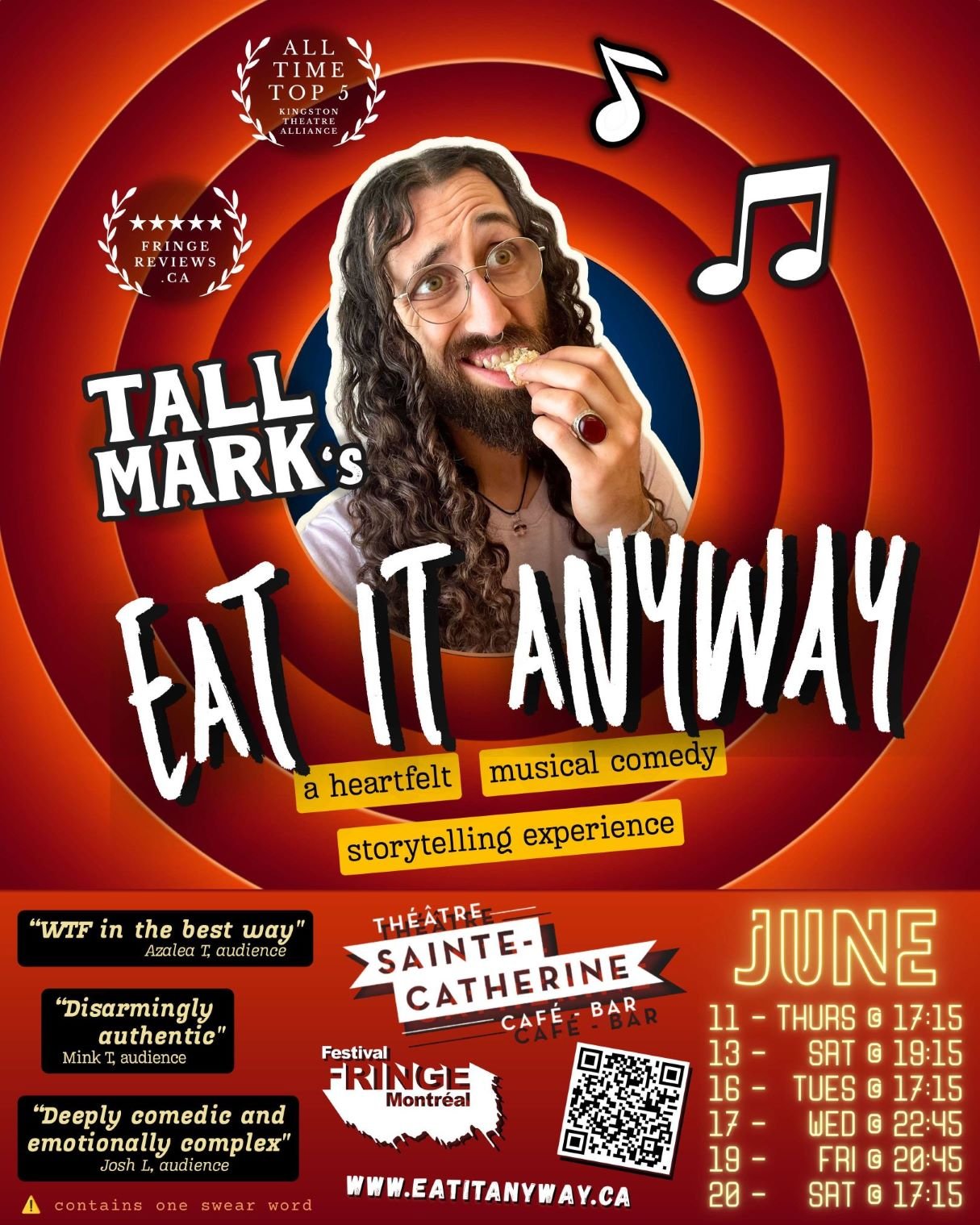
The staging is simple: a stand holds an acoustic guitar, a ukulele, and… is that a bass ukulele? Yes, it most certainly is. On a stool sits a large black case with the words TALL MARK emblazoned on the surface in white letters. That’s it, but that’s all this show needs. EAT IT ANYWAY is a musical comedy, a storytelling show, and the definition of “feel-good”.
Clad in a purple three-piece suit, a headband, and shoeless (hippies, man), Mark opens the show with the title song, “Eat It Anyway”, a fun bop about not wasting food. I mean, in this economy, right? Once he’s set the tone, he addresses the audience, encouraging their energy and participation, both cheers and jeers, which he immediately puts to the test by jumping into a song about pineapple on pizza.
While EAT IT ANYWAY is filled with absurd(ly well written) songs about princesses, pills, hot dogs, and moose, Tall Mark takes us on a journey across the country, telling us a story. His story. It’s a story about chronic illness and pain, about wandering, travelling, friends, and food. “I’ve come a long way from being bedridden to doing this show, and I only sit down for one song,” he tells us, and we’re so fucking happy for him. We’re happy for him because Tall Mark isn’t just a performer on a stage. He sets out to be your friend, and he’s really hard to resist. That’s his charm, and no doubt the reason he’s able to generate so much audience participation with so little effort. Hell, even I was singing along, and that’s really not my thing.
As with Fringe festivals all over the world, the technical situation of any given production is always a gamble. TSC has a great setup, but there were multiple opening night technical hiccups. While the audio levels could have benefitted from some adjustment, it was the lighting that struggled to stay on task, often changing in the middle of the song or, at one point, going out entirely. These issues will no doubt be fixed by the time you read this, though. The only reason I mention it is to applaud Tall Mark’s composure and showmanship when the blackout hit: he asked for the lights to return, cracked a joke, and encouraged the audience to give the technician a round of applause.
The 60-minute run-time flew by, and as the show began drawing to an end, Tall Mark once again had the audience join him in the chorus of a song. While not the closing song, nor the final callback to the title, it was no doubt the song the audience left with in their heads, and in their hearts, and perhaps the most important message in Tall Mark’s EAT IT ANYWAY:
Be kind, or everyone will hate you.
Be kind, or you will die alone.
Buy Tickets
The Runaround: The Journey of Abel the Amish Misfit
O Patro Výš is one of my favorite Fringe venues, despite its inaccessibility. The room is intimate with decent acoustics, it’s well-lit on the small stage, and there is table space to write. The sun is shining today, so I scurry up the side streets, in the shade, til I reach the venue, grabbing a high-top toward the back. The crowd is sparse, but it’s 2:30PM on a beautiful Saturday in Montreal, so it’s important to be realistic.
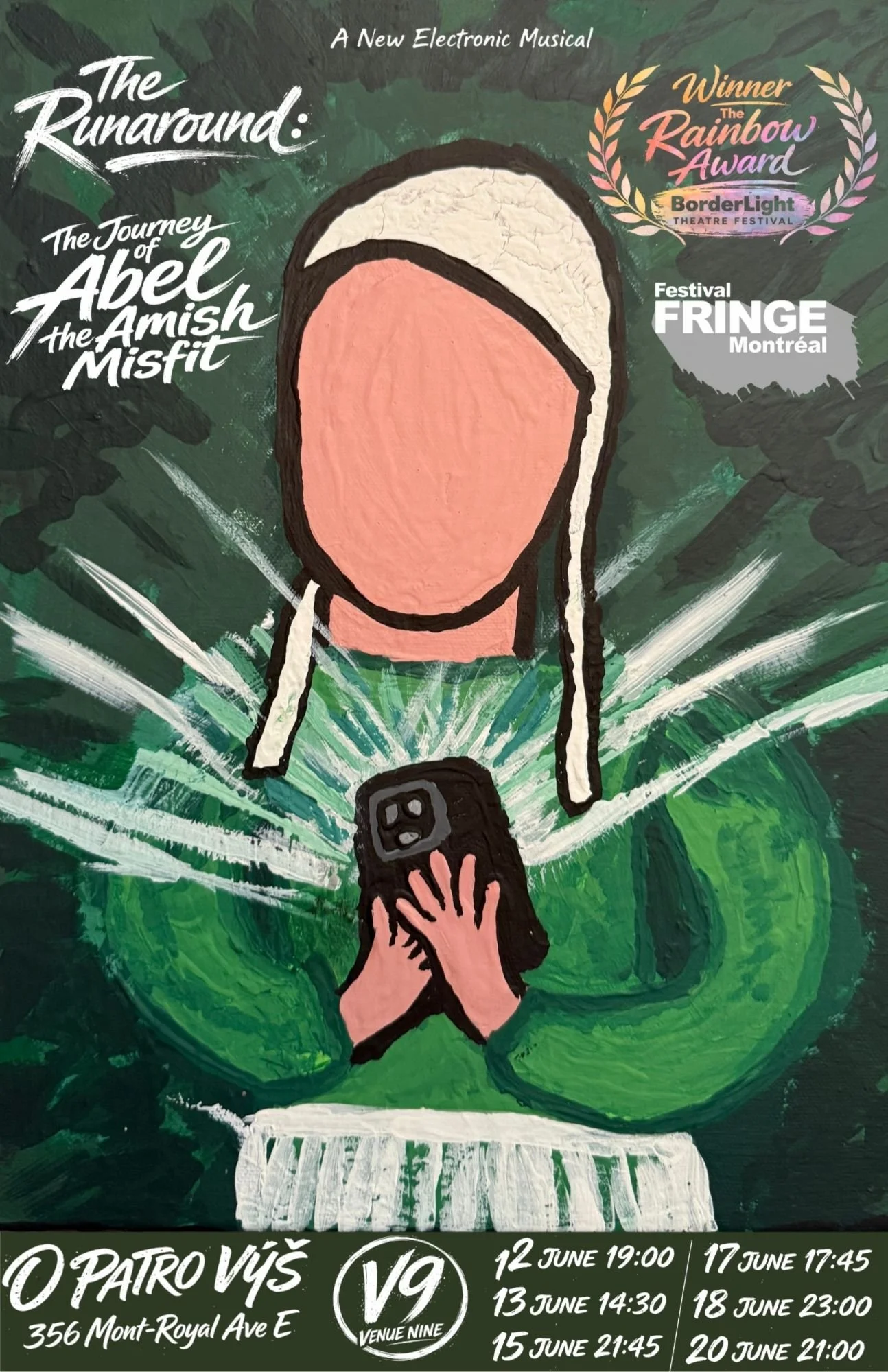
Creatively, I’m a believer in “not about us without us”, so while I was excited to see a one-man electronic musical at Fringe, I paused at the story: Abel is a young amish boy, very secretly queer, who gets his hands on a phone, and starts broadcasting his simple, but oh-so complicated life to the outside world. As he struggles with the rules and responsibilities in a community that rejects who he truly is, he finds friends elsewhere, through a screen, who enjoy his updates. He shares his world with everyone, the cows, the chickens, the sunrise, the barnraisings, the #AmishDefinitionOfTheDay, and a bit of cross-dressing. That last part he does in his sister’s dress, in the hay loft in the barn. His followers grow and grow, and he’s given so much love and support, exactly what a repressed queer in a difficult situation needs. But this also attracts some real negative attention, as the internet does.
And if you’ve ever been a cute young guy on the internet, you know there are a lot of fucking perverts and weirdos out there.
I mean, if you’ve ever been cute and young on the internet, you know there are a lot of fucking perverts and weirdos out there.
Honestly, there are a lot of fucking perverts and weirdos out there.
Anyway, one of these perverts and weirdos comes to their community, with his manifesto, and shoots up their schoolhouse. He’s forgiven, but Abel is shunned. It’s the Amish way. Except, not at all about the Amish experience, really just a plot device. (And yes, for those who are really into true crime, this is a fucking wild reference to the West Nickel Mines School shooting in 2006.) Our dear Abel is then forced out into the real world, where he finds that identity is still heavily policed, and people really aren’t as nice as they seem. But, fuck, he’s optimistic.
Aside from my objections to a people being used as a caricature, what makes this twisting narrative truly stand out is that this is, as I said, a one-man electronic musical. Onstage down centre are two black theatre blocks stacked, holding an iPad, and (what I realized late into the show is) a suitcase holding a drum machine. Finishing the scene is a mic on a stand, and this is where Stewart Alden Tabler tells us the story for the majority of the time. His songs are backed by thumping percussion and precision beats, sung with the voice of a fucking angel, as he loops himself, distorts his vocals, and creates sonic atmospheres that fill the room. Tabler’s pacing, and ability to use live sound effects to add to his narrative, ensures the story keeps moving, keeps you listening, wrapped up. In a genuine demonstration of stage skill on the part of the actor, I truly cared about what would happen to Abel, and that really matters.
This show isn’t about the Amish, don’t be fooled by the advertisement. This show isn’t about an Amish kid being exposed to the outside world, either. This is a gorgeous electronic musical production performed by Stewart Alden Tabler about a queer kid who started life in an Amish community with a strange fucking link to some true crime. What I’m saying is, this is absolutely worth your time. Go for the story, stay for the bops.
Life is poppin’, y’all.
Buy Tickets
One Too Many…
No, that’s not an alleyway, that’s Laval. Yes, there should really be a street sign. Follow the rugged terrain up the block (I swear it’s not an alley), and you’ll find the door for White Wall Studio across from Emile-Nelligan Park.
When I arrive, a group of people are doing Tai Chi in the grass as Fringe goers are instructed to remove their shoes inside, and are offered plastic shoe coverings as an alternative. White Wall Studio is an expansive space, one that feels bigger on the inside, up a single flight of stairs. A dance studio with, you guessed it, white walls, and towering ceilings.
The set is simple, functional, and no doubt cost-effective. An easel stands upstage, paint waiting beside, with multiple cardboard boxes taped together into various geometric shapes, and a small box as the only other set piece. Being a non-traditional theatre venue, White Wall Studio isn’t equipped with stage lighting, but the daylight pours through the windows into the space, and attending the 6PM show, that was all that was necessary. I’m definitely curious, though, how the production is lit at night.
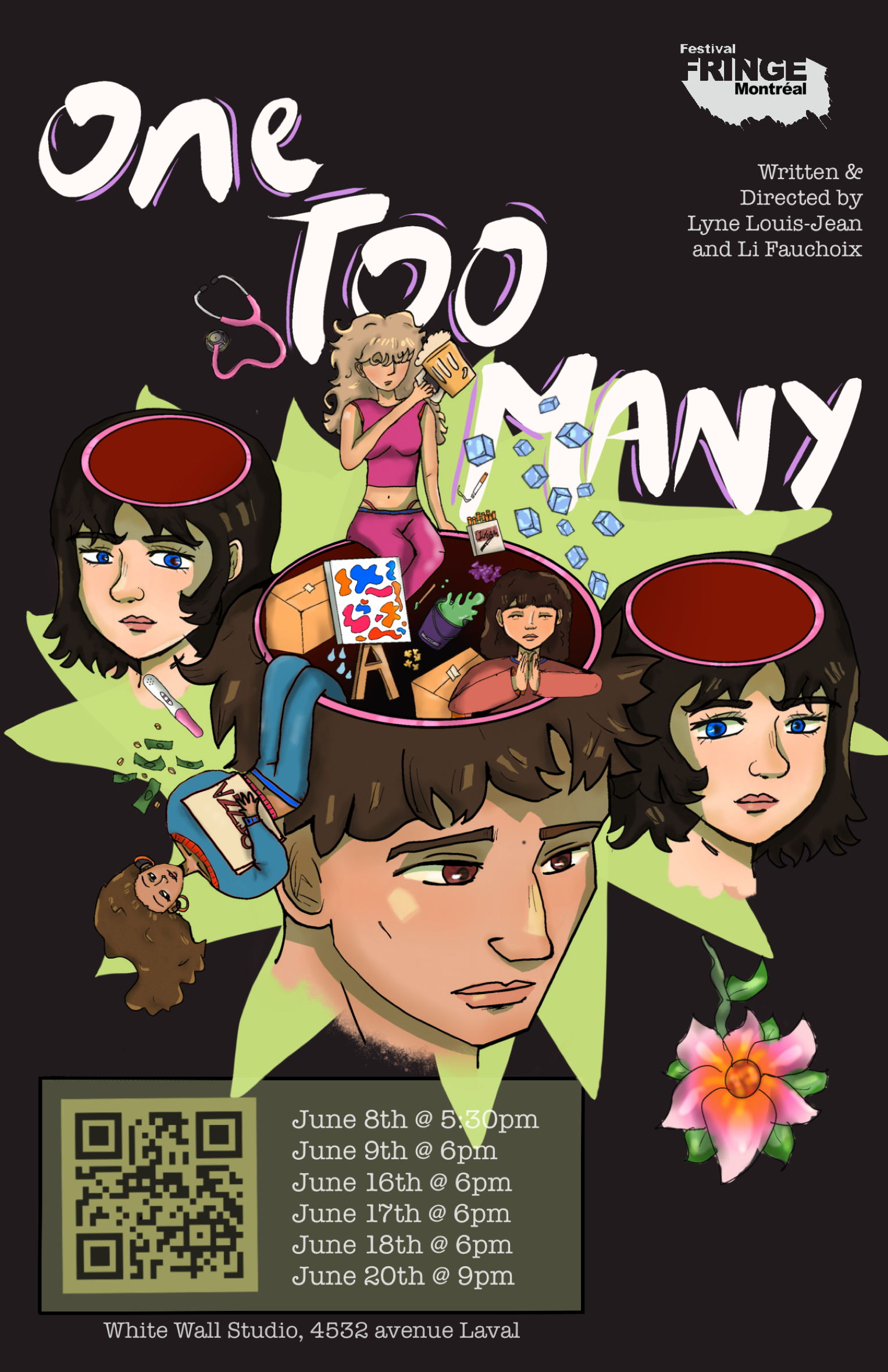
LLOTS Productions is an ambitious new local company focused on artist-driven work in cinema and theatre. With their first production, One Too Many…, founders Lyne Louis-Jean and Li Fauchoix have written a sitcom-style semi-farce with plenty of laughs, and LLOTS of heart (see what I did there?). Anna (Naomi Wark) and her fiancé Jake (Tyler Dezso) have just moved into a new house, and Jake makes it known that he wants to have a baby. Anna does not. She very much does not. They fight, and she kicks him out, setting off a chain of events that leads to broken friendships, broken hearts, and three pregnancies. The cast is appropriately small, limited to five talented actors. The remaining three characters, Sandy (Sana Buchanan Hutchinson), KC (Noriane Girard), and Vanessa (Lydia Larabée), each somehow connected to Anna, encounter Jake as he spirals.
It’s clearly a talented and well-trained group, and the majority of the 40 minutes had the audience fully engaged. The pacing never waned, and the physical comedy was on point. However, the directors have a tendency to position characters to face out, to deliver their lines staring just over the audience, at the horizon. This is okay for an aside, common for a monologue, but often this happens in the middle of a scene, with two characters in dialogue. This creates a disconnect, as the character still in the scene mostly disengages, as though they’re suddenly alone. It was used appropriately at times, yes, but the overuse was unfortunately the only real thorn in the side of this production.
I did find it curious, and sometimes distracting, that outside of the walls of an institution, away from theatre school (where often you’re assigned a role outside your type) the writers chose to position the characters as older than the actors themselves. It’s independent theatre, you’re free, so it baffled me why these early 20-something actors were playing roles with seemingly established careers, like a cop, a doctor, or a small business owner. This piece could have easily worked in a college setting, or something placed just after.
That being said, One Too Many… is a quintessential Fringe production. The performances are high energy, keeping the audience watching, listening, reacting, throughout. The set, rounded out by simple velcro and chalkboard signs to establish location, is changed repeatedly and quickly by the actors, and the hard-working Stage Manager (Eleftheria Lazaridis, who is also the costume designer). The audio cues are spot-on, completing the picture in each scene. The play, with a clever script and an explosive ending, is a triumphant first outing for LLOTS Productions, and a must-see in this year’s festival.
Buy Tickets
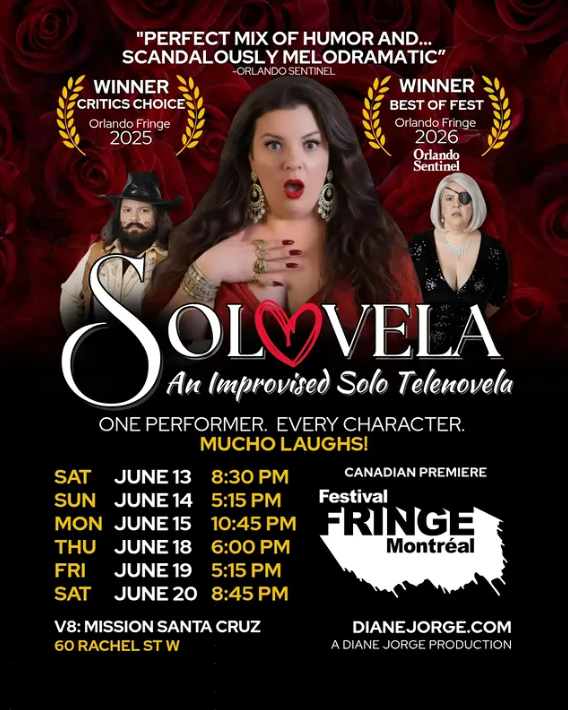
Solovela, An Improvised Solo Telenovela
Walking into the basement of Mission Santa Cruz is unlike any other time I’ve entered that space for a Fringe show. First, it's full. Second, the crowd is fucking jazzed. Nothing on the black-on-black temporary stage but an overstuffed rolling set of drawers and three chairs. Music plays quietly in the background. It’s 5:15PM on a rainy Sunday, but everyone is talking away, to the friends they came with, to strangers, it’s like I missed the first round of margaritas. Welcome to Solovela.
And then here she is.
Holy shit, it’s Diane Jorge.
Running, I’m not kidding, running out of the room at the end of the space, across the stage, to the other side of the room and back, waving at the audience as they cheer loudly, Diane Jorge settles in the center of the stage and greets us. This is her second show ever in Canada, and she’s embarking on quite a Canadian Fringe tour.
I don’t claim to know much about the telenovela format, but I’ve picked up a few things here and there. Though during the opening monologue, it becomes clear that I don’t need to have studied to understand what we’re about to witness. Diane quickly chooses two audience members, a husband and wife (with their twin 13 year-old daughters in the audience) to come on stage. They sit and talk, simple as that, for twenty minutes. Now don’t be fooled, this isn’t the boring part. There is no boring part. Diane Jorge ensures that you are laughing, or at least entertained, from start to finish.
What Diane has created with Solovela is a brilliant improvisational one-woman show with a very simple premise: each performance, she creates a live, improvised, telenovela episode based on the life of one audience member (or in this case, a couple). During the interview, while making us laugh, Diane is carefully mining all the important information necessary for what comes next.
Once the couple returns to their seats, we begin.
Today, we’re being treated to an episode of Carnevale di Amore, and Diane encourages the audience to chant “Carnival of Love” every time they hear the title. I do it without thinking, this whole experience is just magical.
Over the next half hour, Diane then burns countless calories as she runs around the stage playing an unlimited number of characters, each with distinct costume pieces (all of which she pulls from the overstuffed rolling set of drawers I mentioned earlier). Tonight we’re blessed with a boa, a feather fan, glasses, a bald cap, and the villain is wearing an eye patch. I can understand that this sounds chaotic, and it is, yes. However, I cannot stress enough how impressed I am by the time and patience Diane takes to ensure that every joke is heard, every joke lands, and that information is presented clearly. She’s not just telling jokes, she’s telling a story. So while it’s very funny to watch her pulling on and off a bald cap and glasses, switching standing positions between characters, it’s remarkable to watch a performer take her time doing this, to play the whole joke, not just the visual gag.
A special mention must be made for the sound technician involved in Solovela, artist Matti McLean. This is a high-energy, fast-paced, improvised show, and I was blown away not only by the Matti’s ability to pay such close attention to Diane on stage, but to both anticipate, as well as listen and react, to the story she was telling on stage, not having any fucking clue what she was about to do. No, not every cue was in the perfect place, but every one was perfect.
Solovela is easily one of the funniest, and most creatively challenging productions in the festival this year. Diane Jorge’s show is a masterclass in improvised storytelling, and Canada is incredibly lucky to have her this summer. If you’re looking for a production that’s going to give you belly laughs, this is it. And as a bonus, you’ll get to soak up some of Diane’s infectiously positive energy.
Buy Tickets
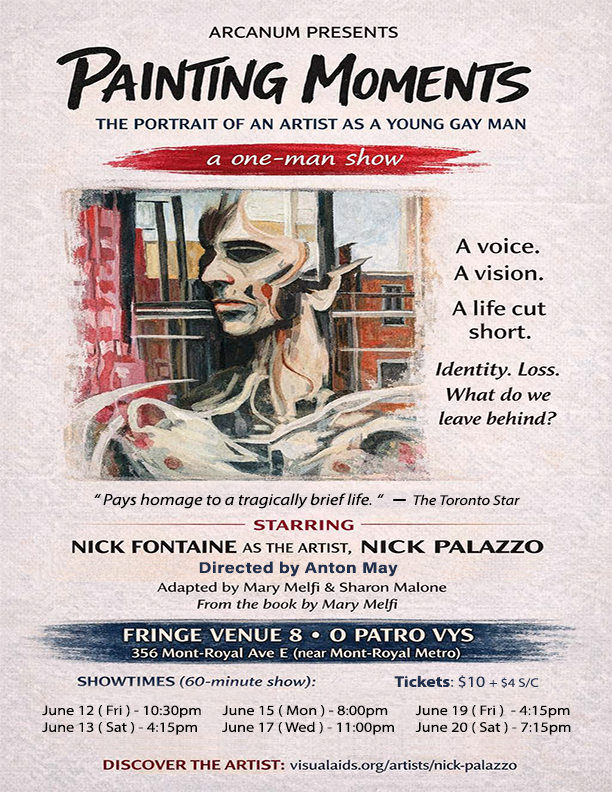
Painting Moments, The Portrait of an Artist as a Young Gay Man
I’m back at O Patro Výš again. Well, I’m almost there, cutting it really close. You know you’re doing Fringe right when you’ve got to sprint from one show to another because your schedule is so packed. Yet, somehow it seems like I’ve been at this particular venue for the majority of the festival. This afternoon I’m here to see Painting Moments, The Portrait of an Artist as a Young Gay Man, written by Mary Melfi and Sharon Malone. I hit Mont Royal, and since it’s Saturday, and the weather is beautiful, I’m elbows up until I reach the door to O Patro Výš and climb the stairs.
Mary Melfi is sort of a big deal. I mean, she’s got a Wikipedia page. No, no, I’m not being an asshole here, Mary Melfi is an accomplished author, poet, and playwright. I recommend her work. I was more than eager to claim this show during the Forget The Box(.ca) review schedule meeting, both for Mary, and for the subject matter.
Painting Moments is a story about Nick Palazzo, a prolific Montreal painter who died of AIDS before he turned 30. The script itself is based on a book by Mary, Painting Moments, Art, AIDS, and Nick Palazzo, published by Guernica in 1998. It’s a non-fiction collection of many of Nick’s own diary entries, essays, and interviews. The staged piece, written by Melfi and Malone, oscillates between a biographical play and documentary theatre.
The stage is mostly bare. A couple of small, black stage blocks, a large white one, and an easel upstage. The projector screen is drawn. The lighting is dim. The actor begins from the back of the room, speaking as he approaches the stage. This is Nick Fontaine as Nick Palazzo, clad entirely in white, with his hair slicked back. Nick Palazzo’s story is heartbreaking. It’s a story of a struggling, young, brilliantly talented artist, yet to be understood, longing for connection, growing up in a conservative family, but in a rapidly changing world, one with growing tolerance and acceptance, during a horrifying epidemic. One which will not only take the life of his lover, but his, as well.
Nick Palazzo’s life story has everything needed for a great play. But, unfortunately, even though Malone and Melfi crafted a compelling script, the overall production falls short, landing in good to okay territory.
This is largely due to the poor casting of Nick Fontaine as Palazzo. In the play, the lead character is 24-29 years of age. Nick Fontaine is beyond too old for this role, and not in a CW way, but in a visible from the back of the room and I didn’t even bring my glasses way. Distracting age aside, his collegiate overacting ripped the sincerity from the words of Melfi and Malone, robbing Palazzo of any truth. He’s not alone, though, as Fontaine’s chaotic blocking, nervous movements, and lack of focus showcase a lack of directorial vision.
While lighting and sound cues are fairly standard, and work well to separate scenes, times, and places, the technical star of the production is the projection video, displaying the works of Palazzo through his brief career, providing us with something about the character to feel, to hold onto, something to visualize as we carry the story with us long after we leave.
Painting Moments struggles to land, sometimes. By that I mean, it’s not always sure what it wants to be. Regardless, it is something. It’s a beautiful story about a brilliant young artist that Mary Melfi has documented in a book, then a script along with Sharon Malone, which has now made it to the stage for the first time. I say that because while there were obvious struggles with the acting and direction, this play has a bright future, and I look forward to it.

