
Wild Pride: Queer Joy, Politics, and Power
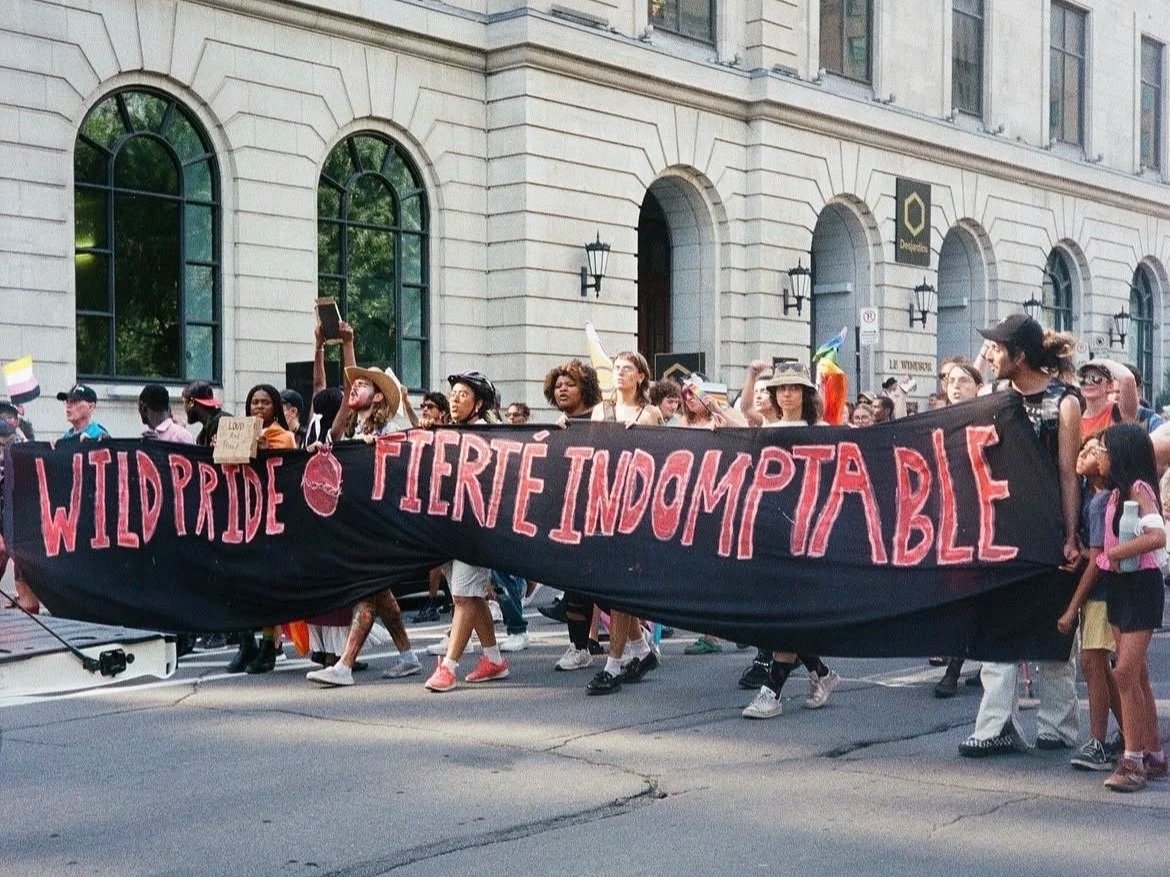
This year the organizers at Wild Pride have built something joyful, political, and community driven. Is it annoying to say that they’re bringing us a Pride celebration we can be Proud of? Sure, but I feel compelled to say it anyway.
There are as many ways to be queer as there are queer people, despite what the number of us with the exact same huge shorts may have led you to believe. We come from different places, cultural identities, we approach gender differently, sexuality differently. My point is that our community is extremely diverse, but in Montreal most of us are united by three things: we want to spend time with other queer people we can relate to, we don’t want to pretend we can separate being queer from the rest of our political and cultural identities, and we want to take care of each other.
So what happens when a bunch of organizers try to make a space where we can be our whole gay selves for Pride month? Wild Pride happens. In 2025 Wild Pride began as the newest in a long line of alternative Pride organizations. Following groups like PerversCité, Rad Pride, Brûlances, and Constellation, the idea was to support grassroots programming from the queer community, this time explicitly united by political stances like being pro-Palestine, being anti-racist, anti-capitalist, and anti-colonial. They wanted to divest from corporate prides that were taking money from the same people who were attacking our communities. As 2026 Wild Pride march organizer Billie Moran (they/them) explains, “I guess at first [Wild Pride] started as a fuck you to Fierte, and now it’s more… people really need something by and for the community. Not just a part of the community, but for all the community: accessible for wheelchair users, BIPOC, and kids; as a teacher I know that they need a safe space and a place to be themselves.” Last year was a huge success and the organization has only grown as a result. Let’s take the march as an example.
The first year, organizers predicted around 500 people would take to the streets for the 2025 march. Instead around 10,000 showed up for Sudan, Congo, Palestine, and queerness. This created some operational difficulties, what with the heat, the direct sun, and the small park the march ended at. But the message was received. There’s not only an interest in an explicitly political Pride march that centers politics, cultural identity, and queerness, there is a desperate need.
Moran says Wild Pride has learned a lot from last year. The August 9th March has been planned around another organizer’s archival research into the old lesbian village; they want to highlight Montreal's queer history, and this year stick as much as possible to the shade. They will also provide a bus as an accessibility support and ask wheelchair users and people with mobility aids to form a contingent at the front of the March. A masked contingent will also be at the front.
Last year the small group that made up Wild Pride provided logistical and fundraising support to community groups to put on around 60 events for themselves and their communities. This year there are around 130 events. I counted, and then they added new events. I can’t overstate what an incredible accomplishment that is.
This is all possible because 2026 Wild Pride has several new organizing committees made up of what seems like an endless stream of volunteers. As Kamâmik Poundmaker, (he/they/she) Wild Pride Board Member says: “We are creating beautiful spaces because for the most part we are on the same page. Nobody is the perfect activist, but we are figuring out how we can hold each other and protect each other from the barriers and the shit we are going through.”
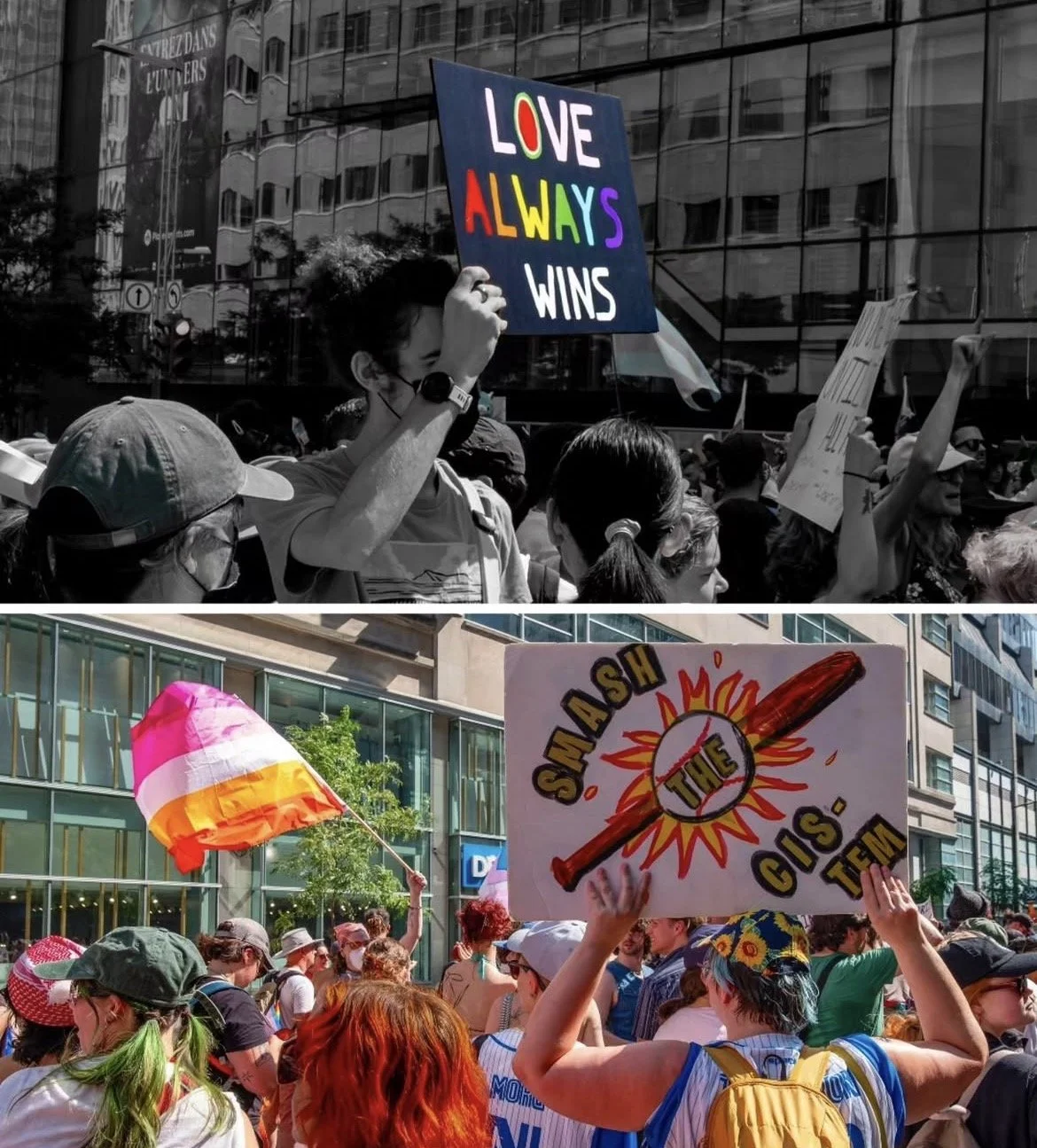
Because Wild Pride is funded exclusively by the community through donations and fundraisers, the community is supported in creating their event ideas, there are no funding expectations to bend to except those of the community. It’s a real masterclass in grassroots organizing. Ayla Vejdani (she/her), part of the new Care Team (more on that later) says that this process has been “call and response, listening to each other and the community, with eyes wide open to the systems at play. Part of organizing is knowing that we must be adaptable.“ This call and response has meant there are more demographics putting on events, and more outreach in different communities. Poundmaker says for him, “there’s a lot of pressure. I’m the only Indigenous person on the board.” They know most Indigenous people have a lot on their plate, and there are many good reasons why people can’t dedicate huge amounts of time to being on a board, but they are hopeful that this year’s events will make people more curious and want to get involved. “Wild Pride is just asking Indigenous leaders to come and be present without asking them to be digestible.”
Wild Pride seems to be right on track to continue providing more and more events, workshops, and support to our communities. This year more people than last year are showing up and making what they need real, putting on the events they want to happen for them, their friends and their loved ones. Hopefully next year that will continue. Because communities are putting on events “by us, for us,” there are events open to everyone but specifically run by Indigenous people for Indigenous people, for queer Iranian writers, for Black & Trans People, and there are also closed events exclusively for lesbians, for everyone except cis men, for sex workers, for immigrants, for the trans community, for QTBIPOC, and for trans femmes. If you want an event to exist, check the schedule–it might already be there. If it’s not, it sounds like they want to help you make it happen next year.
One of the things that Poundmaker wants is “to bridge the gap with older queers, and marginalized queers who feel like they have to accept crumbs. We want to prove to everybody that we don’t have to accept crumbs, we can make what we need.”
I asked Vejdani why Wild Pride exists and she said, “in a moment where we are so loud about what we are against, it's also so beautiful to see what we are for, create the spaces we want to see. When we notice things that are harming us, the only remedy is to create the alternative. (…)There is so much preaching and so much telling us how to behave but there’s very little opportunity to witness what to do. (…) That’s Wild Pride–let’s just show them what it looks like. I hope it opens up perspectives, I hope it shows BIPOC people that they can take centre stage and be the main act, actively doing it–that’s the medicine.” Organizing against something can feel pretty direct, usually straightforward. We have demands, and we are trying to get those demands met. When you are organizing for certain values you need to do the creative work of how to enact those values in the way organizers and volunteers treat each other, as well as create space for people to experience the type of generative change you’re trying to build. It sounds difficult, and also deeply rewarding.
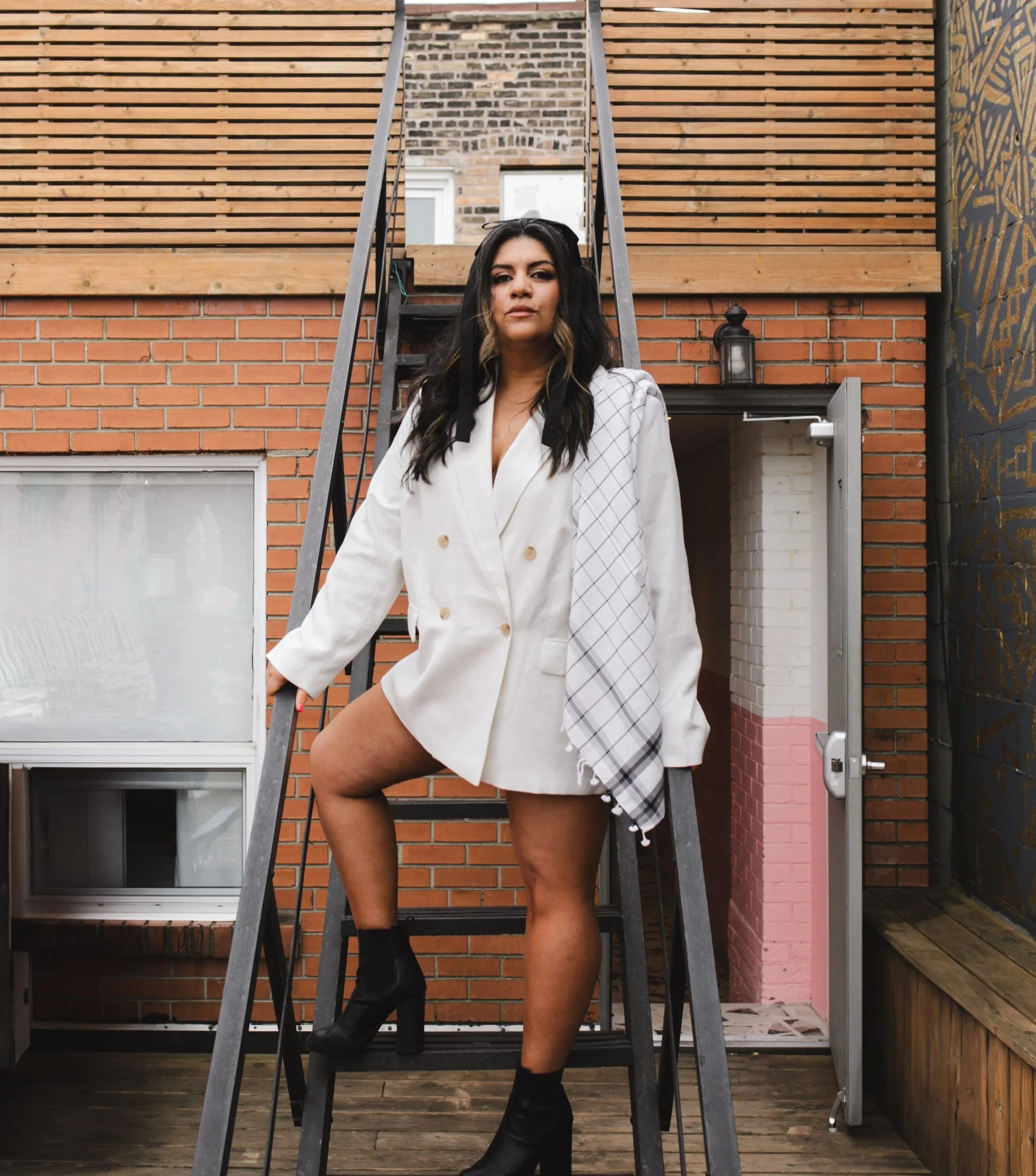
I spoke to Ayla Vejdani who is a core part of implementing some of Wild Pride’s values of community care and transformative justice: the Care Team.
Vejdani was one of the many people who showed up to Wild Pride last year. She went to Poetry for Palestine and the line to get in stretched around the block. She realized there’s such a need for this. “Corporate prides don’t often provide this space, but our romance is political, we need to celebrate and be seen and be political.” (If you want more on queer romance, she just published a book! It’s called YOU x ME and it's available online and at Joie de Livres). Immediately after the event, Vejdani dm-ed one of the organizers to get involved. Not to organize her own events necessarily, but because she wanted to help. Vejdani is an expert in conflict navigation, finding organizational “pain points” and finding their solutions.
When lefty queer people get together to organize there’s going to be conflict. We have different needs, different priorities, and we’re all marginalized in various ways, passionate, and often traumatized. Also, Vejdani didn’t mention this but I will say, queer Montreal is shockingly tiny; everyone knows everyone, and we are in each other's business. Conflict can get very intense, and very difficult to navigate, especially when we all want to do good by our communities. The Care team is trying to help with that; they are somewhere between in-house therapists, a protective space between volunteers and committees, interpersonal, conflict management, and the queer elders so many of us are lacking.
“As queer people we often don't have elders, and it matters to have intergenerational care in the queer community. Most people create chosen families, but often are missing that component of care.” Vejdani imagines the care team as the missing piece of this puzzle, the care team is older than most of the people they are supporting. They are trying to support people in learning how to set compassionate boundaries, and to navigate conflict. “We are within a community that is highly marginalized and truthfully very traumatized, so how do we care for each other? (...) We stand for transformative justice, what does that mean?”
Pondmaker tells me “when conflict happens, the Care Team are specifically responsible for navigating that. There are a lot of people involved, people at very different stages, people studying therapy, anarchists who do whatever they want, people who are working professionals, students, community organizers, some people this is their first thing they’ve ever organized. There’s a nice environment where we are all learning from each other. It’s useful to know that [the care team] is around. It's super useful.”
Vejdani explained that the team is necessary to embody the values they all have, “Transformative justice means holding tension and conflict. The revolution is relational and we are setting precedent for how the movement will grow and change.“
2026 Wild Pride is about putting the values of the organization into practice, and growing and changing to build what we need. In doing so, Wild Pride is co-creating an alternative to a world where most of us are not welcome. This alternative is caring, and joyful, it means an Indigenous open mic, Line Dancing, a panel on writing the Queer experience, raves, board games, free hair cuts, free packers, tattoo giveaways, the Prisoner Correspondence Project’s fundraising show, oh my. One of the returning aspects are the community days. These are vital to connect people directly to the multitude of queer organizations in this city. “It’s free advertising for the organizations.” Moran gestures broadly: “There is a queer organization for everything in Montreal. We are helping to break down isolation between them.” The organizers are trying to make sure we have access to the vast network of Montreal venders, individuals, and organizations for the rest of the year, not just during Pride month, and so we can continue to sustain ourselves.It sounds like whatever happens in the future, this year’s Wild Pride is designed with a deep radical care for our communities. And at the first few events, you could really feel it. They’re trying to build spaces that feel like home. Or like how home is supposed to feel. I asked Vejdani what she wants people to take from Wild Pride, both the organizers, and the public. She paused for a moment, and when she continued you could hear the care in her voice, “for the organizing team and volunteers, I want them to be very proud of themselves. Anyone should be proud when they do things that are brave and generous. (…) It’s important to see things grow when so many things are being destroyed. And the public, I hope they can be seen to hold grief and joy, desire and celebration. And be political! I hope they don’t have to compartmentalize themselves to be held, to be joyful. We take our power back with joy. Joy is brave and joy is queer.“
For Billie Moran, the goal for Wild Pride’s future is simple: “to survive for more than two years, to grow bigger and get better. We aren’t always the best but we do our best. Next year we will try to rent bigger spaces, to grow bigger. Never for money, just for the community.”
Sounds like a future I’d like to be a part of.
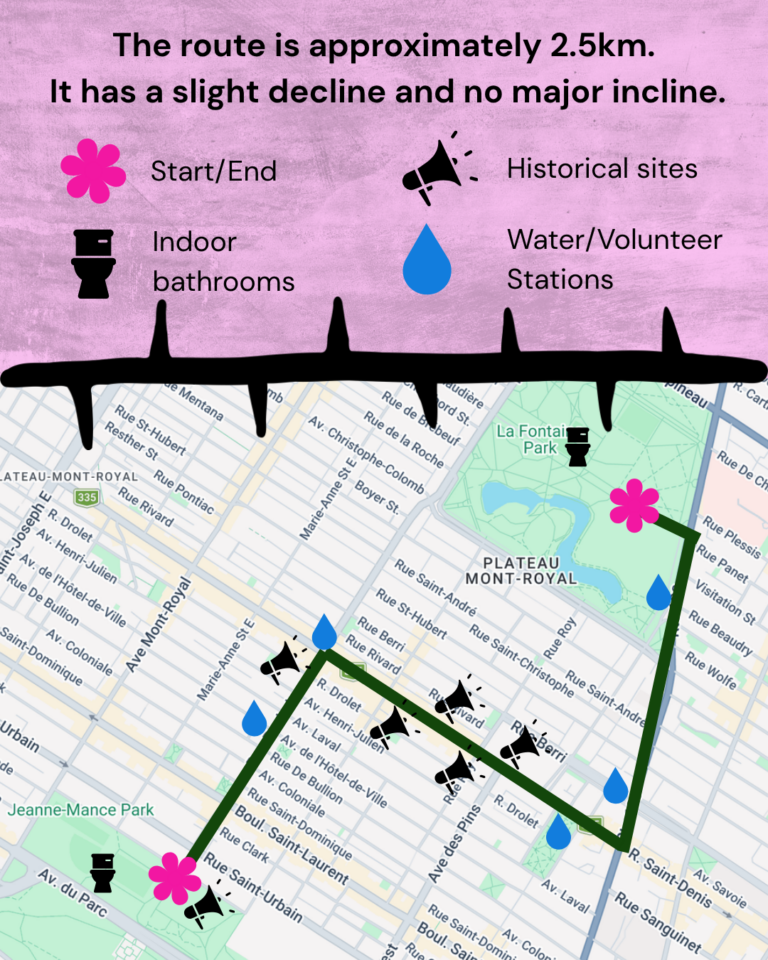
March Route and Accessibility Information
ROUTE
The route is approximately 2.5km. It has a slight decline and no major incline.
We will begin the march with a minute of noise with the help of Durs À Queer. Earplugs will be available.
Start at Jeanne-Mance Parc
Down Rue Rachel
Right on Rue St-Denis
Left on Rue Sherbrooke
Left on Av. Calixa-Lavallée
HISTORICAL SITES
Wild Pride will speak about the historical and queer significance of these locations.
151 Rue Rachel – Café Névé
Corner of Rue Rachel & St-Denis
St-Louis Square
Aqueduc over Rue Berri
Sir Louis-Hippolyte La Fontaine Monument
WATER STATIONS
Our volunteers will be set up with water along the route at the following locations. Please bring your own bottle and we can fill it up!
BATHROOMS
Jeanne Mance and La Fontaine have nearby indoor bathrooms and water fountains.
