
Subverting The Narrative
The Garden of Literary Delights In Bloom
This feature is part of Forget The Box’s MTL Event Series.
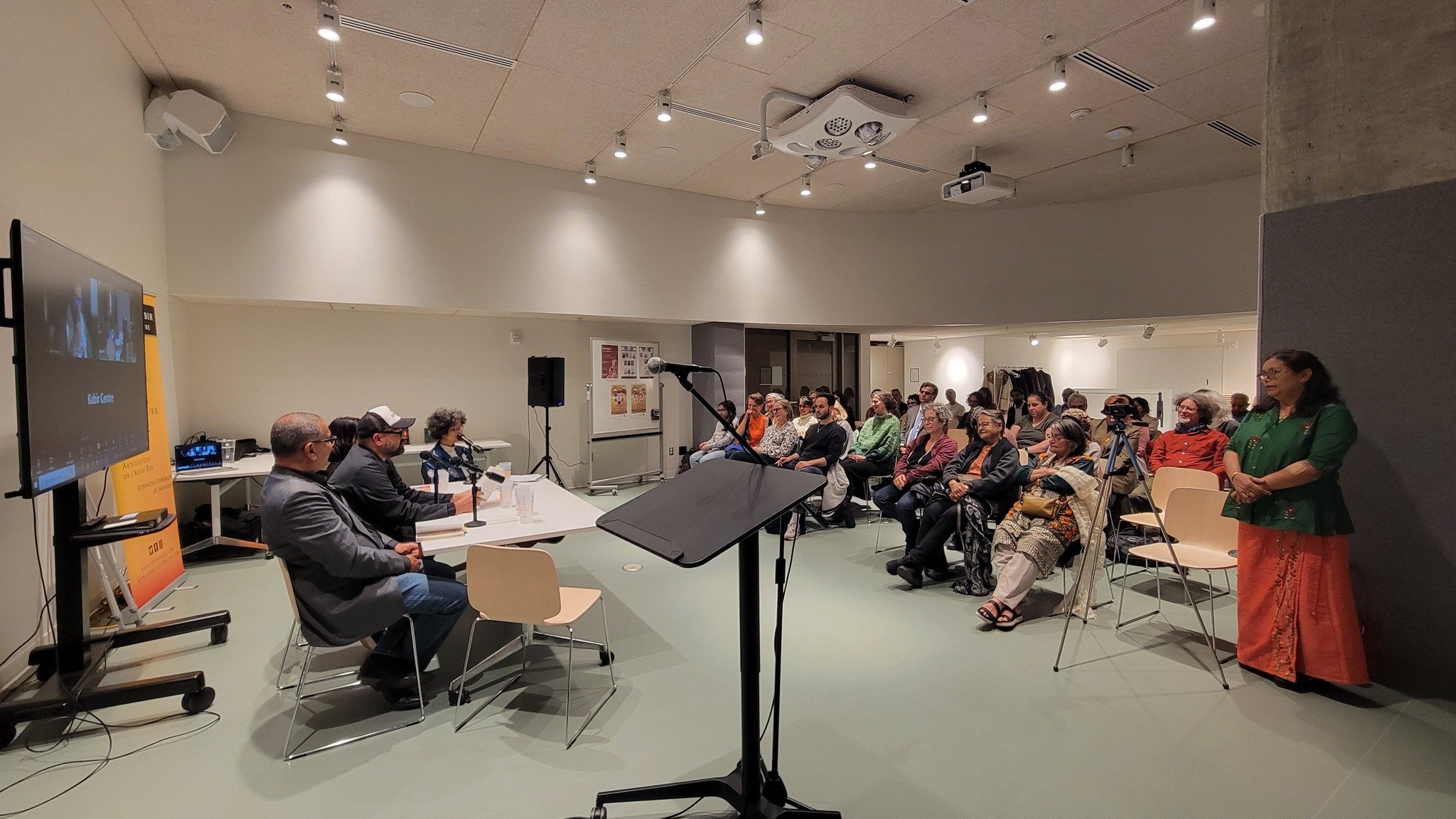
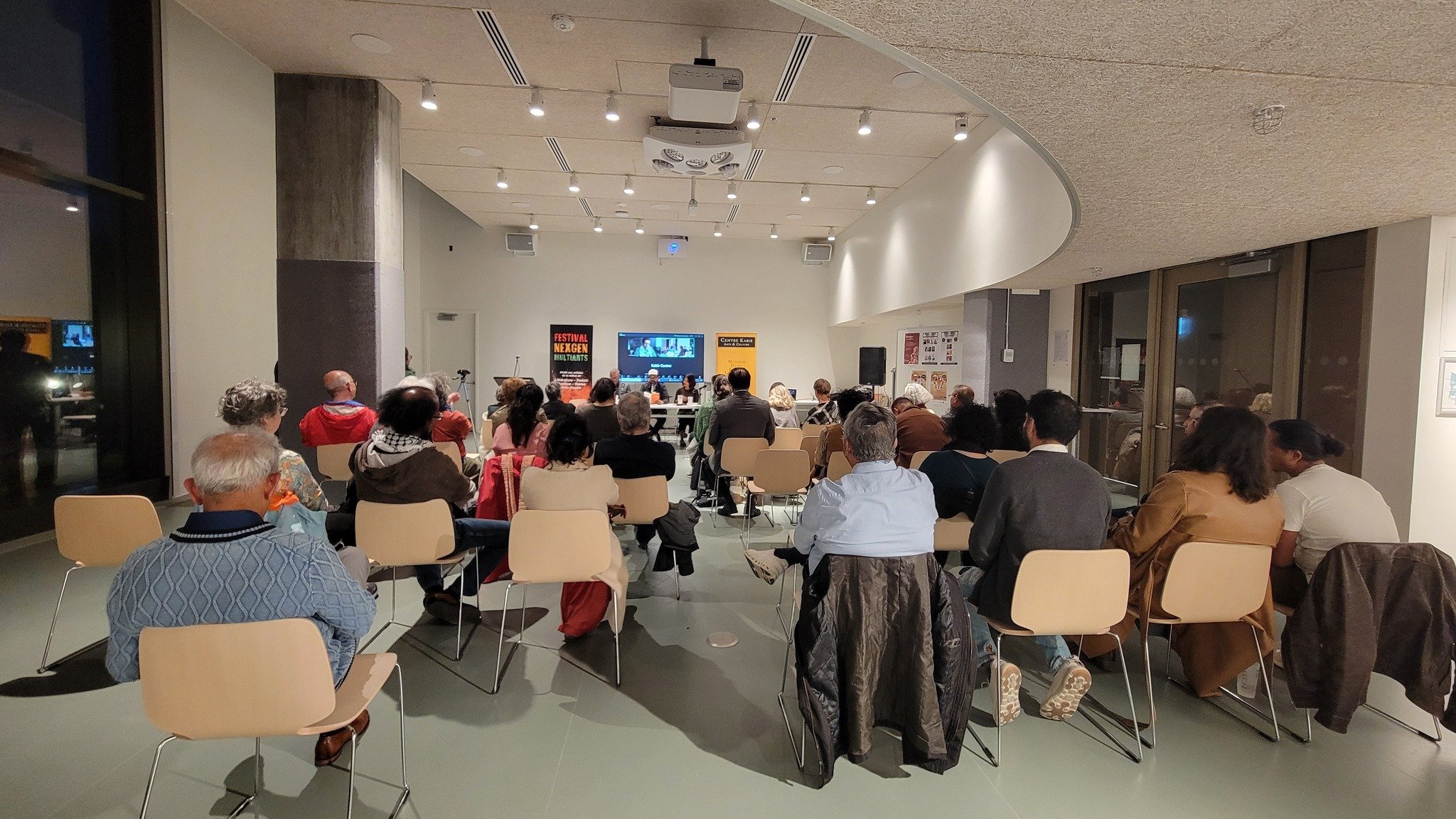
On October 10, readers from all over Montreal gathered at Centre Sanaaq for the fifth edition of the Kabir Cultural Centre’s “Garden of Literary Delights.” It was my second time attending the literary panel, and to say I was excited would be an understatement—I left last year’s event buzzing with the excitement of engaging with fresh ideas and adding several new books to my to-read list. This year was no exception.
Introduced five years ago as part of the centre’s NexGen MultiArts Festival, the main aim of the Garden of Literary Delights (or GOLD) is to highlight rising Canadian authors of South Asian origin. The literature covered at the panel can range from murder mysteries to high fantasy, and each author has the chance to read from their books before engaging in discussion with the audience. It is the only literary event in Quebec that focuses on South Asian Canadians.
The panel is curated each year by Veena Gokhale, an established writer and “immigrant shapeshifter” who has worked in various literary circles over the years. She recently published the short story collection Annapurna’s Bounty, and was proud to announce that the 2025 edition of GOLD featured two short story writers as well. As Gokhale spoke, she drew our attention to an empty chair at the end of the table meant to symbolize all the writers in the world currently unable to express themselves due to incarceration or governmental suppression. She asked us to remember the importance of pluralism and diversity within the world of literature as she introduced the authors present in the room: Deepa Rajagopalan, Arjun Basu, Aamir Hussain, and Aditya Banerjee.
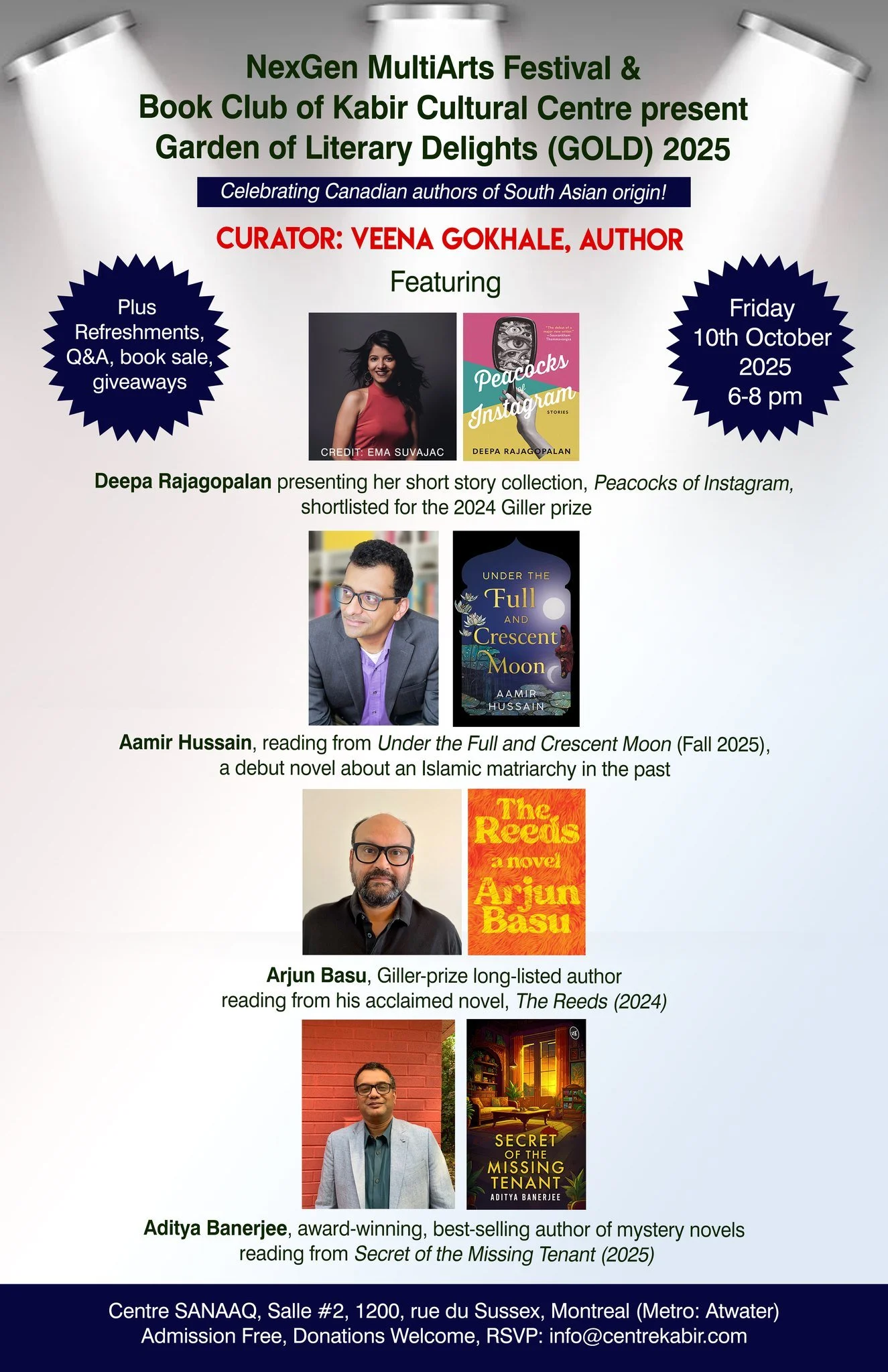
Deepa Rajagopalan kicked off the event by reading from her debut short story collection, Peacocks of Instagram, which was shortlisted for the 2024 Giller Prize. Rajagopalan moved from India to the United States and Canada in her twenties, experiencing firsthand what many immigrants go through as she adjusted to her new life. When writing Peacocks of Instagram, though, she was determined to write a book that “refuses to be called an immigrant narrative.” Her goal was to draw the reader in by using common stereotypes about South Asian immigrants, before completely subverting them to create something new and fresh.
The story that Rajagopalan read from, “Bestsellers,” exemplified this subversion in the best way. It revolves around a woman who sells handmade ceramics on Instagram to earn support for herself after her divorce, but the reader’s initial image of her is quickly undermined as the story unfolds with a cheeky plot twist. Rajagopalan’s intention was to “present a character you think you know before realising that you don’t,” as a way of challenging the audience’s biases and making them question their preconceived notions about certain characters.
Unpredictable characters and complicated family dynamics also take center stage in the work of Arjun Basu, a Montreal-based author who has previously published two novels and a short story collection. He read from his latest novel, The Reeds, which centers a mixed family in Montreal’s west end and follows each character through a tumultuous period in their lives. While part of it is clearly inspired by Basu’s own experiences growing up in Montreal, the idea for The Reeds actually struck him when he was posting a Tweet. Basu shared that he used to frequently write 140-character short stories on Twitter, and he noticed one character just kept popping up throughout these stories—this character eventually morphed into Bobby, the father of the Reeds family.
When asked about his writing process behind mapping out the family dynamics in the novel, Basu replied, “I discovered the family in a way that I hope the reader will as well.” The intricacies of their relationships with each other and the inner motivations of each character were fleshed out slowly, over the course of years, and Basu sheepishly admitted to using a colour-coded Excel spreadsheet to keep track of all the information. It’s a heavily character driven story, switching perspectives between Bobby and his wife Mimi to their adopted children Abbie and Dee, which allows for deeply diverse representations of identity within the same family. Through witty observations and a sharp attention to detail, Basu brings these characters to life in an extremely believable way.
The next panelist moves us away from Canada to a land that is part historical and part fictionalised. Pakistani-Canadian author Aamir Hussain joined the panel via Zoom to speak to us about his first novel, Under the Full and Crescent Moon, which imagines a city led by a Muslim matriarchy during the Islamic Golden Age. Having grown up in a family of strong women, Hussain quipped that he always felt like “the women in his family were more than capable of running the world.” His novel is a result of this belief. Hussain leads us into a rich and immersive world, following the main character Khadija through her journey learning to lead her city. He read from a scene where she visits a street market, which Hussain mentioned was inspired by his own experiences going to markets in Karachi with his mother.
Alongside his visually immersive writing and evocative imagery, Hussain also deploys an impressive knowledge of history in his novel. It took almost twelve years for Under the Full and Crescent Moon to come to fruition simply due to the amount of research required. Hussain would spend two hours during his daily commute to work researching for his novel, chipping away at it slowly until he was finally able to finish the novel during the 2020 lockdown. His journey as an author highlights a common experience for many immigrant writers, who often do not have the privilege of solely writing for a living. Hussain, along with many of the other writers on the panel, found a way to balance his day job with his passion for writing and telling stories that are important to him.
We remain rooted in the world of historical fiction with the work of Aditya Banerjee, another Montreal-based author who has published several best-selling murder mystery novels. He created the character Detective Shankar Sen, whose adventures in solving mysteries lead us to 1970s India. Banerjee read from his latest novel, Secret of the Missing Tenant, which takes the reader on a journey across three different cities in India. “The setting is almost its own character,” Banerjee said, explaining that he had always been fascinated by the 70s as a transitional period in Indian history, and how he tried to present the socio-political tensions of the decade through the medium of genre fiction.
These tensions are at the forefront of Banerjee’s mind while writing: though his work primarily centers around the titular mysteries, he wants to draw our attention to the novel’s underlying feminist themes. Detective Shankar is joined by investigative journalist Nitya Chaturvedi, who has the added challenge of navigating sexist stereotypes while trying to solve the case at hand. “I tried to write what I felt was lacking in the mystery novels that I grew up with,” Banerjee shared. For him, this meant focusing on realistic characters that made mistakes, had flaws, and were deeply human before anything else.
More than anything, each author present at the Garden of Literary Delights exemplifies the importance of bringing South Asian voices into the spotlight of the Canadian literary scene. GOLD has quickly become one of my most anticipated Montreal-based literary events of the year, and I’ll be eagerly awaiting the next lineup of authors. If you’d like to get more involved, the Kabir Centre for Arts and Culture will continue to highlight emerging South Asians artists from Montreal and beyond in its programming for the rest of the year.
If you’re reading Forget The Box, you’re a supporter of free, independent arts coverage. We ask you to take a moment to consider donating $1 to help us continue our mission to spotlight ground level, underground, and marginalized art in Montreal. Every little bit helps.
