
From Passion To Power

In the past few years, our cinematic landscape has been blessed with an increasing number of movies about the queer and trans experience. From Tangerine (2015), a movie about two transgender sex workers, to I Saw the TV Glow (2024), a powerful allegory about transness. Still, while these mainstream movies have such raw and beautiful depictions of the trans experience, they remain few and far between.
The voices of the trans community are not uplifted in popular media. The world of filmmaking stays defined by who is the most prominent, who is the most seen. This does not stop trans, Two-Spirit, and gender non-comforming creatives from creating their own representation. Deserving of being seen, heard, and felt by the public, the Exposures trans film festival aims to uplift voices of the trans community that aren’t always given the opportunity.
When first arriving in Montreal from London 3 years ago, Iris Pint, the festival’s founder, quickly noticed the lack of queer and gender-diverse cultural offerings compared to the UK. Particularly, as a PhD student in film studies, they wished to provide queer film screenings for their friends. What began as small gatherings among friends and acquaintances in a queer bar turned into huge crowds. From simple word of mouth, the event rapidly outgrew the space beyond its capacity.
This led Pint to notice this great search and want for activities organised for the trans community in the city. A place of belonging is essential, and so they chose to take matters into their own hands. In the fall of 2022, Exposures Montreal was founded as a non-profit passion project, aiming to represent the Two-Spirited, gender-diverse and trans communities in Montreal’s cinematic scene. It didn’t take long for the project to gain traction. Supported by a loyal following of nearly 200 people at each screening, Exposures was taken a step further by launching Montreal’s first trans film festival in 2024–a huge milestone for the trans community in the city and across the country.
Exposures’ first edition featured 84 films, each carefully curated into 13 screenings, showcasing both Canadian and international trans voices, drawing an audience of over 1000 people: a huge success. Pint, the mind behind the idea, built this festival from the ground up with a team of over 100 volunteers and hefty spending on their credit card. This year, they are coming back even bigger and better with 88 films, including 5 feature length films, a variety of workshops, activities, networking opportunities, trivia, and more!
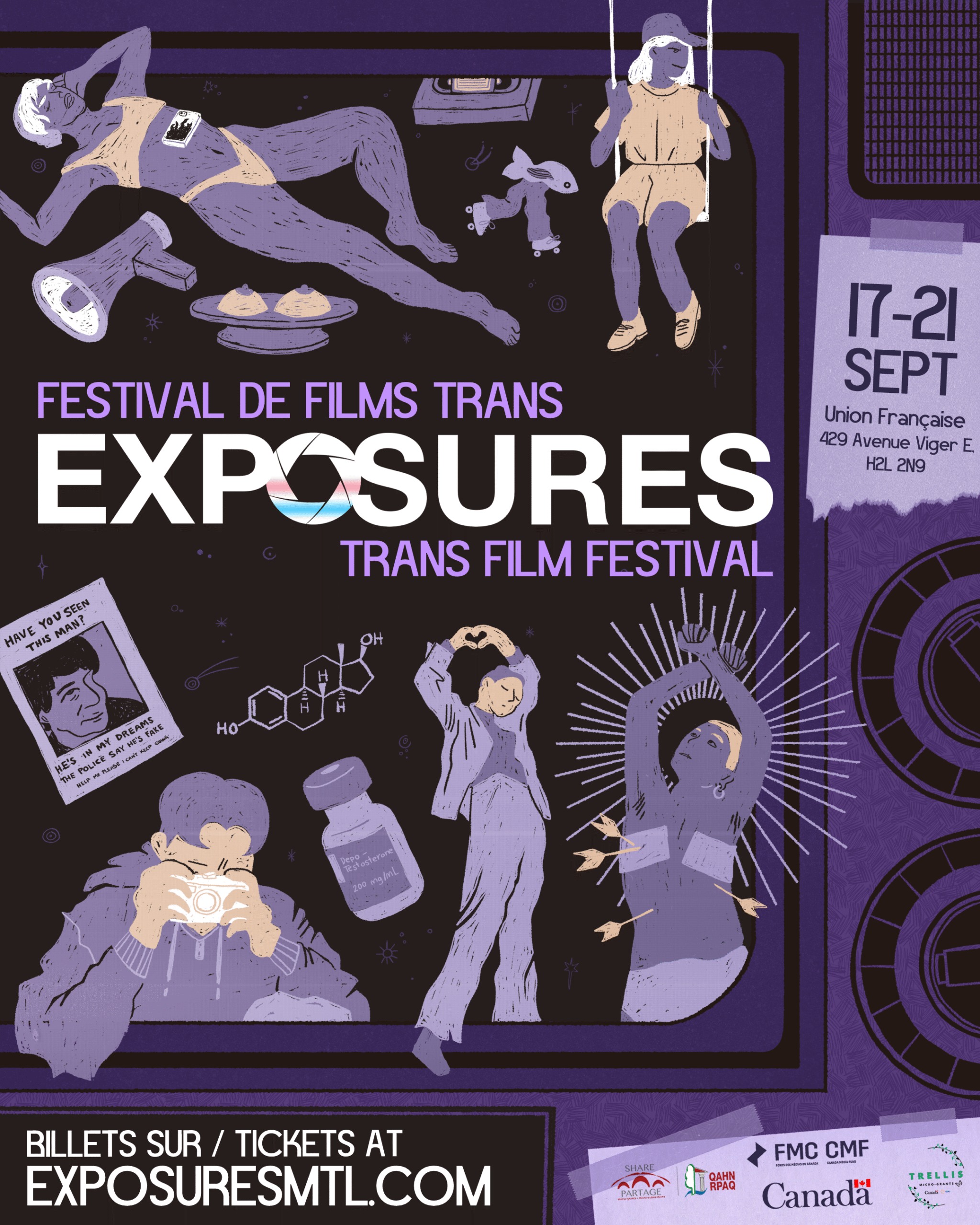
Exposures doesn’t classify its films within rigid labels. It steps away from conforming to specific standards, setting the festival apart through Pint’s curatorial process. Exposures resists easy categorization, instead searching for shared niche aesthetics and “vibes”. Pint asks their team, when watching the films, to form connections between them; to “look for fun little nuggets that no one would’ve picked out before.” Maybe a specific tone, atmosphere, subtle creative choices. A recurring color or a visual motif–anything that could shape the festival’s groupings. This allows a mix of narrative and experimental films to speak to each other in surprising ways. This approach offers viewers the opportunity to experience diverse cinematic styles, mirroring the trans experience: an expansive, varying spectrum rather than a singular narrative. Different perspective of shared experiences, told through the lens of diverse creators.
Pint shared some of their favourite and most meaningful programs of the festival, though, as they put it, it felt like “trying to pick their favourite baby”. Among some must-sees include programs like From Trans Coast to Coast to Coast, a collection of shorts that captures stories from across the provinces of Canada. It offers “a sense of what’s happening across the country, in the trans community.” Another standout is Mundo Trans, a collection of riotous, campy films, celebrating the grotesque, and We Are Pat, a feature length film that re-examines a problematic pop culture character mocked for their gender ambiguity, yet paradoxically, was the first exposure to transness for many in the community. The festival also makes space for elders, a group too often absent from trans conversations. Yesterday, Today, Forever centers trans elders from across the world. Elders may be hard to come by, but they are a big part of the community. Pint intentionally chose to close off the festival with this program as a gesture of gratitude. A thanks, “for the road they’ve paved for our community.” The lineup also includes a lighthearted Cereal and Cartoons program, a festival favourite which Pint likens to the nostalgia of “Saturday morning cartoons”. Audiences are encouraged to show up in pajamas and slippers, paired with blankets, plushies and cereal. A playful reminder of the joy and comfort at the heart of the community.
In a time when trans rights are under attack, the need for community spaces feels all the more important. Exposures was built with this in mind: not simply watching a screening and leaving, but a gathering place. Beyond screenings, there is a space catered for meaningful dialogue. With everything set in one venue, it becomes easier for audiences to foster connections, whether at the bar, during workshops, panels or activities. Pint encourages people to attend even if they come alone; the films themselves can become conversation starters, erasing the pressure of having to overthink small talk. This focus on community also offers an alternative to nightlife queer events. Pint wanted to give Exposures a more relaxed atmosphere, ensuring that it remains intergenerational and accessible to everyone. They describe it as a place where the trans community could “recharge their battery” within the comfort and safety of their community. The festival is more than a lineup of films. It is a rare space to gather, an anchor offering solidarity and joy, during a time when safe spaces feel increasingly under threat.
Pint emphasizes that accessibility and intersectionality remains a central concern. All screenings are held in wheelchair-accessible spaces, and every film includes closed captions to reflect Montreal’s multilingual culture. In the same vein, Exposures actively spotlights intersectional stories. From migrant experiences, racialized stories, and disabled voices, Pint ensures that trans representation isn’t reduced to a narrow lens. The festival itself becomes a site of resistance: by refusing corporate sponsorships from companies with harmful practices. Exposures reaffirms a guiding principle: “no one is free until everyone is free.”
Looking ahead, Exposures wishes to expand while staying true to their values. After finally securing funding this year, Pint’s priority remains establishing security by securing long-term funding with no strings attached. They want funders who will back the festival’s mission without compromising its principle, allowing them to stay firmly rooted and stay loyal to the needs of the trans community.
Future goals also include building a larger, trans led, organizing team, and eventually taking Exposures to the road, bringing screenings to communities across Canada. The interest for trans film festivals is there; Pint has even heard from international organizers asking for advice to start their own trans film festival, curious to learn how they accomplished so much in such a short time, and with no funding at that. Pint hopes to plan more workshops, activities, and opportunities for trans filmmakers, to help transform what might have only been a hobby into a sustainable career.
Exposures Montreal is about building community, being visible, and resisting erasure by embracing the complexities of identity. Because films are more than entertainment; they are a labor of love, an act of resistance, and a vision of liberation for all.
Exposures trans film festival will run from September 17th to September 21st. Make sure to check out exposuresmtl.com for more information on the festival, from various feature films, workshops, and activities throughout the year.
If you’re reading Forget The Box, you’re a supporter of free, independent arts coverage. We ask you to take a moment to consider donating $1 to help us continue our mission to spotlight ground level, underground, and marginalized art in Montreal. Every little bit helps.
