
Rage and Resistance in New Stockholm
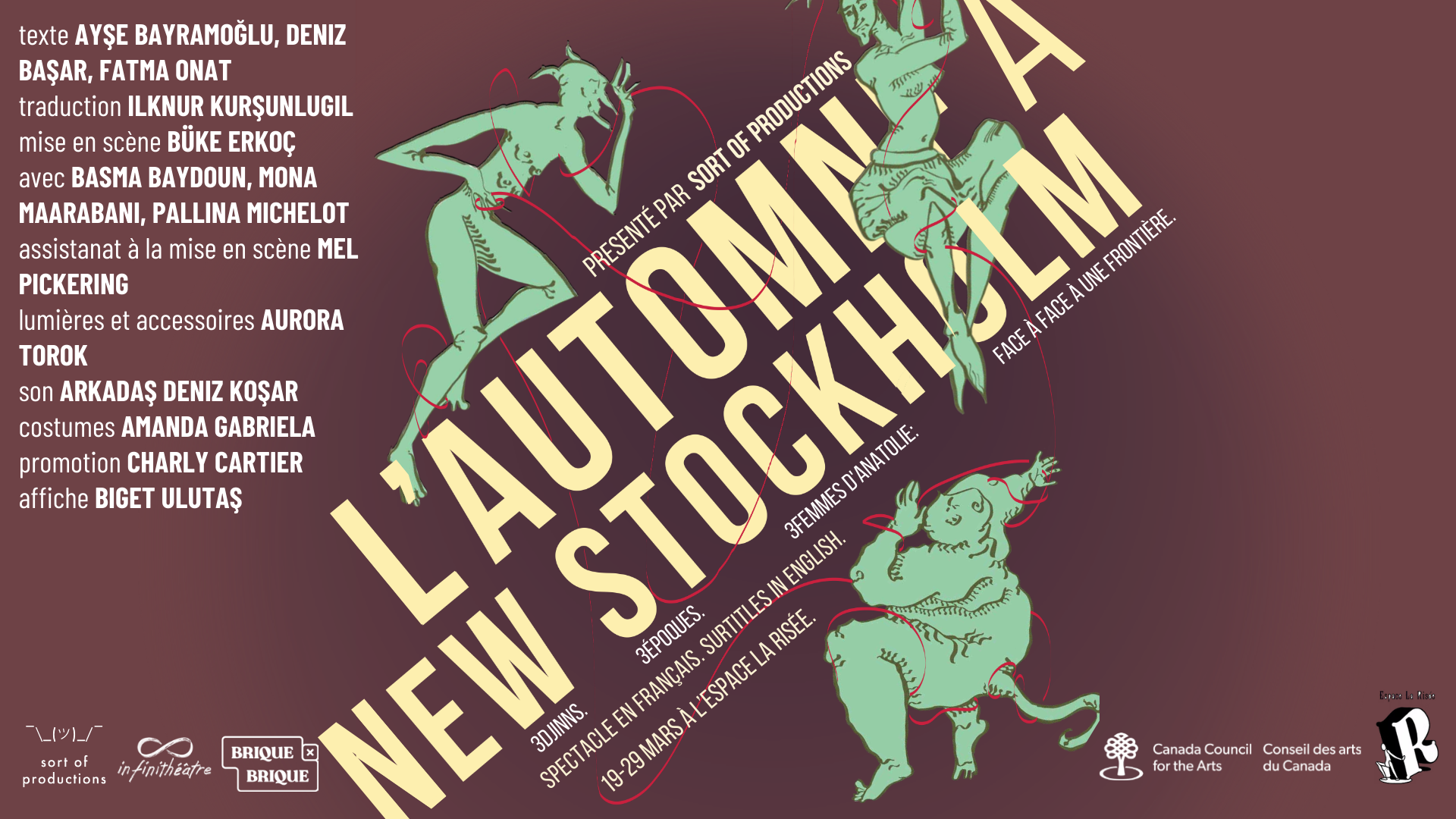
For immigrants who’ve settled within these colonial North American borders, there is a constant tension between what one wants to say and how (if at all) to say it.
“You have to be really careful,” says Lebanese-Canadian actor and cultural practitioner Basma Baydoun. “You know, hide your rage, hide your anger – hide how you feel about injustice. Having to integrate in a very specific way comes through policing your thoughts and policing your language. It's something that we do to ourselves also because we feel that pressure.”
Luckily for us, though, playwrights Deniz Başar, Fatma Onat, and Ayşe Bayramoğlu have given themselves permission to explore rage, resistance, and solidarity however the hell they’d like in the first French-language staging of Automne à New Stockholm, directed by Büke Erkoç. And even luckier for me, I got to sit down with two of the lead actors ahead of the premiere on March 19th to hear all about it.
The play’s premise is deceptively simple: three women emigrate to the strange and sterile city of New Stockholm from their unnamed countries of origin. It’s autumn, a season often tied to cyclical death and decay. And yet, each protagonist contains within her a refusal to disappear, a latent potential for growth in adverse conditions. Across three timelines, they navigate a city that both exists and doesn’t, a geographical and metaphysical oddity that stands in for any other WASPy metropolis.
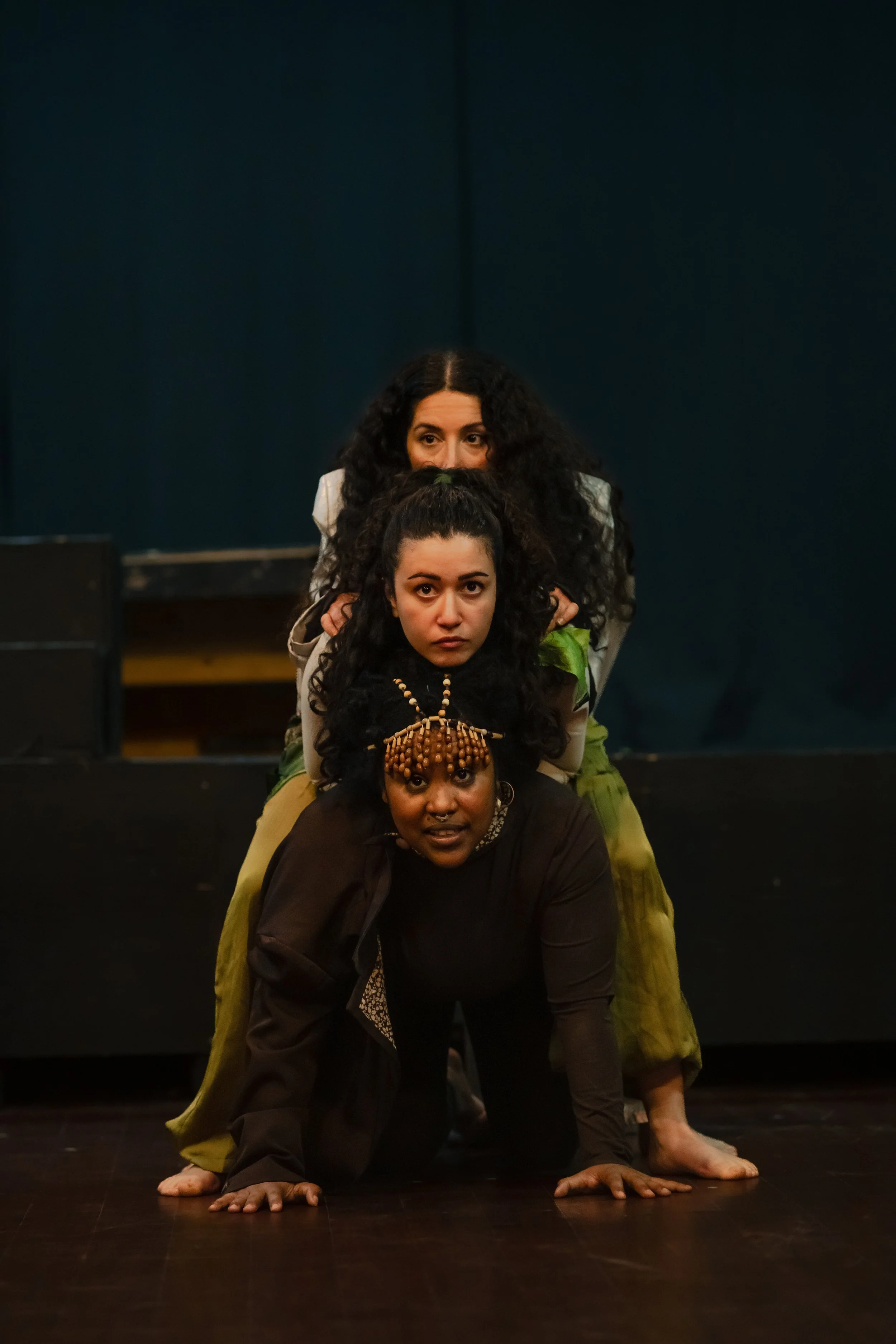
Photo by Emma Rosa
Each of the three actors – Basma Baydoun, Mona Maarabani, and Pallina Michelot – embody multiple roles over the course of the play, including djinni capable of reading into the past, present, and future in unexpected and mischievous ways. “They very much behave like children when they're together,” remarks Baydoun, “which balances out the heaviness of what the three immigrant women have gone through.”
Maarabani, a Tiohtià:ke-based director, producer, and actor, adds: “The idea of the show is that we, as djinni, are passing on this story and this rage to the audience. It's letting that rage and that resistance go to bed within us so that it can then be born again in the audience, so that they can go on and tell the story again and again. That’s a very cyclical process, one that probably doesn't have an end.”
Migration – who leaves, who stays, who gets the right to be mobile – lies at the heart of AàNS. There is a restlessness in our three protagonists, a sense of not-quite-belonging in either direction. Assimilation can mean safety, but it’s also a devastating personal loss.
“From my own experience as an immigrant in Montréal, being in a city where there are so many different communities, you notice by engaging with people that our basic instinct as human beings is to be together – to gather and to create and to learn from each other,” Baydoun says. “For the longest time, I was confused about which place I should be in. And it took me a while to accept that we shouldn't have to choose, because that in itself is a practice of separation. There's this idea that we can only all live together if we all speak the same language, if we all behave the same, which is ridiculous.”
AàNS opens in Tiohtià:ke/Montréal, a city notorious for its fraught linguistic tensions. From forcing new immigrants to master French within a matter of months with little pedagogical support to implementing increasingly-restrictive policies designed to erase visible cultural and religious differences, our government is no stranger to New Stockholm-esque public policies.
For all these reasons, Québec seems an awfully apt place to stage this production.
“It's been very interesting to play this with Québec and French specifically in mind,” says Maarabani. “There are a lot of references to language – learning the language – and what kind of barrier an accent can be here. We’ve gotten to play with the script a little bit, understanding the differences in expressions in different languages, and how those affect the ways that the people can be understood by each other. The constant fear of being misinterpreted, I think, is part of that experience as well.”
Baydoun adds: “It's definitely the kind of script that you can imagine being translated to whatever common language is spoken in the city that it's being presented in, because the language that these characters use to talk to the border agent is also the language that they're using to talk to audiences.”
Throughout our chat, the word that keeps popping up is sterility. As Maarabani puts it: “It's this idea of the new world being a modern and bland one, and yet it’s what we strive for for some reason.” The city of New Stockholm is defined by its sameness, its inability to let anything grow, and defying that order is the act of resistance at the heart of AàNS. “What ties these women together,” she continues, “what creates these knots and these bridges between them is their refusal to give in to that sterility. To grow within that space.”
The entire composition of this play – writing, timelines, characters, staging – is decidedly unsterile. If anything, it’s a direct challenge to orthodox New Stockholmian slice-of-life theatre. On March 19th, audiences will see actors shifting between human and non-human roles on a dime. Past, present, and future will collide at breakneck speed. No break in dialogue, no room for error.
“It's a very difficult play,” says Baydoun, bluntly. “It's not easy. Not on the performers, not on the audience. You’ve really got to look people in the eye. So if someone's confused, you're gonna see it and you just have to keep going.”
Maarabani agrees. “It's my first time being aware of an audience, I think, in a show. I'm feeling very silly.”
Oh?
“Yeah, because I think the only way to get through such a dense text, for both us and the audience, is to really just embrace the levels that we can play with. Showing up as a djinn that doesn't have a human body is – yeah, we’ve got to keep the silliness alive.”
Before we part, I ask the actors what they hope their audiences take home with them.
“Rage,” replies Maarabani. “I think that rage should inspire a new desire to play your part. There’s a pride in that, in holding your head high, not letting things slide. And it takes a lot of pride to maintain hope.”
“If we're able to share our stories and if there are people who are willing to listen, then that’s very hopeful,” Baydoun offers. “And that hope is in how we catch each other's stories, how we find similarities and celebrate our differences. We’re the only ones that can keep each other safe and protected – and we really have to lean into that more than we already do.”
WHAT: Automne à New Stockholm
WHERE: Espace La Risée, 1258 Rue Bélanger, Montréal, QC H2S 1H9
WHEN: March 19, 20, 21, 22, 26, 27, 28, 29 @ 7:30PM / March 22, 29 @ 2:30PM
METRO: Jean Talon (Orange)
TICKETS: Automne à New Stockholm
