
Julie Neff is fine?!
The Power of Spiritual Composting
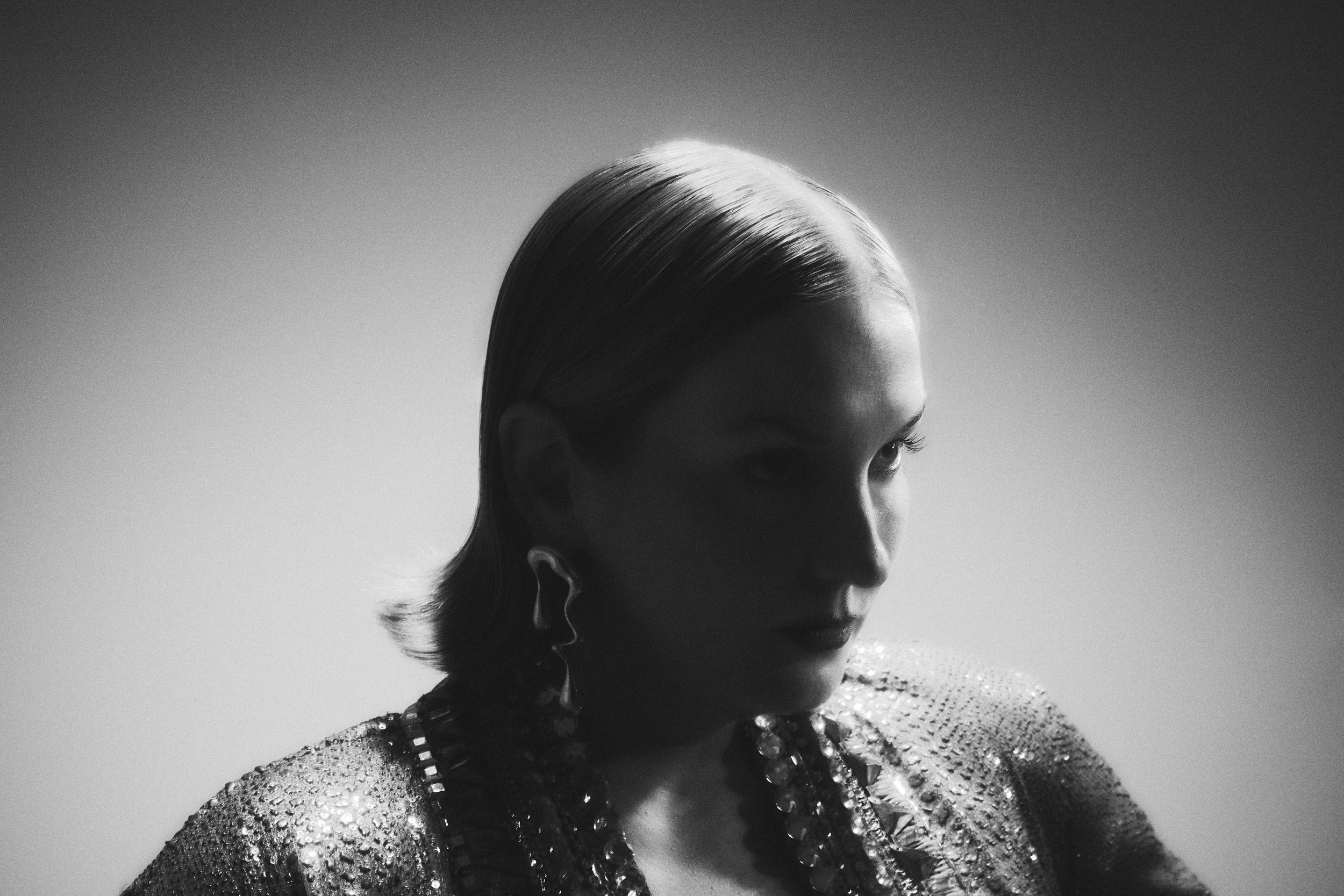
Photo by Bruna Hissae
Julie Neff understands pain.
Years ago, she found herself in the wreckage of her personal and professional life. She’d just relocated from Spain, her first serious relationship had just fallen apart, and she was facing a very real health crisis — the first of many in what would turn out to be a chronic and systemic lifelong condition — and if all that wasn’t bad enough, she was in Toronto.
A lifelong performer and appreciator of music, it wasn’t until this crisis point that she felt like composing was something she was going to have to do to save her own life.
“I started writing,” she tells me, “because I had no other choice.”
Julie is a gorgeous, statuesque woman. When we meet in a cafe-slash-vintage-shop in the plateau, she’s in a coordinated animal print denim number, gold jewelry dripping from her fingers and earlobes. I’m curious about the musical environment she grew up in. When I ask her, she laughs.
“Jesus,” She tells me.
Julie is not a believer anymore, but it’s clear how much she appreciates coming of age in an environment where music was considered an essential aspect of what it was to accept, as well as share, divine love. She tells me about church choirs and a school environment where choir or band was mandatory, and the musical styles being celebrated were diverse even if the content was quite homogeneous — “Contemporary Christian music makes Christian versions of whatever is popular,” She explains. “So, there was a Christian Destiny’s Child. Christian rappers. Christian heavy metal. Everything.”
This ideological environment also offered a specific ethic of what it meant to perform.
"Jesus music is deferential.” I’m struck by how massive of a distinction this is: contemporary popular music is usually a reflection of a broader popular culture where performers are rewarded for how willing they are to take up space. What Julie describes is a fundamentally different approach, where a musician’s role is to facilitate a religious experience for other people. “You’re there to serve the divine experience,” Julie says. “Not to show off.”
This approach to music followed her through university, where her first experiences performing were actually to provide moral support (and harmonies) to a singer-songwriter friend who was too shy to perform onstage by himself. This eventually snowballed into a “hilariously large” band.
“It was eight people,” she says, laughing. “Everyone brought their own genre—” Funk, pop, blues, a rapper — “and then we did nothing to blend it.”
Julie split from religion, finished her bachelor’s degree in Hispanic studies, and relocated to Spain — and then eventually found herself in Toronto, during the period of suffering so profound she had to sing her way out. I like to call this kind of art practice spiritual composting: I have this agony in my life. How can I channel that into something beautiful, so that something good can come of it? This is often an act of desperation. That’s what Julie tells me: that she didn’t know what else to do.
Since then, she’s released the EPs Growing Pains, Catharsis, and Over It. Her music has taken her to Europe and all over the Americas. Julie’s new single fine?! is the lead on a whole new album.
fine?! is a bluesy rock song that has shades of Bonnie Raitt and Springsteen, as well as Florence in the Machine. The vocal performance takes us on a rollercoaster — running the gamut from tones that are soft and vulnerable as inflamed skin to the snarling, breathy heights that invoke the frustration and desperation of chronic pain.
She was inspired to write the song as an artistic protest against the assumptions that are often made of people with invisible, chronic illness.
“People tell me that I’m doing a good job, that I show up and do good work, that I manage to do the music as well, that I’m doing great — when I’m often not doing great, actually.” My heart aches in recognition as we talk about the way chronic illness robs people of time, and opportunity — and then often manages to isolate those people from gratitude and presence. I understand that — the way hurting makes you miss things, even if your body is there and a smile is on it.
“I shared that at a show recently, and this woman came up to me with tears in her eyes. She told me that she works with people with disabilities, but people often forget that she is also disabled and also needs people to check on her.” Julie tells me that this is something that she sees often, especially in women. “We figure things out for other people, and we don’t realize we’ve completely abandoned ourselves in the process.”
That’s what the album is about — what does it look like to abandon ourselves in the service of others? And how do we change, once we figure that out?
Like Julie, I’m also not a literal believer in dogmatic Christianity, but I had the feeling that the worship music — the Jesus music, to use her words — was still impacting her art practice, somehow.
When I ask her, she takes a long pause before she answers.
“There’s this common theme in Christian music,” she says. “It’s, I’m going through this hard thing, please give me strength.” She suggests that this is the offering she makes, when she sings: here is something I made from my pain. Please find strength in it.
If you’re reading Forget The Box, you’re a supporter of free, independent arts coverage. We ask you to take a moment to consider donating $1 to help us continue our mission to spotlight ground level, underground, and marginalized art in Montreal. Every little bit helps.
