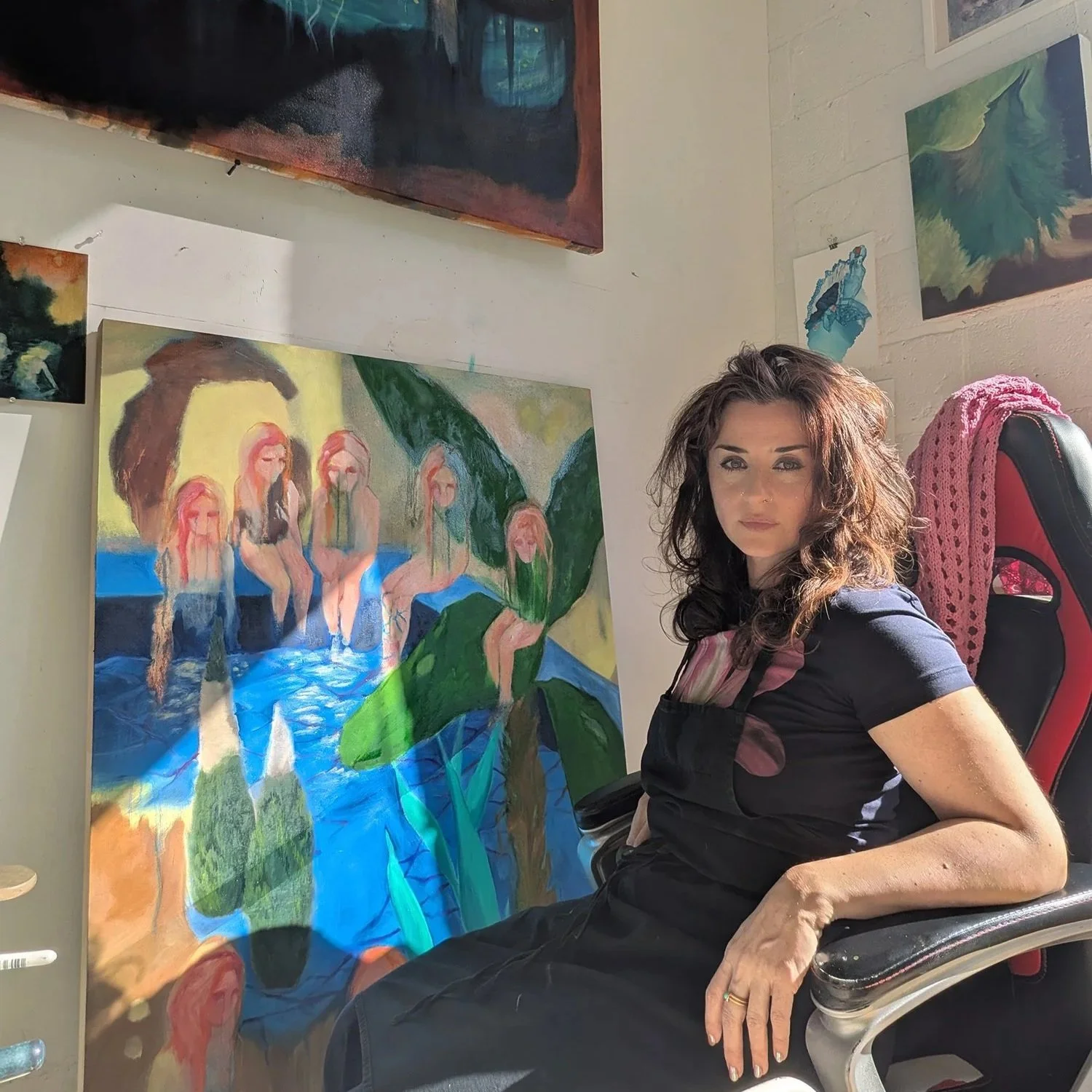
Feature Friday - Naghmeh Sharifi

Forget The Box(.ca) is proud to announce a month-long collaboration with the HTMlles Festival, Montreal's premier biennial for feminist media arts and digital culture, produced by Ada X.
Over the next month, we will be publishing our weekly FeatureFriday interviews spotlighting a curated selection of artists who embody the festival’s commitment to technocritical reflection and transdisciplinary creation. This collaboration explores the intersection of identity, technology, and art, highlighting the voices that define Montreal’s underground and digital landscapes.
Check out Naghmeh Sharifi’s HTMlles Festival workshop, Sineh-be-sineh – Reimagining Oral Traditions on May 24, 2026 @ 1PM.
Name
Naghmeh Sharifi
Pronouns
She / Her
Bio
Naghmeh Sharifi is an Iranian-Canadian multidisciplinary artist based in Tiohtiá:ke / Montreal. She holds a BA in Visual Arts and one in Psychology from the University of British Columbia, and completed her MFA degree at Concordia University in 2018. Her work has been exhibited internationally: including in Iran, Germany, France, and Italy and extensively in Montreal, with recent solo exhibitions at La Centrale Galerie Powerhouse (2025) and Galerie Hugues Charbonneau (2026). Naghmeh Sharifi was the recipient of the Impressions Residency at the Montreal Museum of Fine Arts and the Phi Centre’s Parallel Lines Residency. Formally trained as a painter, her practice has evolved into a complex multidisciplinary inquiry spanning animation, sculptural and audiovisual installations. Her animation work has been screened at the Festival International du Film sur l'Art (FIFA) and is currently included in its art film catalogue. Sharifi’s recent work explores the fantastical dimensions of folktales, with a particular focus on those transmitted through matrilineal oral storytelling traditions.
Instagram
@naghmehsharifi
Where in Montreal are you located?
New Rosemont.
What do you love about your neighborhood?
I love my proximity to Parc Maisonneuve and the Botanical Gardens, I feel both in the city and in my own little oasis of urban forests and rare birds.
What’s your favourite art space in Montreal and why?
I honestly can’t single out just one when it comes to exhibiting great art, as there are several galleries and artist-run centres I value. If I had to name one, I would say MAI (Montréal, arts interculturels), a space that presents important work and one to which I feel indebted for shaping my artistic path in Montreal.
Describe your art practice in your own words.
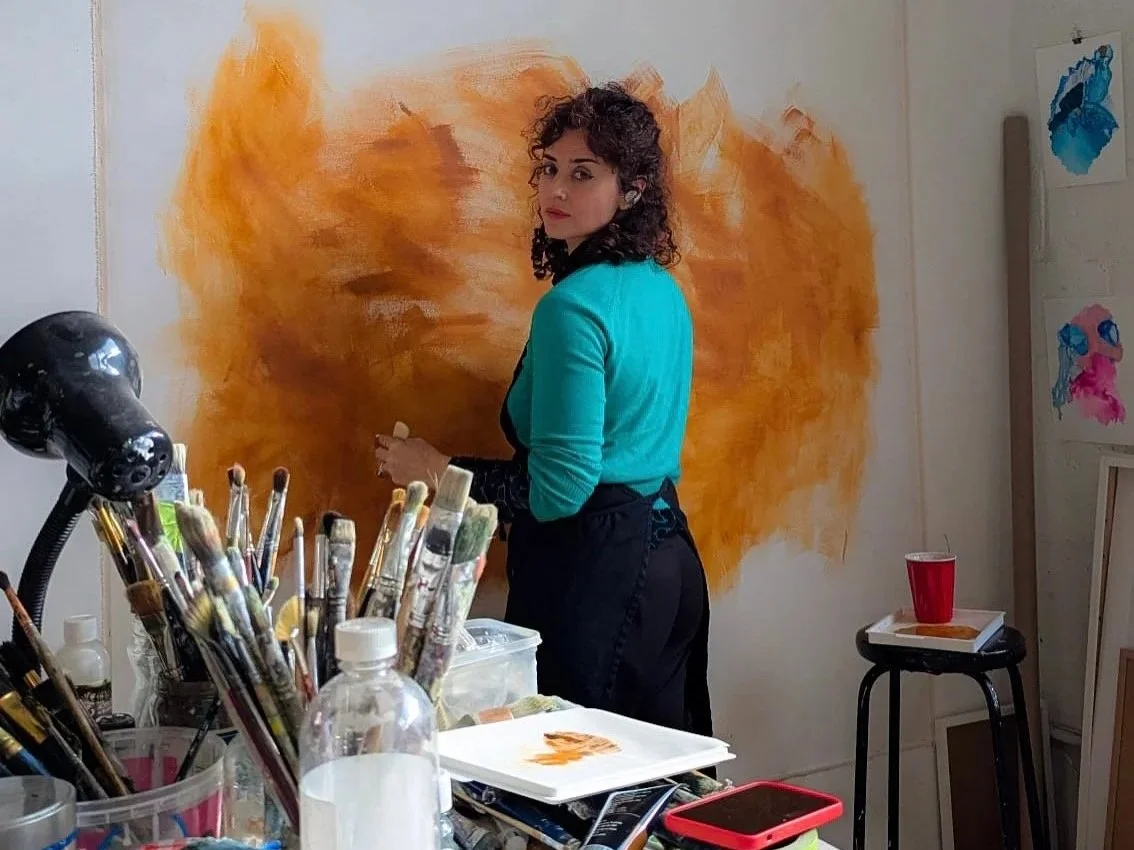
Writing artist statements is my least favourite thing, as much as the world looks for the right words to describe one's practice the minute I write something down I feel that I have excluded all that those sentences can not say, and images hold much more meaning. ''But for practical reasons in a hopelessly practical world'': I have a multidisciplinary practice. It spans painting, drawing, installation and time-based media. I explore the body as a form, a site and carrier of memories that are personal, cultural, and ancestral. I am drawn to the in-between space, thresholds between presence and absence, reality and imagination, and the fluidity of selfhood: obscured, or transformed across time, space, and language.
In a way my own uncertainties and in-between-ness come through my techniques of layering, un-painting and erasure as ways of digging at and thinking through these fragmentations. These gestures help me explore the emotional texture of diasporic experience: what is remembered, what is inherited, and what resists translation. In the recent past I have been mostly inspired by the fantastical nature of folktales Influenced by oral traditions, and the domestic rituals of storytelling, particularly those passed down through women.
I guess I am drawn to these stories in part for the visual possibilities they have opened up in my works, and for being able to use my imagination as a tool for survival, continuity, and self-making.
What mediums do you work with?
Painting, Drawing, Animation, Audio-Visual installation, Sculptural pieces, immersive drawing installations, some photography and print.
What are you currently working on?
I have been working on a project called Sineh-be-Sineh, a Farsi term that literally means “chest to chest” and refers to the oral transmission of stories and knowledge from one person to another.
At this stage, my work is partly research-based. I’ve been studying Iranian folktales and oral storytelling traditions, listening to archival recordings, including a story told by my grandmother, and paying close attention to rhythm, tone, and the emotional qualities of the voice, as well as elements that appear across multiple tales. At the same time, I’m translating these stories into images through drawing and painting, trying to capture the atmosphere, pacing, and emotional texture of a folktale rather than illustrating it directly.
Since part of the project will take the form of an audiovisual installation, I’ve also been using an open-source application to animate and illustrate parts of one of these stories. This is something I’ll also be sharing in a workshop at Articule (as part of the HTMLL festival) in late May.
This phase is really about understanding how a spoken story can become a visual language: how memory, voice, and imagination can take form through image-making.
I’m also in the final stages of an animation/audiovisual installation called Dandelion, which I’ve been working on since August 2024.
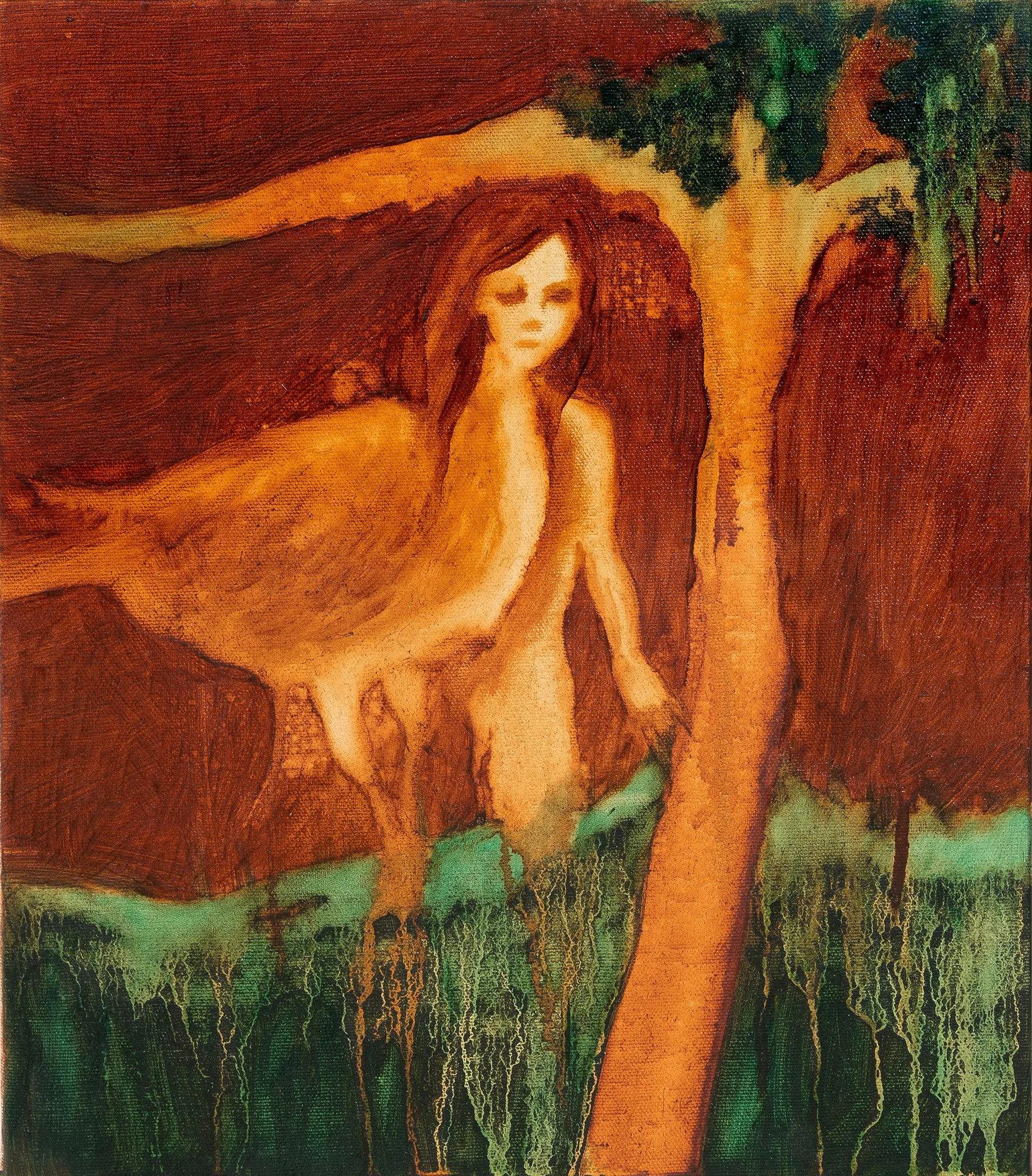
Naghmeh Sharifi’s painting photographed by Jean-Michael Seminaro
Where do you find your inspiration?
In so many things. Literature for one, magical realism and visual writing can give me so many ideas, a sentence in a book or a poem can create such strong imagery in my mind that ultimately comes out as a painting or moving image. Travelling in the sense of exploring the flora and fauna of different climates, for example I recently visited an extremely lush region in Colombia and I wanted to capture that right away. The quality of light or the temperature of a place I yearn to experience more of. Dance even, I have been pole dancing for several years now and somehow the spinning and movement becomes something to explore in the studio later. And of course seeing art that moves me but that lands lower on the scale, I think whatever time I spend in these ''other spaces'' feeds my practice more than art-related activities partly because my process is also highly intuitive.
Describe your creative process.
It varies from project to project, sometimes I get stuck with an image in my mind, whether through reading something or hearing something that informs it, and then I think about painting it, or if it is a moving image, creating it through animation or video. If making it more tangible through those mediums is a possibility, because I also get ideas that I envisions as a sculptural or installation piece but being less eloquent in large scale 3d work, those ideas take a back seat and somehow painting and drawing as more immediate mediums happen more often. An animation for example starts with a simple act, a person recasting fallen dandelions into the air, or the window frame of a building holding a person, becoming their grave and a window frame again. With painting, sometimes I start playing around with the medium and unpainting (spraying solvent into the freshly painted canvas), then I start making sense of the erased forms and follow the reaction of the chemicals. Sometimes I take a photograph or see one that stays with me for its mood, lighting or something powerful that wants to become a painting. I also write a lot, I used to have a more prolific writing practice but if a writing is too visual, it becomes an image.
What led you to pursue visual art?
I was taking drawing and painting classes as a child, and it was something that I got a lot of positive feedback on, it led me to believe I am good at image-making I guess and I kept doing it. I have been drawing for as long as I can remember, I never stopped. I am also an extremely visual person, images stay with me for so long that sometimes when the news gets extremely heavy the only way I can be up to date and not be floored by it is by avoiding the images. Of course I rarely do that, I let the images be the ''daisies and bruises'' they are.
Is there any medium you don’t currently work with, but would like to explore?
Ceramics, I would absolutely love create sculptures from some of my figures and think about how they would interact with their environment as these three dimensional forms.