Feature Friday - Fannie L'Heureux

Forget The Box(.ca) is proud to announce a month-long collaboration with the HTMlles Festival, Montreal's premier biennial for feminist media arts and digital culture, produced by Ada X.
Over the next month, we will be publishing our weekly FeatureFriday interviews spotlighting a curated selection of artists who embody the festival’s commitment to technocritical reflection and transdisciplinary creation. This collaboration explores the intersection of identity, technology, and art, highlighting the voices that define Montreal’s underground and digital landscapes.
Fannie L'Heureux performs At the whim of our permeable bodies at OBORO on May 16, 2026.
Name
Fannie L'Heureux
Pronouns
Elle/she/her
Bio
Fannie L’Heureux is a multidisciplinary artist whose practice revolves around the revaluation of femininity and resilience as acts of resistance. With a bachelor’s degree in visual and media arts from UQÀM, she explores the interrelationships between the body, femininity, consumer objects, and digital media. Her poetic, critical, and feminist approach unfolds through performance, relational art, performative archives, video, and installation. She has presented her work in numerous venues, including the Galerie de l’UQAM, TOPO, Le Lieu, Studio 303, Les Ateliers Belleville, and the Espace culturel Georges-Émile-Lapalme at Place des Arts. She has also been part of performance programs for RIPA 2025, Artch 2025, Nuit blanche at PHI 2026 and Festival HTMlles in 2026. In 2022, she received the McAbbie Foundation Excellence Award. She lives and works in Montreal.
Instagram
@fannie.lheureux
Website
fannielheureux.org
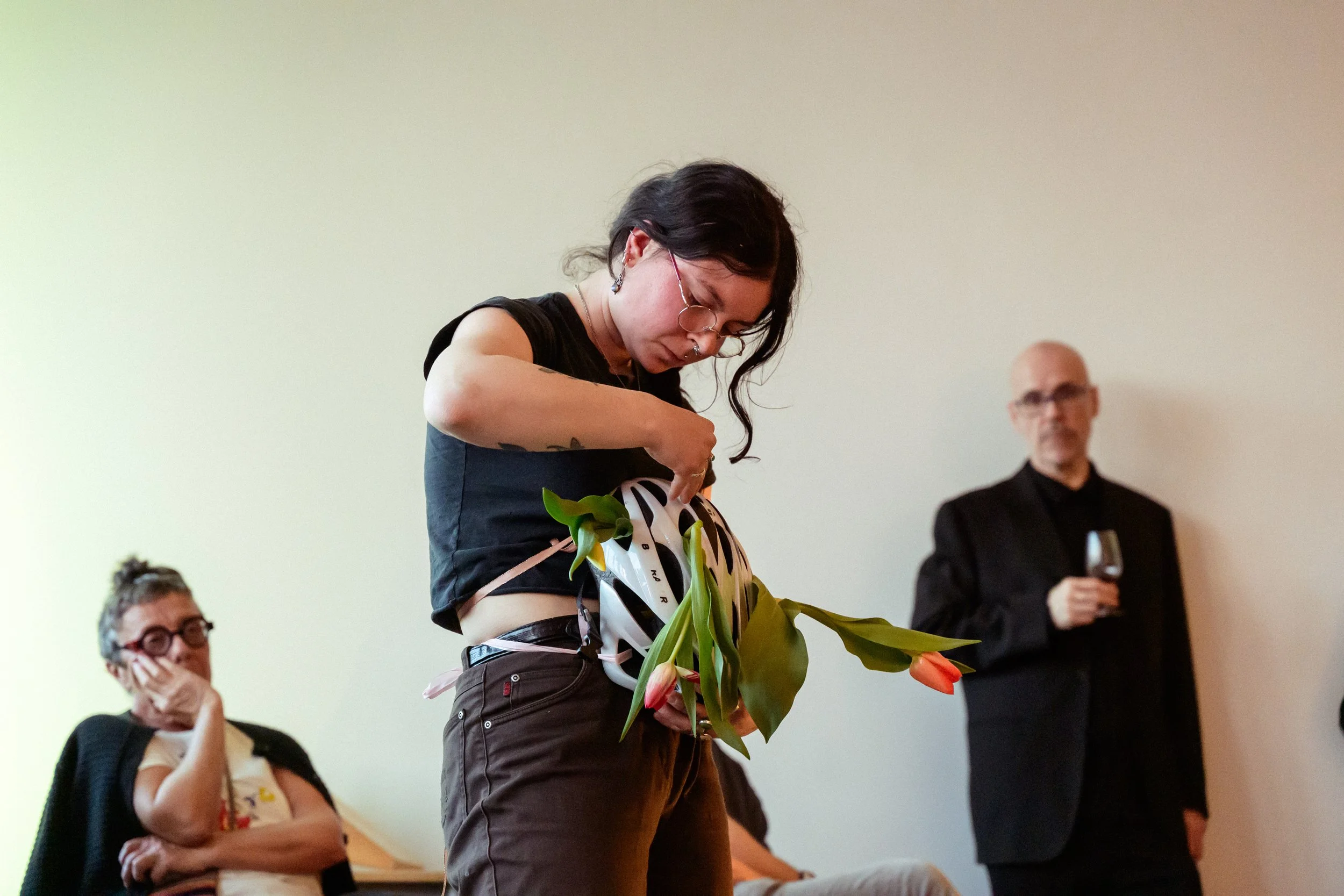
Photo by Eugénie Pigeonnier
Where in Montreal are you located?
Hochelaga Maisonneuve
What do you love about that neighborhood?
This neighbourhood is vibrant and full of artists; it’s hard to go for a walk without bumping into a familiar face. Over there, I feel at home, invisible in the crowd and right where I belong. I love Hochelaga's graffiti culture, particularly the art of street collages. Every time I go for a walk, the neighbourhood’s walls have changed; it’s a work of art in a state of constant flux. Posters, stickers and graffiti build up in layers, and it’s incredibly inspiring.
What’s your favourite art space in Montreal and why?
My favourite places for art in Montreal are, above all, the informal ones. Those created by organisations that don’t have fixed venues, such as the VIVA! Art Action festival and the events organised by DARE-DARE. As they can’t settle in one place for the long term, everything has to be constantly recreated, and, for me, it is this kind of process that most encourages innovation and engagement. Otherwise, Ada X is the most interesting centre for creation and dissemination, in my view. Its spaces and events foster collaboration and research, and the programme is always very contemporary and inclusive.
What do you do on stage? Tell us about your work!
I've performed on stage once, and when I did so, it was part of my process to try to break down the barriers between stage and audience. Usually, I perform on the same floor as the audience, in an empty space or outdoors. I practise action and relational art, which means I create in the present moment with the audience for a specific context. It is impossible for me to repeat the same performance twice as I never find myself in exactly the same context; even if the venue remains the same, the time, the audience, the weather, the political climate and my mood are always changing. My artistic process focuses first on the parameters and the venue in which I perform; I begin by imagining a way to move and transform the space, which involves the audience in the process. I like to offer gifts to the audience, such as tea, onions, medical gloves or a make-up service. I think of sequences of poetic actions, punctuated by unknowns to make room for the unexpected and vulnerability.
Describe your art in your own words.
I increasingly see myself as an undisciplined artist, although my work has developed within the field of visual arts. My work is driven by an intersectional feminism that seeks to reclaim the feminine through a non-oppressive reconstruction. I draw inspiration from trends on social media, in an attempt at a feminist demystification of the discourses conveyed there. I also draw on my experiences as a teacher and a waitress, exploring care and its contradictions.
I evoke the internet as a neglectful female figure. She appears in my performative work in the form of various bodies or objects. By deconstructing the femininities present on the internet and denouncing media hypersexuality, I use resilience and vulnerability as a radical tool, first towards myself and then towards a political ideal.
My mediums are audiences, objects, timeframes and contexts. When I perform an action and address the audience, I am myself. During my last performance, an artist pointed out to me that the participants had been surprised by the contrast between my boisterous actions, my punk make-up, and the gentleness with which I spoke to them. I use these contrasts poetically, but also as a tool to tackle taboo subjects such as the hypersexualisation of young people on social media. My most recent actions have focused on community and activism, organising a make-up stand for the Fête solidaire ahead of the May Day demonstration, as well as a discussion session on hyperconnectivity over tea at OBORO on 16 May.
What have you been working on recently?
This year, I launched a relational art project called ‘Maquillage pour toustes’ (Makeup for Everyone); this performance-installation draws inspiration from the attentive approach of professional make-up artists and the make-up stations found at funfairs, local festivals and birthday parties. I use make-up as a political tool for empowerment, whether it serves as a means of resisting surveillance, reconnecting with one’s inner child, or exploring identity. Because it acts as a marker of identity, an indicator of social class and a rite of passage between stages of life, I seek to blur its functions. This project is currently taking place as a pre-event activity and will also take place on Ontario Street in Hochelaga.
My next relational performance, ‘Au gré de nos corps perméables’ (At the Whim of Our Permeable Bodies), will take place at Oboro on 16 May as part of HTMlles Festival. Together with my collaborator Anne-Sophie, we will invite participants to join a reflective tea session exploring our feelings towards technology. The idea is to create an informal discussion space that encourages speaking or writing in a liberated, authentic and vulnerable way. In a space free of phones and photography, we'll allow dirty crockery to accumulate as a tangible trace of the participants’ presence and a metaphor for the uncontrolled collection of personal data.
What drew you to the stage?
Performance has always been part of my creative process. It was in 2024, when I first shared an artist’s studio in Chabanel with performance artists, that they inspired me to try my hand at performing in front of an audience. Performance brings people together and fosters solidarity and collaboration; through it, I discovered a community with anarchist values that resonate with me and inspire me. My early experiments with performance revealed to me other dimensions that video performance struggles to offer: the creation of a work in the present moment with different audiences, and the element of risk-taking inherent in the process.
Who are some of your favourite stage performers?
I'm inspired, among others, by the work of Nadège Grebmeier Forget, Geneviève Matthieu and Ayana M. Evans.
Tell us about your BEST or WORST performance.
Although I don’t believe in the concept of ‘mistakes’ in performance, there is one particular experiment that I didn’t enjoy as much. I gave myself too little material to explore and too few constraints, using only a state of mind and an object as my raw materials. The lack of structure in my preparation made me too anxious during the performance. As a result, the stress prevented me from taking my actions as far as they could have gone. In front of the audience, I felt like I was in survival mode rather than in a state of creative freedom. Now, in my process, I’m thinking of a more elaborate yet flexible structure, one that leaves room for the unknown.
What’s your favorite Montreal stage and why?
The street and public spaces. Although these spaces come with their own challenges and vulnerabilities, they remain the most accessible venues for a diverse audience. It is a place where people can meet on equal terms, leaving room for the unexpected, and I'd like to make greater use of it.
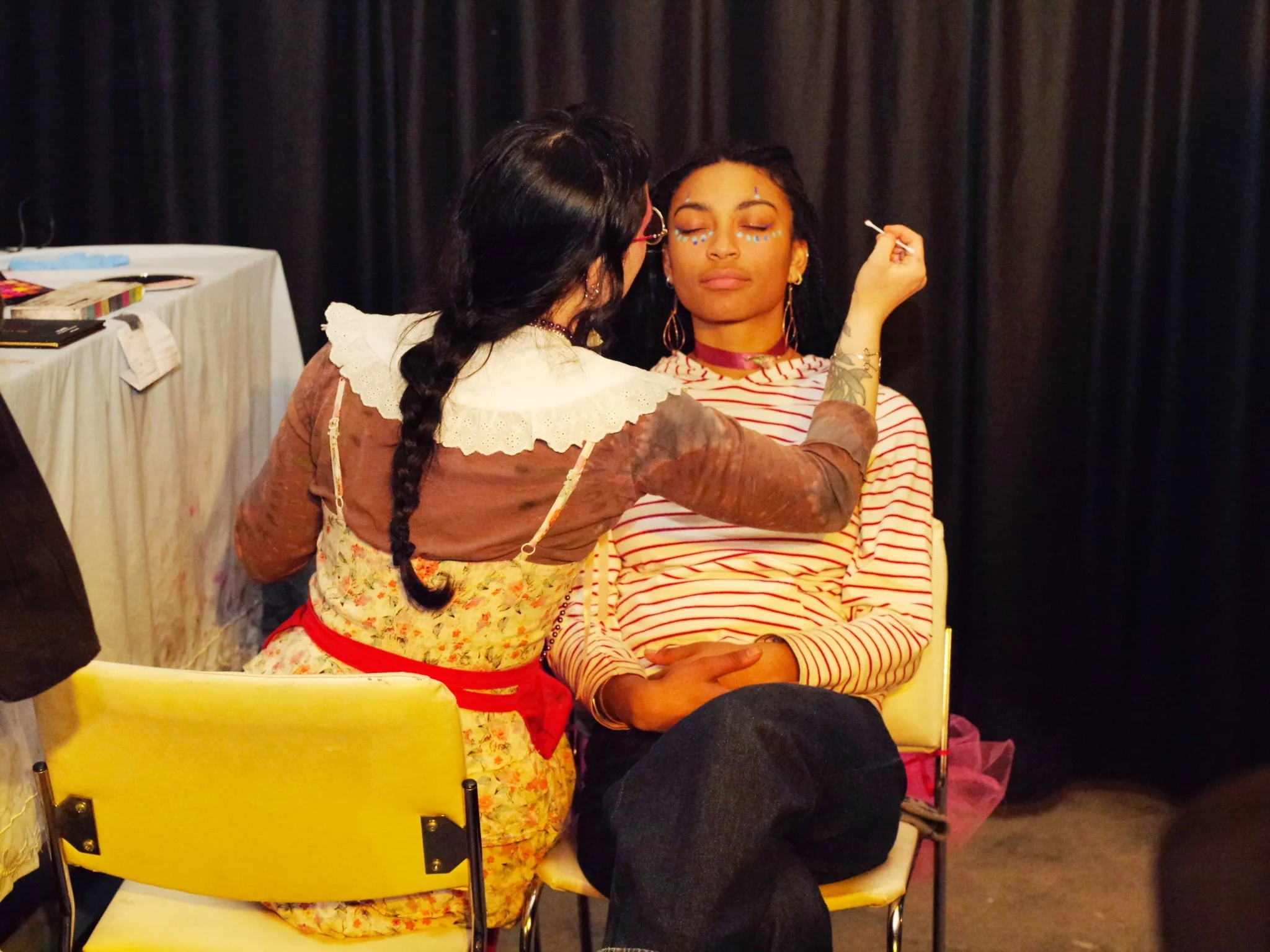
Photo by Fernando Belote