
Anne with a Katana
An Interview with Kirsten Shute
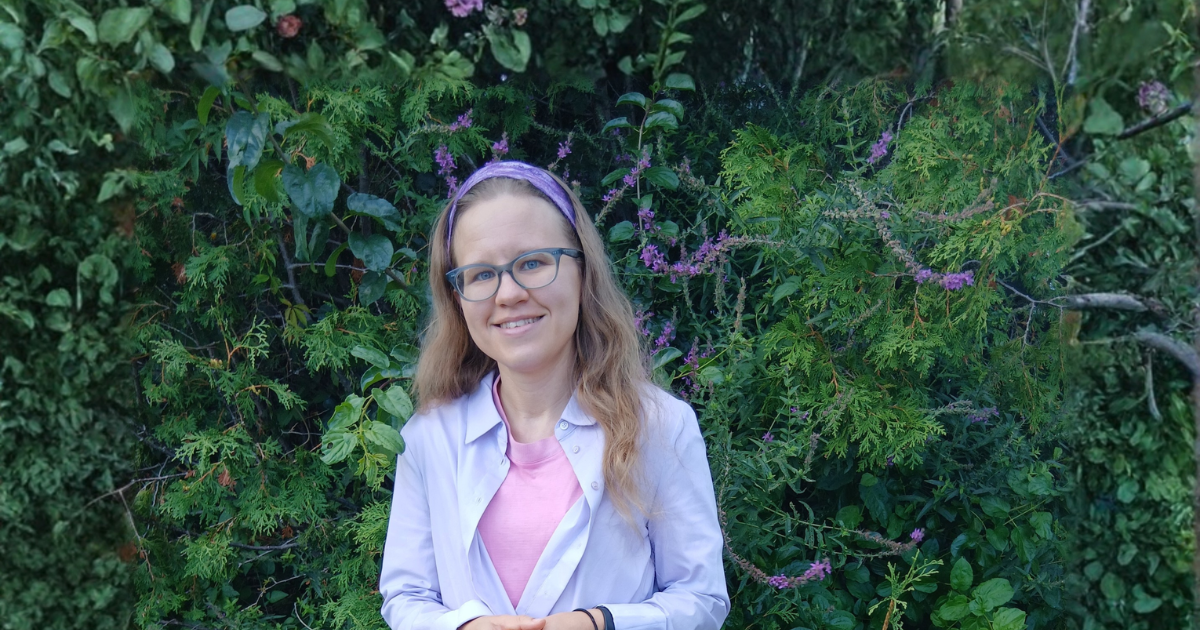
Anne of Green Gables becoming a multiverse-crossing serial killer wielding a Japanese sword is just the beginning of Kirsten Shute’s Fanfiction Is for Teenage Girls (Cactus Press, 2025). Her chapbook is full of clever, hilarious wordplay and even dips into the history of ancient, reconstructed languages.
Kirsten lives in Dorval and has a BA in linguistics from Concordia University. Her poetry has previously appeared in the chapbook Songs of Irrelevance, several Twigs & Leaves anthologies, and Soliloquies. I met Kirsten Shute in NDG at the Underdog Café on Monkland in December where we discussed linguistics, a legendary figure on FanFiction.net, her batik crafts, and a defunct but well-remembered poetry reading series held at TWIGS Café in Ste-Anne-de-Bellevue.
Matthew Rettino: Let’s start talking about your chapbook Fanfiction Is for Teenage Girls. Can you tell us a little bit about how this chapbook arose?
Kirsten Shute: My first idea for a new chapbook was one about music. I think the title was Ear-Hungry. But that’s not what I decided to focus on. The impetus was what’s now the second poem, which used to be called “Fanfiction is For Teenage Girls.” Now it’s called “Anne of Green Gables, Serial Killer.”
Originally, it was something about teenage girls from different books, [a riff on] an idea that’s sometimes dismissive, “Oh, it’s just teen girls who like fanfiction.” I remembered Anne Shirley’s propensity for violence, even if it’s short-lived, and I thought it would be funny if that continued through all these fictional universes.
MR: Is there something poetic about fanfiction? Do you find there’s something there that poetry can speak well to?
KS: I’m a bit old for AO3 and that, but I was on FanFiction.net when I was going to university for the first time. Mostly it was short stories, one-shots, [and] sometimes multi-chapter epics. But they had a few poems too. Some people would write poems about characters. I actually wrote one about The Hitchhiker’s Guide to the Galaxy that I put on FanFiction and submitted to a poetry class. So there was a bit of overlap there.
I’m probably not answering your question well about “poetic”because I’m going to be annoying and say it depends on how you define “poetic.”
MR: Is crossing over different storylines like rhyming?
KS: I didn’t think of it like that. Now that you mention crossover fanfiction, I find that’s easy to do in a poem because oftentimes there’s a connecting theme or image or conceit, like an extended metaphor, and it’s not necessarily focused on one narrative. So I think in poetry, it’s a little freer than a story, in that you can connect disparate things, and they’re not always united by narrative.
MR: You also have a lot of training in linguistics.
KS: I did one undergrad in linguistics.
MR: How has your poetry built off your interest in that domain?
KS: When I write, I include a lot of my interests even if I’m not being specifically autobiographical. I was surprised how autobiographical this collection ended up being when I was mostly focusing on one theme.
[“The Nostratic Hypothesis”] is from a specific incident when I took a course in Indo-European linguistics. So just a bit of background: Proto-Indo-European (PIE) is the reconstructed ancestor of a number of European and Asian languages. Obviously, it’s probably not exactly what people spoke, but the words people reconstruct are probably something like it.
[The title refers to] the theory that Afro-Asiatic, which would include Arabic, Hebrew, and also many of the Ethiopian and Northern African languages, is part of the PIE language family.
There’s this word in my textbook that meant “star.” There are different noun cases, and one of them was *h2stḗr. I was excited because I remembered the Bible story of Esther. So [while studying linguistics] I was, like, this sounds like Esther and “Esther” means “star”! And I was all excited.
And then my father, who studied ancient Biblical languages, said, “But in the story, that was her Persian name.” Persian was in the PIE family [though I’d taken it as evidence of a link between the PIE and Afro-Asiatic families]. So the poem is kind of a meditation on different parts of my family, where I felt different kinds of expectations [growing up].
MR: When you use world plays in your poems, are you approaching that from a linguistics angle?
KS: “Clockwork Soda” [the title of a poem] was the name of an imaginary band that I wrote about when I was probably in my early 20s. I was always kind of interested in puns and plays on words, partly to be funny, but [also for] the possibilities of words meaning different things. I wasn’t thinking specifically about linguistics then.
But [about “Symptom Girl and the 1970s”]—this was during the pandemic, and the lectures were online—there was this automatic transcription software that the university website used and oftentimes it would come up with something out of whack, something completely random. I shared some of the things the transcription software came up with on blather (the website blather.newdream.net/red). And then I decided to put it together into something resembling a narrative.
In this case I was kind of inspired by another writer who made a poem out of half-asleep thoughts. So, for example, “diglossia,” the ability to speak two languages at once, turned into “the glossier.” I have no idea what “box collider” is. “Grammar” turned into “grandma.” There’s this word, “superstrate,” where there are two languages that form a creole. Unfortunately, in the conditions where they usually come up, usually the colonial language [the European language] would be the superstrate. But then it turned out “super straight.” That made me think of gender expectations.
MR: I wanted to ask some more questions about your background. What is the poetry scene like in the West Island? What is it that you like most about Dorval?
KS: Dorval is where I grew up. I used to think that downtown meant places on the Montreal island that are down and Mount Royal was uptown, like any place that was uphill was “uptown.” You hear planes going over [since Dorval is close to the airport], and eventually that just becomes part of the background fabric.
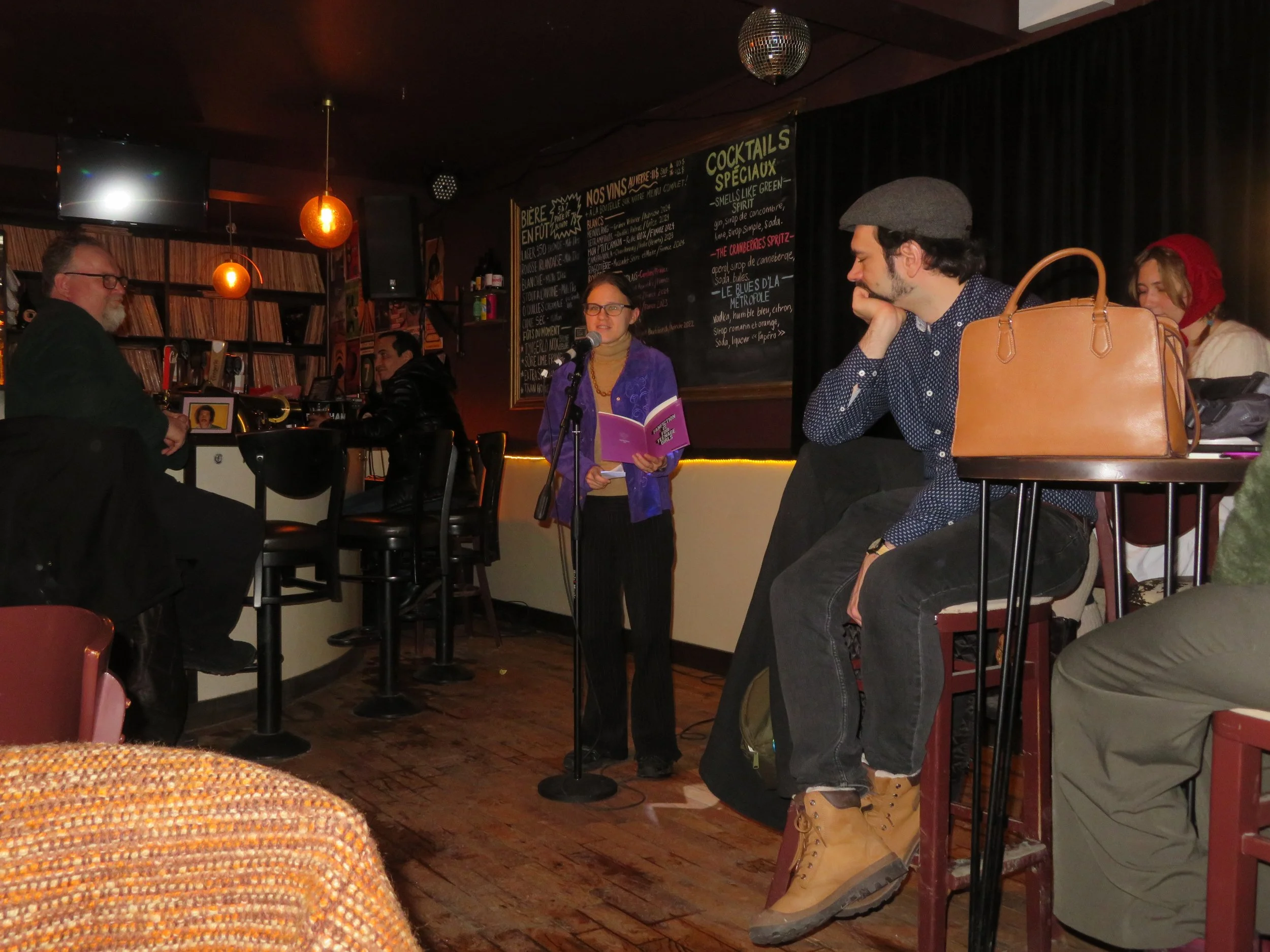
I went to John Abbott and there’s this really nice place called TWIGS Café in Ste.-Anne’s, and they had a reading series there, so that’s how I got involved with some of the poetry community early on. There were some profs and former profs and students there.
There was Erika N. White and Robert de Smit, and [from 2007–2019], there would be a poetry open mic on Tuesday evenings once a month and also a small press, Broken Rules. Besides a self-published chapbook, that was one of the first places I ever published.
One of the funny things about the event—well, quirky, I guess—was that people could vote for their favourite poet of the evening. Everybody got a vote when they came in. You could also buy more votes for a dollar, so if people really wanted their friend to win, they could just buy more votes. Then the votes went to support the press and buying special things for events.
MR: You’re involved with artists and artisans through the Dorval Artisans’ Guild. What does that consist of?
KS: That’s the artist side of me. My main craft is batik, which [involves] fabric dye and wax on cloth. I was taught by my aunt, Sarah Hale, who has a store in Arden, Ontario. The Artisans’ Guild is a club for artists and artisans, and they do a big show once a year, and I’m on the committee to organize that.
MR: What kind of poets do you read?
KS: I like poets who will use wordplay but also take an idea and turn it in an unexpected direction. One poet I admire for narrative is George Elliott Clarke. [Similarly,] there’s a book Christl Verduyn wrote [titled Silt] about her family’s experience immigrating to Canada from the Netherlands. There’s a really stressful experience when her mother’s having dental problems, and she has the rest of her teeth pulled out because it’s cheaper, [in order] to support her children. Something I would normally consider gruesome is just described in such a way that it transforms that experience.
MR: What’s your next project or one future project you’re really excited about?
For poetry, I’m working on hopefully a full-length book tentatively titled Immer Immersion. Immer is German for always. The throughline would be my experience going to Germany in 2023 for a month and a half for a summer language course. It’s about my experience as an older student—I was 34 turning 35 then—and struggles with ADHD and how that affects or doesn’t affect language learning, or maybe my confidence in that. And, also, riffing on community, history, on longing.
[For this project, I’ve written] a poem about Hans von Hozel, a sort of parody account on FanFiction.net where someone claimed to be a German learning English and kind of exploiting the fact that people will laugh at other people making mistakes in English. [He] was apparently from the States and was doing this as a joke and would use “Danube” as a verb. So the Danube is a river, immersion, water—the idea of going under water and being “over your head.”
I’m also writing a novel, tentatively called Carol Winter Writes a Symphony. The main character is a 13-year-old girl who’s going to a new school and causes a lot of chaos and perhaps gets in over her head as well. Again, this might change because I’ve had first lines change before, but the first line is “When I was 13, I had a crush on Osama bin Laden.” That part was not autobiographical—I did not have a crush on Osama bin Laden—but I thought it was a good line.
Thank you so much for your patience and generosity for putting this out there. And I would also like to thank Willow Loveday Little and the rest of Cactus Press, including the publisher, Devon Gallant.
Our conversation showed that fanfiction is not just for teenage girls—it’s for grown women, poets, and linguists too. Kirsten took me through a multiverse that led from the imaginary connections between Proto-Indo-European languages to the secret history of the Ste.-Anne-de-Bellevue poetry scene, a grim dental office, and, finally, a teenybopping troublemaker’s post-9/11 yearning. When it comes to Kirsten Shute, every word has its own poem, and every headcanon is a metaphor. As an ex-West Islander myself, I’m deeply grateful to have learned more about the TWIGS readings, and I appreciate the humour and insight Kirsten brings to her poetry.
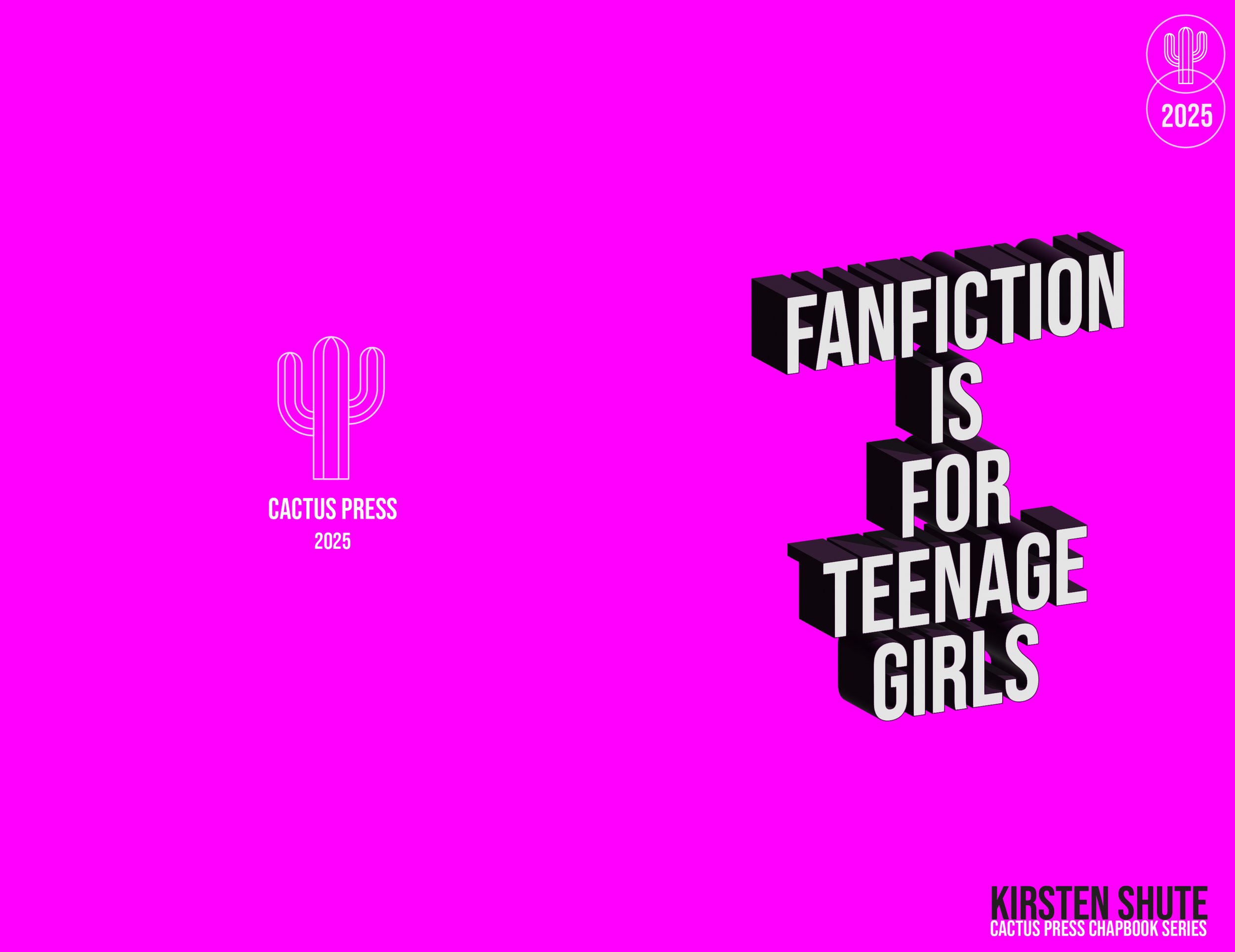
Buy Fanfiction Is For Teenage Girls from Cactus Press
Follow Kirsten Shute on Instagram
